
8 Books for Personal Growth in Your 20s
Your 20s have a way of feeling simultaneously like the best and worst time of your life. You are supposed to be figuring out your career, your relationships, your finances, and your sense of self, all at once, often while surviving on questionable grocery budgets and too little sleep. Nobody hands you a manual. And honestly, most advice from well-meaning relatives tends to be either vague or wildly outdated.
Books, though, have always been a different story. The right book at the right moment can feel like sitting down with someone who actually gets it. Not someone who has all the answers, but someone who has thought carefully about the questions. The eight books below are not here to fix you or tell you who to be. They are here to help you think more clearly, relate more honestly, and move through this decade with a little more intention and a little less panic.
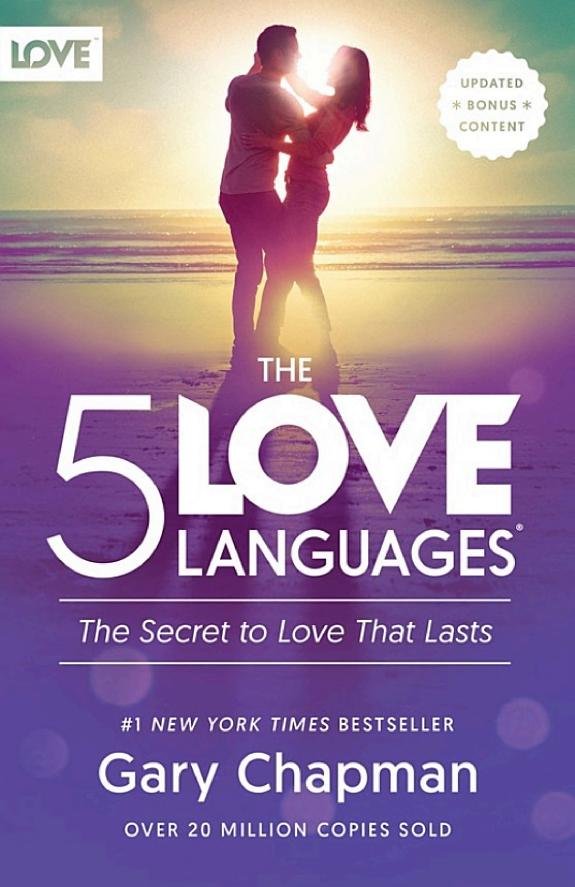
The 5 Love Languages: The Secret to Love that Lasts
1. The 5 Love Languages: The Secret to Love that Lasts by Gary Chapman
Gary Chapman is a marriage counselor with decades of experience listening to couples talk past each other, and this book is essentially the distillation of what he kept noticing. The central idea is straightforward: people express and receive love in different ways, and when two people have different primary love languages, they can both be trying hard and still leaving each other feeling unloved. The five languages Chapman identifies are words of affirmation, acts of service, receiving gifts, quality time, and physical touch.
What makes this book worth reading in your 20s specifically is that it applies well beyond romantic relationships. Understanding how you naturally show care, and how the people around you need to receive it, is useful in friendships, family dynamics, and even workplace relationships. Chapman writes in a warm, pastoral style that some readers find a bit old-fashioned, and his framework does lean on a fairly traditional view of partnership. If you are looking for something that engages with queer relationships or non-traditional structures in any meaningful way, you will likely feel the absence.
That said, the core insight holds up. Most relationship friction is not about a lack of love. It is about a mismatch in how love is communicated. Recognizing that gap is genuinely useful, and it is the kind of thing you can spend years learning the hard way without ever quite naming it. Chapman gives you the vocabulary early.
“The in-love experience does not focus on our own growth nor on the growth and development of the other person. Rather, it gives us the sense that we have arrived.” Chapman’s point is that real love is a choice made after that feeling fades, not a reward for having it.
This is perfect for anyone navigating a serious relationship for the first time, or for someone who keeps feeling disconnected from the people they care about and cannot quite figure out why.
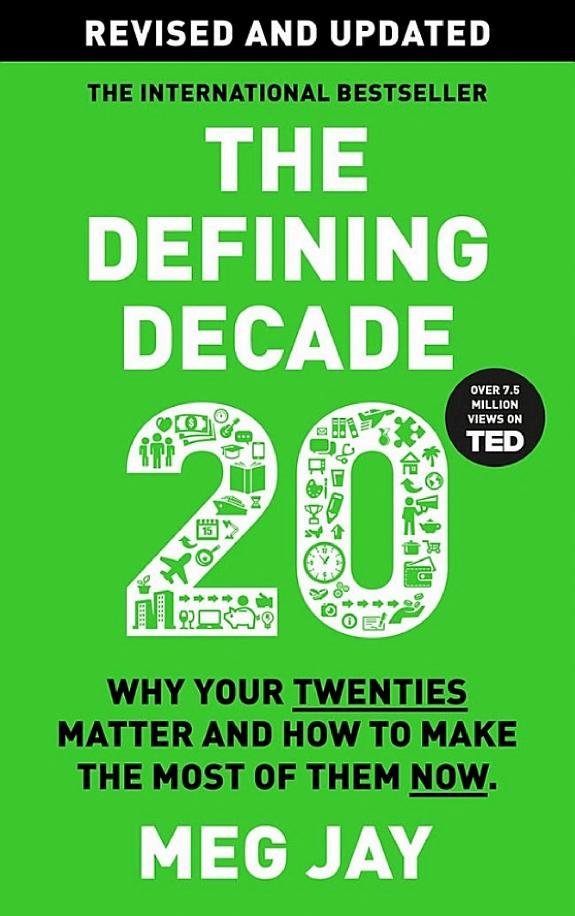
The Defining Decade: Why Your Twenties Matter and How to Make the Most of Them Now
2. The Defining Decade: Why Your Twenties Matter and How to Make the Most of Them Now by Meg Jay
Meg Jay is a clinical psychologist who works primarily with people in their 20s, and she wrote this book partly out of frustration with a cultural narrative she kept seeing do real damage. That narrative goes something like this: your 20s are for messing around, real life starts at 30, and there is plenty of time to figure things out later. Jay’s argument, backed by research and illustrated through anonymized client stories, is that this framing is not just wrong but genuinely costly. The decisions and habits formed in your 20s have an outsized effect on your 30s, 40s, and beyond.
The book is divided into sections covering work, love, and the brain, and Jay moves through each with clarity and a certain brisk urgency. She is not trying to scare you into productivity. She is trying to give you a more honest picture of how adult life actually compounds over time, so that you can make more deliberate choices now rather than spending your 30s trying to undo avoidable mistakes. The client stories give the book a human texture that pure research writing often lacks.
Some readers bristle at what they perceive as pressure, and it is fair to say that Jay’s framework works best for people with access to conventional markers of stability like education, career ladders, and the ability to choose a partner on a reasonable timeline. If your 20s are consumed by financial precarity, caregiving, or circumstances outside your control, parts of this book may feel like it is speaking to someone else’s life. That is worth knowing going in.
“The twenties are that critical period of adult development that comes right before everything starts to count more.” Jay is not being alarmist. She is pointing out that the window for low-stakes experimentation is shorter than most people assume.
This is perfect for someone in their early-to-mid 20s who feels like they are drifting and wants a clear-eyed, research-grounded case for taking their own life more seriously.
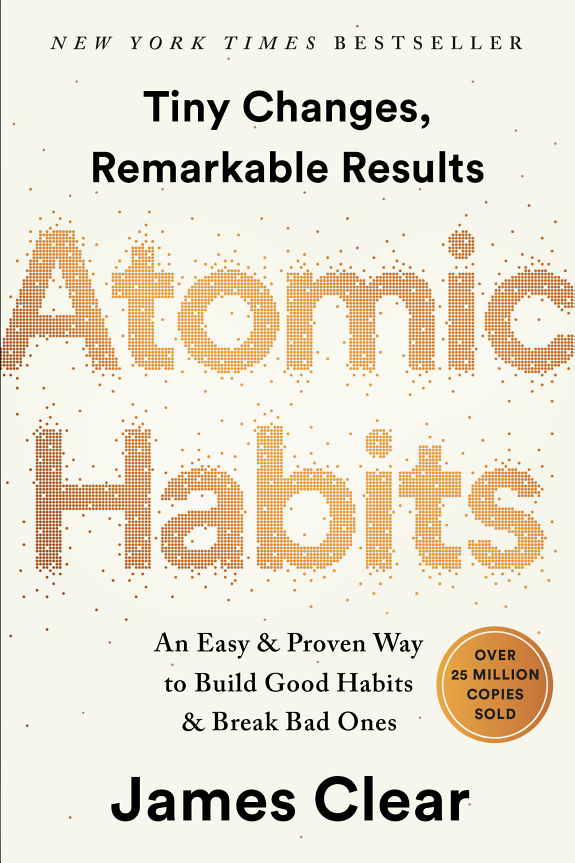
Atomic Habits
3. Atomic Habits by James Clear
James Clear spent years writing about behavior change on his website before distilling his thinking into this book, and the accumulated care shows. The central argument is that outcomes are not the product of goals. They are the product of systems. More specifically, they are the product of the small, repeated behaviors that compound over time in ways that are almost invisible in the short term and almost inevitable in the long term. Clear calls these atomic habits, meaning both small and foundational, like atoms.
The framework he builds around habit formation is practical without being gimmicky. He draws on existing research in psychology and neuroscience but never lets the citations overwhelm the readability. The four laws of behavior change he outlines, make it obvious, make it attractive, make it easy, make it satisfying, give you a genuinely usable structure for building new habits or breaking old ones. Your 20s are when a lot of your default patterns get set, which makes this an especially well-timed read.
If you are someone who finds self-help writing too breezy or surface-level, Clear’s style might occasionally feel that way too. He is a clear, accessible writer, which is a strength, but it does mean the book rarely sits with complexity for very long. It is also worth noting that this framework works best when your environment is reasonably within your control. For people dealing with chaotic living situations or significant mental health challenges, the advice can feel a bit too tidy.
“You do not rise to the level of your goals. You fall to the level of your systems.” This one sentence probably saves more people from cycles of resolution and disappointment than any motivational speech ever could.
This is perfect for someone who knows what they want to change but keeps failing to make it stick, and who would rather have a practical system than another dose of inspiration.
The Power of Habit: Why We Do What We Do in Life and Business
4. The Power of Habit: Why We Do What We Do in Life and Business by Charles Duhigg
Charles Duhigg is a journalist, and it shows in the best possible way. Where Clear’s book is a how-to guide, Duhigg’s is more of an investigation. He wants to understand why habits exist at all, how they form neurologically, and what it actually takes to change them. The book moves across individual psychology, organizational behavior, and social movements, which gives it a scope that feels genuinely ambitious rather than padded.
The habit loop, the idea that every habit consists of a cue, a routine, and a reward, is the structural spine of the book. Duhigg illustrates it through stories that are well-reported and often fascinating, covering everything from a man who lost his ability to form new memories but still retained his habits, to how Target figured out which customers were pregnant before they told anyone. Some of these stories have been discussed and debated since the book came out, but they remain compelling as illustrations of how deeply automatic behavior runs in human life.
Read alongside Atomic Habits, this book gives you the why behind what Clear is teaching you to do. They cover some of the same territory, so if you are only going to read one book about habits, choose based on whether you want the science-and-story approach or the practical-framework approach. If you find narrative nonfiction more engaging than self-help writing, Duhigg is probably your pick. If you are not particularly interested in the business and organizational sections, you may find the second half of the book less gripping than the first.
“Once you understand that habits can change, you have the freedom and the responsibility to remake them.” Duhigg frames habit change not as a trick but as a kind of moral agency, which is a more interesting take than most books in this space bother with.
This is perfect for the curious reader who wants to understand the science and psychology behind why they do what they do, not just a checklist for doing it differently.
Daring Greatly: How the Courage to Be Vulnerable Transforms the Way We Live, Love, Parent, and Lead
5. Daring Greatly: How the Courage to Be Vulnerable Transforms the Way We Live, Love, Parent, and Lead by Brené Brown
Brené Brown spent years as a shame researcher before her 2010 TED talk turned her into one of the most recognized voices in the conversation about vulnerability and human connection. Daring Greatly is the book that most fully develops the ideas from that talk, and it is a more rigorous and nuanced read than her public profile might suggest. The title comes from a Theodore Roosevelt speech, and Brown uses it to argue that showing up fully, being willing to be seen without guarantees, is not weakness but the actual foundation of courage.
The book covers shame, vulnerability, and what Brown calls “wholehearted living” across relationships, parenting, work, and culture. Her writing is warm and personal, drawing on both her research and her own struggles, which gives the book a quality of honesty that purely academic writing tends to lack. She is also genuinely funny in places, which helps when the subject matter gets heavy. The sections on shame are particularly worth sitting with. Brown distinguishes between shame, which is the feeling that you are fundamentally flawed, and guilt, which is the feeling that you have done something wrong, and argues that this distinction matters enormously for how we treat ourselves and each other.
This is not a book for everyone. If you are skeptical of therapy-inflected language or find the concept of vulnerability a bit too feelings-forward for your taste, you may find yourself rolling your eyes at certain passages. Brown’s framework is also largely built on research conducted with a fairly specific demographic, and she acknowledges this to some degree but does not fully grapple with how culture and identity shape vulnerability differently for different people.
“Vulnerability is not winning or losing; it’s having the courage to show up and be seen when we have no control over the outcome.” Brown is not asking you to overshare. She is asking you to stop armoring up as a default.
This is perfect for someone who suspects their habit of keeping people at arm’s length is costing them something real, and who is ready to look at that honestly.
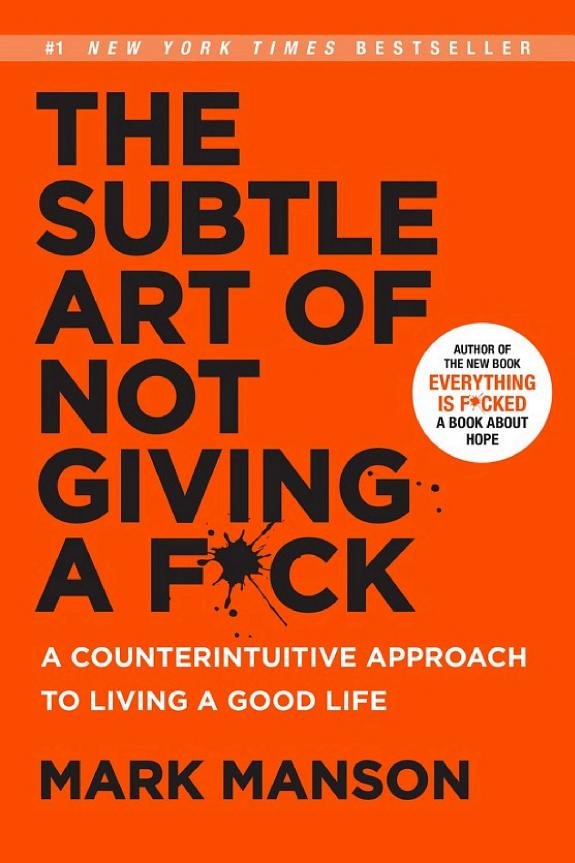
The Subtle Art of Not Giving a F*ck
6. The Subtle Art of Not Giving a F*ck by Mark Manson
Mark Manson’s book arrived at a moment when a lot of people were exhausted by relentlessly positive self-help content, and it found an audience quickly. The title is deliberately provocative, but the argument underneath it is more considered than the branding suggests. Manson is not telling you to stop caring about things. He is telling you that you have a limited amount of care to give, and that most people waste enormous energy caring about things that do not actually align with their values, mainly because they have never stopped to examine what those values are.
The philosophical backbone of the book leans on Stoic ideas and a little existentialism, filtered through Manson’s conversational, profanity-comfortable voice. He is blunt, occasionally irreverent, and refreshingly willing to say that some problems do not have solutions and that accepting that is itself a form of growth. His chapter on failure and the relationship between action and motivation is one of the more genuinely useful things written about motivation in the self-help genre, largely because it inverts the usual logic: you do not wait to feel motivated before acting, you act and motivation sometimes follows.
The book has real weaknesses. Manson’s voice works well in doses but can start to feel a bit one-note over a full read. Some of his examples are shallow, and the book occasionally mistakes contrarianism for insight. Readers who are looking for emotional depth or careful nuance may find it frustrating. It is also worth noting that the book’s framing tends to assume a fairly individualistic worldview, which will resonate with some readers and feel incomplete to others.
“The desire for more positive experience is itself a negative experience. And, paradoxically, the acceptance of one’s negative experience is itself a positive experience.” Manson is borrowing from Alan Watts here, but he makes it accessible in a way that sticks.
This is perfect for someone who has consumed a lot of motivational content and found it hollow, and who is ready for a more honest, less cheerful conversation about what actually matters.
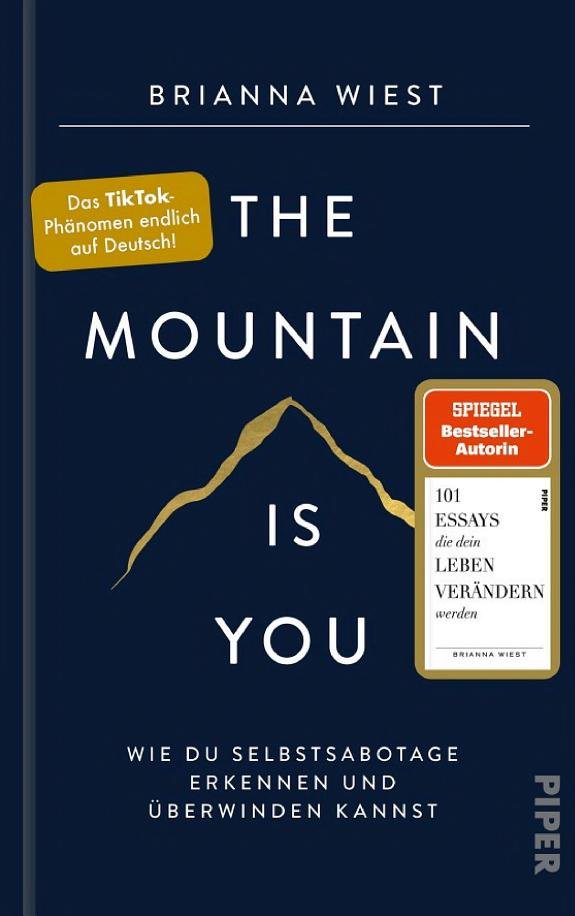
The Mountain Is You: Transforming Self-Sabotage Into Self-Mastery
7. The Mountain Is You: Transforming Self-Sabotage Into Self-Mastery by Brianna Wiest
Brianna Wiest writes with a directness that younger readers in particular tend to respond to strongly. This book is built around a single, genuinely interesting premise: that self-sabotage is not random or irrational. It is a protection mechanism. When you keep undermining your own goals, some part of you believes the goal is dangerous, or that you do not deserve it, or that achieving it would require you to become someone unfamiliar. The mountain in the title is not an obstacle in your path. It is you.
Wiest moves through the psychological roots of self-sabotage with clarity and care, covering topics like emotional immaturity, unmet needs, fear of success, and the difference between what you say you want and what your behavior suggests you actually want. The writing is accessible without being dumbed down, and the book has a reflective quality that encourages you to pause and apply what you are reading to your own patterns rather than just consuming it abstractly. It is a good book to read slowly, with a journal nearby, which is not something you can say about every book in this space.
Some readers find the tone occasionally a bit too neat, as though every psychological knot can be untied with enough self-awareness. If you are dealing with significant trauma, clinical anxiety, or depression, this book is not a substitute for professional support, and Wiest does not really address that boundary clearly enough. It also works best for readers who are already somewhat comfortable with introspective thinking. If that kind of inward examination feels foreign or uncomfortable, this book may feel more abstract than useful.
“Your self-sabotage is not a character flaw. It is a coping mechanism that once served you, and now no longer does.” Framing it this way removes the shame from the equation, which turns out to be exactly what most people need before they can actually change anything.
This is perfect for someone who keeps getting in their own way and wants a thoughtful, psychologically grounded explanation for why, along with a genuine path forward.
Year of Yes: How to Dance It Out, Stand in the Sun and Be Your Own Person
8. Year of Yes: How to Dance It Out, Stand in the Sun and Be Your Own Person by Shonda Rhimes
Shonda Rhimes is the creator of Grey’s Anatomy, Scandal, and a handful of other television series that have collectively dominated primetime for years. By any external measure, she was wildly successful. And yet, as she describes it, she had quietly retreated from almost everything that scared her, including public speaking, social events, and anything that required her to be present and visible in a way she could not script and control. Her sister’s offhand comment at Thanksgiving, that Shonda never says yes to anything, became the catalyst for a year-long experiment.
The book is funny, self-aware, and genuinely moving in places. Rhimes does not pretend that saying yes to things magically fixed her life. She is honest about her anxiety, her weight, her complicated relationship with her own success, and the ways that busyness had become a kind of armor. What the year of yes actually gave her was not a schedule full of events but a practice of showing up, of choosing discomfort over avoidance, and of learning to be in her own life rather than managing it from a safe distance.
This is not a prescriptive book. Rhimes is not telling you to say yes to everything or to structure a year around a personal challenge. She is sharing her own story, and the lessons are embedded in the narrative rather than packaged into frameworks. Readers who prefer structured, research-backed self-help may find the memoir format frustrating. And it is worth acknowledging that Rhimes’s particular version of avoidance, turning down high-profile speaking invitations and Hollywood parties, is a fairly specific context. The emotional truth translates broadly, but the details are distinctly her world.
“Dull women have immaculate homes.” Rhimes is quoting a magnet on her refrigerator, but she means it as a small manifesto: the life you actually want to live is probably messier than the one you have been performing.
This is perfect for the overachiever who has built a successful-looking life from the outside but privately knows they have been playing it safe, and who needs permission to take up more space.
Personal growth is one of those phrases that can start to feel meaningless if you say it too many times. But what it actually points to is something real: the slow, often uncomfortable process of understanding yourself better, relating to others more honestly, and making choices that reflect who you actually want to be rather than who you defaulted into being. Your 20s are a particularly good time for this kind of work, not because the stakes are low, but because the habits and patterns you build now tend to travel with you.
None of these eight books will do the work for you. A few of them will challenge you. Some will resonate immediately, and others might need to sit on your shelf for a year before the timing feels right. That is fine. Reading is not a race, and personal growth is definitely not one either. Pick the book that speaks to where you actually are right now, not where you think you should be, and start there.