

6 Books to Break Free From Limiting Beliefs
Most of us carry around a set of quiet, stubborn convictions about what we are and are not capable of. They rarely announce themselves. They just quietly redirect you away from the thing you wanted, the conversation you needed to have, or the version of yourself you keep almost becoming. Books, at their best, have a way of interrupting that pattern.
The six books on this list all approach the subject of limiting beliefs from very different angles. Some are rooted in research, some in raw personal experience, and at least one involves a philosophy old enough to have survived several centuries without losing its edge. None of them will do the work for you. But each one has a genuine shot at making you think twice about the story you have been telling yourself for years.
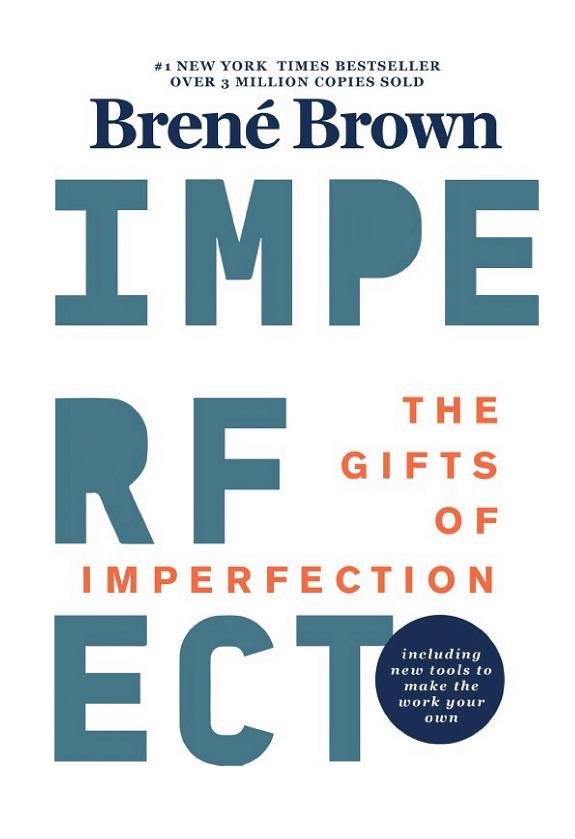
The Gifts of Imperfection
1. The Gifts of Imperfection by Brené Brown
Brené Brown spent years as a researcher studying shame, vulnerability, and human connection before she reluctantly concluded that the data was pointing directly at her own life. That tension between the clinical and the personal is exactly what makes this book feel so unusually honest. Her writing has warmth without being saccharine, and a kind of dry self-awareness that keeps things grounded. She is not standing at a podium. She is sitting across a table, telling you something she probably did not want to admit.
The central idea is that worthiness is not something you earn by achieving enough or fixing enough about yourself. It is something you choose, and the main thing blocking that choice is usually shame. Brown argues that perfectionism is not about high standards. It is about fear. The belief that if you look perfect, work perfectly, and perform perfectly, you can avoid the pain of judgment. That reframe alone is worth the price of admission.
Where this book genuinely shines is in its practicality. Brown does not leave you sitting in a puddle of self-awareness with no idea what to do next. She talks about cultivating specific qualities, rest, play, creativity, gratitude, and how letting go of who you think you should be is the only real path to who you actually are. It is gentler than some of the other books on this list, and deliberately so.
If you are someone who prefers your self-help delivered with a side of stoicism and zero feelings, this one may not be your speed. Brown is asking you to sit with discomfort, not push through it on sheer willpower. That is a meaningful distinction.
“Worthiness doesn’t have prerequisites” is easy to read and surprisingly hard to actually believe. Brown does not pretend otherwise, and that honesty is what separates this from the usual cheerful affirmation fare.
This is perfect for readers who have spent years tying their self-worth to productivity or achievement and are quietly exhausted by it.
Mindset: The New Psychology of Success
2. Mindset: The New Psychology of Success by Carol S. Dweck
Carol Dweck is a Stanford psychologist, and this book comes from decades of research rather than a single dramatic personal revelation. The writing is clear and methodical, occasionally a little dry, but the core idea she introduces is one of those rare concepts that genuinely changes how you observe yourself and other people. She draws a distinction between a fixed mindset, the belief that your abilities are essentially set at birth, and a growth mindset, the belief that abilities can be developed through effort and learning. Simple enough. The implications, however, are not simple at all.
What makes the fixed mindset so insidious is that it often disguises itself as identity. Saying “I’m just not a math person” feels like honest self-knowledge. Dweck’s research suggests it is actually a defense mechanism, a way of protecting your ego from the discomfort of struggle and failure. The limiting belief is not just “I can’t do this.” It is “trying and failing would prove something terrible about who I am.” That is a much heavier thing to carry than it looks.
Dweck walks through how these mindsets show up in parenting, education, sports, business, and relationships. Some of the case studies are genuinely fascinating, particularly the sections on how praise is delivered to children and what kind of praise actually builds resilience versus what quietly undermines it. If you have ever been told you were gifted as a kid, this section may produce some uncomfortable recognition. Worth it, though.
The book is not for readers looking for dramatic storytelling or emotional intensity. Dweck is a researcher first, and the writing reflects that. But for anyone who wants to understand the mechanics behind why certain beliefs about ability are so sticky, this is one of the most well-supported arguments you will find.
The growth mindset is not about pretending everything is easy. It is about believing that difficulty is the process, not evidence that you are in the wrong place.
This is perfect for parents, teachers, coaches, or anyone who has ever avoided trying something new because failing at it felt too revealing.
The Big Leap
3. The Big Leap by Gay Hendricks
Gay Hendricks introduces a concept in this book that is irritatingly easy to recognize once you have heard it. He calls it the Upper Limit Problem, which is his term for the self-sabotage that happens whenever things in your life start going genuinely well. You get the promotion and immediately pick a fight with your partner. You finish the creative project you are proud of and spend the next week convinced it is terrible. Hendricks argues this is not bad luck or coincidence. It is an unconscious mechanism designed to keep you inside a comfort zone of happiness you have decided, somewhere below awareness, that you deserve.
The book is built around the idea that each person has a Zone of Genius, a specific area where their natural talents and deepest passions overlap, and that most people spend the majority of their time operating well below it. Not because they lack ability, but because operating at full capacity feels genuinely threatening. Competence feels safe. Excellence feels exposed. That distinction is one of the more quietly useful things this book offers.
Hendricks writes with a kind of breezy confidence that some readers find energizing and others find a little too smooth. The concepts are presented as fairly universal, and there is not a lot of nuance given to the ways that external circumstances, structural barriers, and plain old bad luck also shape what people are able to achieve. If you come to the book looking for that complexity, you will not find much of it here.
That said, for the specific purpose of recognizing self-sabotage patterns, this book is genuinely useful. The Upper Limit concept is one of those frameworks that, once installed in your brain, starts flagging behavior you would previously have explained away as coincidence or bad timing.
The idea that we sabotage good things not out of self-destruction but out of a deeply held belief about how much happiness we are allowed to have is unsettling in exactly the right way.
This is perfect for high achievers who notice a suspicious pattern of things going sideways right when life starts to feel genuinely good.
Can’t Hurt Me
4. Can’t Hurt Me by David Goggins
David Goggins is not going to sit across a table and talk about vulnerability with you. He is going to tell you, in considerable detail, about running ultramarathons on broken feet, completing Navy SEAL training three times, and growing up in circumstances that would have given most people every reasonable excuse to stop trying. His voice is blunt, sometimes abrasive, and completely unapologetic. This is either exactly what you need or not remotely what you are looking for. There is not much middle ground.
The core argument of the book is that most people are operating at roughly forty percent of their actual capacity, and that the stories we tell ourselves about our limits are almost entirely fictional. Goggins calls this the “cookie jar” method, drawing on memories of past suffering and survival to remind yourself that you have already gotten through hard things. The limiting belief he is targeting is not a subtle psychological pattern. It is the straightforward conviction that you cannot do something. His response to that conviction is, essentially, empirical. He tests it, repeatedly, until the belief collapses under the weight of evidence.
The book is structured as a memoir with what Goggins calls “challenges” at the end of each chapter, practical exercises designed to push you toward the edge of your comfort zone. Some of them are genuinely useful. Some feel like they were designed for someone training for a specific military selection program. Your mileage will vary.
Where this book falls short is in its acknowledgment that not everyone is starting from the same place, and that willpower, while genuinely underused by most people, is also not infinitely available. If you are dealing with chronic illness, burnout, or circumstances that require rest rather than relentless pushing, Goggins is not your guide. But for the specific belief that you are softer than you need to be, this book makes a fairly compelling counter-argument.
Goggins is not interested in making you feel better about your limits. He is interested in making you question whether they exist at all. That is a different project entirely.
This is perfect for readers who suspect they have been letting comfort masquerade as contentment and want someone to say so directly.
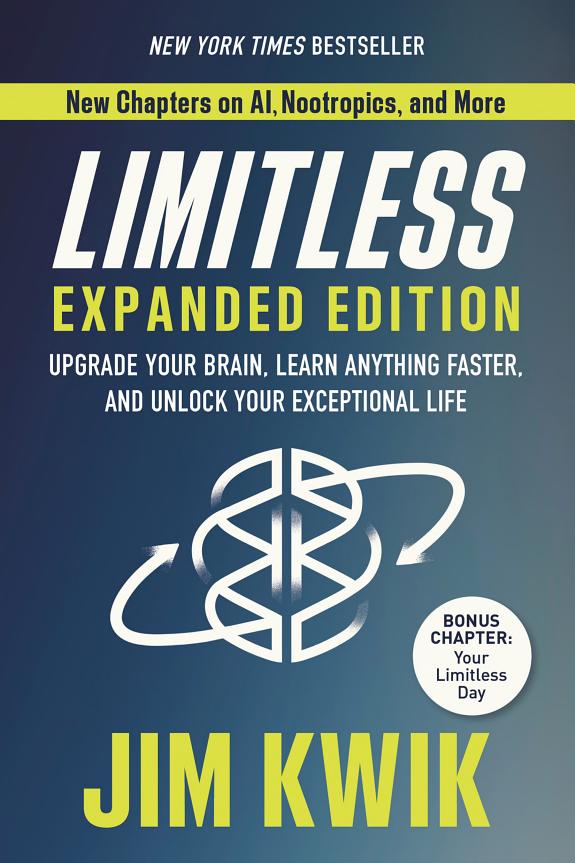
Limitless
5. Limitless by Jim Kwik
Jim Kwik spent years as a child struggling with a brain injury that made learning feel nearly impossible, and he eventually built a career around teaching people how to learn more effectively. That origin story is not incidental to the book. It is the whole foundation of it. His argument is that most of us have accepted a deeply limited idea of what our brains can do, and that this belief is not based on neuroscience. It is based on a school system that was never designed to teach people how to learn, only what to learn.
The book is structured around three areas he calls the three Ms: Mindset, the beliefs you hold about your own intelligence and potential; Motivation, understanding what actually drives you rather than what you think should drive you; and Methods, specific techniques for reading faster, retaining more, and thinking more clearly. It is a practical book with a philosophical backbone, which is a combination that tends to work well for readers who want both the why and the how.
Kwik’s writing is enthusiastic, occasionally to a fault. There are moments where the energy tips into the kind of relentless positivity that can feel slightly exhausting, particularly if you are reading while tired, which is ironic given that the book has an entire section on sleep and brain performance. The techniques themselves, however, are well-explained and largely grounded in legitimate cognitive research rather than wishful thinking.
This is not a book for readers who want a deep philosophical exploration of identity or belief. It is a book for people who want to do something specific: learn faster, remember more, and stop believing that their brain is a fixed and limited instrument. If that is the constraint you are working against, Kwik is a useful and knowledgeable guide.
The most limiting belief Kwik addresses is also the most common: that some people are simply smarter than others and there is not much to be done about it. He spends the entire book disagreeing with that idea, and he does it with receipts.
This is perfect for students, professionals, or lifelong learners who feel like their brain is working against them and want practical tools to change that.
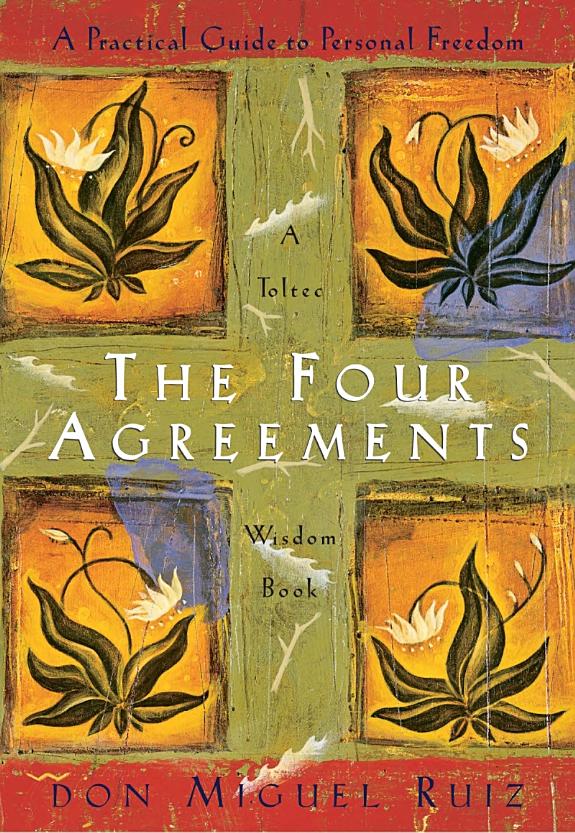
The Four Agreements
6. The Four Agreements by Don Miguel Ruiz
Don Miguel Ruiz draws on Toltec wisdom, an ancient Mesoamerican tradition, to make an argument about the nature of belief that is deceptively simple and genuinely hard to argue with. His central premise is that from childhood onward, we make agreements with ourselves and others about what is true, what is possible, and who we are. Most of these agreements were made without our conscious consent, handed to us by parents, teachers, religion, and culture, and they run quietly in the background shaping almost every reaction we have. The Four Agreements he proposes are a way of replacing the most damaging of those old contracts with something more deliberate.
The four agreements themselves are: be impeccable with your word, do not take anything personally, do not make assumptions, and always do your best. Written out like that, they sound like a motivational poster. In the context of Ruiz’s explanation, they are considerably more interesting. The section on not taking things personally, for instance, is built on the idea that other people’s opinions of you are almost entirely a projection of their own internal world, and that taking those opinions as truth is a choice you are making, not a fact you are receiving. That reframe has legs.
The writing is spare and slightly parable-like, which fits the philosophical tradition it draws from but may feel too abstract for readers who prefer their ideas grounded in data or personal narrative. Ruiz is not interested in research citations. He is interested in something older than that, a framework for understanding how humans construct their own suffering and how they might, with some deliberate effort, stop.
The book is short, which is either a virtue or a limitation depending on what you are looking for. It does not go deep into the psychological mechanics of why these agreements form or how to work through them in a therapeutic sense. It simply names them and offers alternatives. For some readers, that is exactly the right amount. For others, it will feel like an introduction to a conversation that never quite gets started.
The idea that most of our suffering comes from agreements we never knowingly made is one of the more quietly radical things this book suggests. It is also, on reflection, almost impossible to disprove.
This is perfect for readers drawn to philosophy and spiritual traditions who want a short, clear framework for understanding how inherited beliefs shape daily life.
Six books, six very different approaches to the same stubborn problem. What is worth noticing is that none of them agree on exactly where limiting beliefs come from or how to dismantle them. Brown says to lead with vulnerability. Goggins says to push through discomfort until the belief gives way. Ruiz says to examine the agreements you never consciously made. Dweck says to change your relationship with failure. That disagreement is not a flaw in this list. It is actually the point.
Different beliefs respond to different kinds of pressure. A belief rooted in shame is not going to yield to the same approach as a belief rooted in laziness, and a belief about your intellectual capacity is a different animal from a belief about your worthiness. The best thing you can do is read the description that made you slightly uncomfortable and start there. That slight flinch is usually a reliable compass.
None of these books are magic. They are conversations, and like all good conversations, they require something from you in return. But if you are genuinely tired of the ceiling you keep bumping into, at least one of these is worth the time.