

5 Books That Teach What School Never Did
Nobody graduates high school knowing how to negotiate a salary, read their own emotional reactions, or understand why they keep making the same financial mistakes. You walk out with a decent grip on the Pythagorean theorem and a vague memory of the mitochondria, but the stuff that actually shapes your daily life? That was left as an exercise for the reader.
These five books fill in those gaps. Not in a preachy, self-help-aisle kind of way, but in a way that feels more like a conversation with someone who has spent years thinking carefully about how people actually work. Each one covers a subject that most of us had to stumble into on our own, usually after making a few expensive or embarrassing mistakes first. Consider this a slightly belated curriculum.
The Psychology of Money
1. The Psychology of Money by Morgan Housel
Morgan Housel is not a financial advisor and he is very upfront about that. What he is, is a writer who has spent years watching smart people do genuinely baffling things with their money, and then asking why. The Psychology of Money is his attempt to answer that question, and it turns out the answer has almost nothing to do with spreadsheets or compound interest formulas. It has everything to do with how we think, how we were raised, and what we secretly believe money is supposed to do for us.
The book is built around short, readable chapters, each one centered on a specific behavioral tendency. Housel writes about things like the role of luck versus skill in financial success, the danger of moving the goalposts on what “enough” means, and why reasonable financial decisions often beat technically optimal ones. His voice is calm and genuinely curious rather than lecturing, which makes the whole thing feel less like a finance book and more like a series of well-crafted essays.
Where school taught you to calculate interest rates, Housel teaches you to examine the stories you tell yourself about money. That is a considerably more useful skill for most people. He is also refreshingly honest that there is no single right way to manage your finances, only approaches that fit your temperament and your life.
If you are the kind of person who wants detailed investment strategies, ticker symbols, or a step-by-step portfolio plan, this is not that book and Housel would be the first to tell you so. But if you have ever wondered why you feel anxious about money even when things are objectively fine, this one will give you a lot to think about.
“Doing well with money has a little to do with how smart you are and a lot to do with how you behave. And behavior is hard to teach, even to really smart people.”
This is perfect for anyone who wants to understand their own relationship with money before they try to optimize it, especially people in their twenties and thirties who are starting to make real financial decisions for the first time.
Never Split the Difference
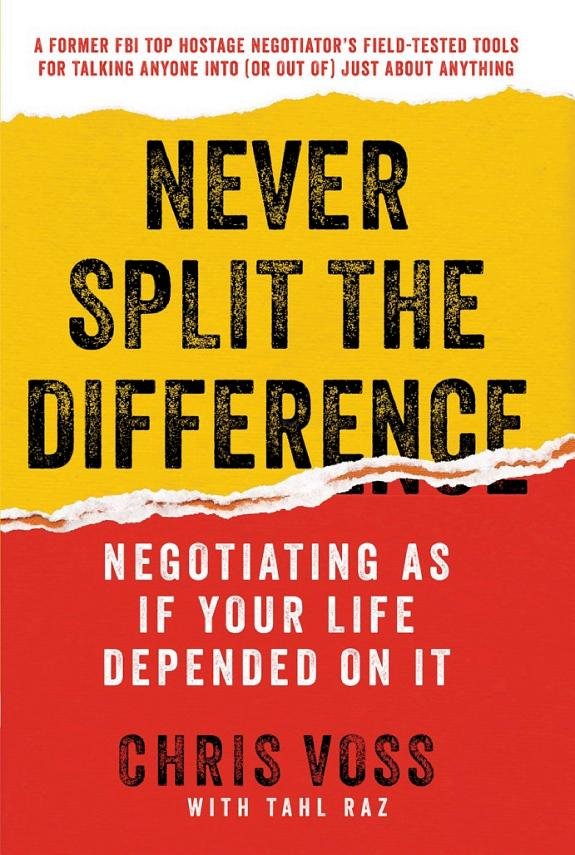
2. Never Split the Difference by Chris Voss
Chris Voss spent years as an FBI hostage negotiator, which is about as high-stakes a proving ground for communication skills as you can find. Never Split the Difference is his account of what actually works when you need to get someone to a yes, and the answer is not what most negotiation courses will tell you. Forget splitting the difference, finding the middle ground, or appealing to pure logic. Voss argues that the most effective negotiation is built on emotional intelligence and tactical empathy, not compromise.
The book introduces a set of specific, learnable techniques. Mirroring, labeling emotions, calibrated questions, the power of a well-placed silence. Voss explains each one with stories from his career and from the business world, and the techniques are concrete enough that you can actually try them the next day. There is something quietly satisfying about realizing that a tool used to talk armed criminals into releasing hostages also works when you are trying to negotiate your rent.
Voss writes with a lot of energy and the book moves quickly. He is not shy about his own confidence in these methods, which occasionally tips into swagger, but he earns it with enough compelling examples that it rarely feels unwarranted. The underlying message, that most people are not listening nearly as carefully as they think they are, is both humbling and useful.
This book is not for people who are looking for a purely ethical framework for negotiation. Voss is focused on effectiveness, and some readers find the tactical framing a little cold. But if you have ever left a conversation feeling like you gave up more than you should have, this book will reframe how you think about every difficult discussion you have going forward.
“The beauty of empathy is that it doesn’t demand that you agree with the other person’s ideas. It just requires you to acknowledge their position.”
This is perfect for anyone who regularly negotiates, whether that means job offers, business deals, or simply trying to get a fair outcome in a disagreement, and who wants practical tools rather than abstract principles.
Emotional Intelligence
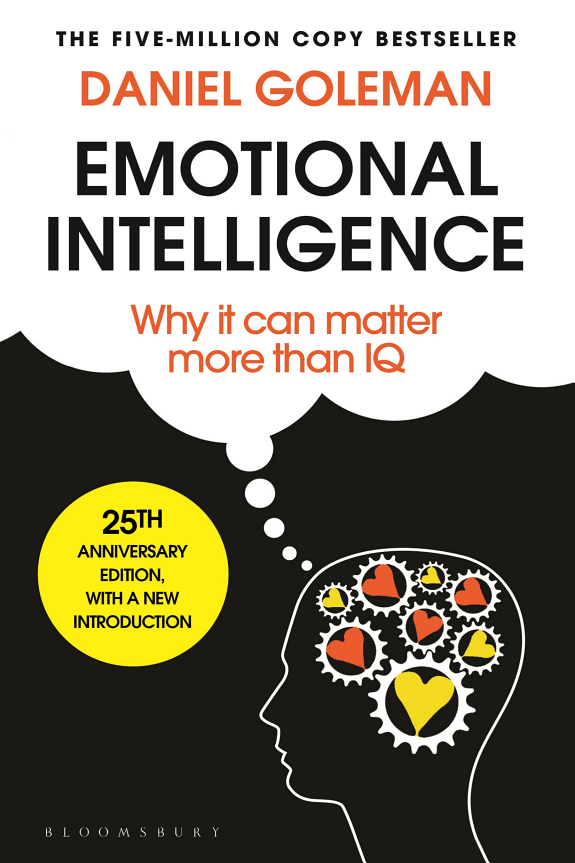
3. Emotional Intelligence by Daniel Goleman
When Daniel Goleman published Emotional Intelligence in 1995, the idea that your ability to understand and manage emotions might matter as much as your IQ was genuinely controversial in some circles. Decades later, the concept has become so widely accepted that it shows up in job listings and corporate training programs, sometimes reduced to a buzzword in the process. Reading the original book is a useful reminder of how carefully and rigorously Goleman actually built the case.
Goleman draws on neuroscience, psychology, and a wide range of real-world research to explain what emotional intelligence actually is, which turns out to be a cluster of distinct skills. Self-awareness, self-regulation, motivation, empathy, and social skill. He is careful to distinguish between these and to show how deficits in each one play out in real lives, in relationships, in workplaces, and in health outcomes. The writing is accessible without being dumbed down, which is a harder balance to strike than it sounds.
The book is not a self-help manual in the traditional sense. Goleman is not handing you a five-step plan to become more emotionally intelligent. He is making a broader argument about what emotional competence means and why it matters, and he backs that argument up with enough evidence that it is hard to dismiss. The sections on childhood development and education are particularly worth reading for anyone who works with young people or thinks about how character gets formed.
Readers who want immediate, actionable exercises may find the book more theoretical than they were hoping for. It is more of a thorough explanation than a workbook. But for anyone who wants to genuinely understand what emotional intelligence means before they try to develop it, this is the foundational text.
“In a very real sense we have two minds, one that thinks and one that feels.”
This is perfect for people who want a serious, research-grounded understanding of emotional intelligence, particularly those in leadership roles, education, or anyone who has noticed that intellect alone does not seem to be enough in their relationships or career.
Influence: The Psychology of Persuasion
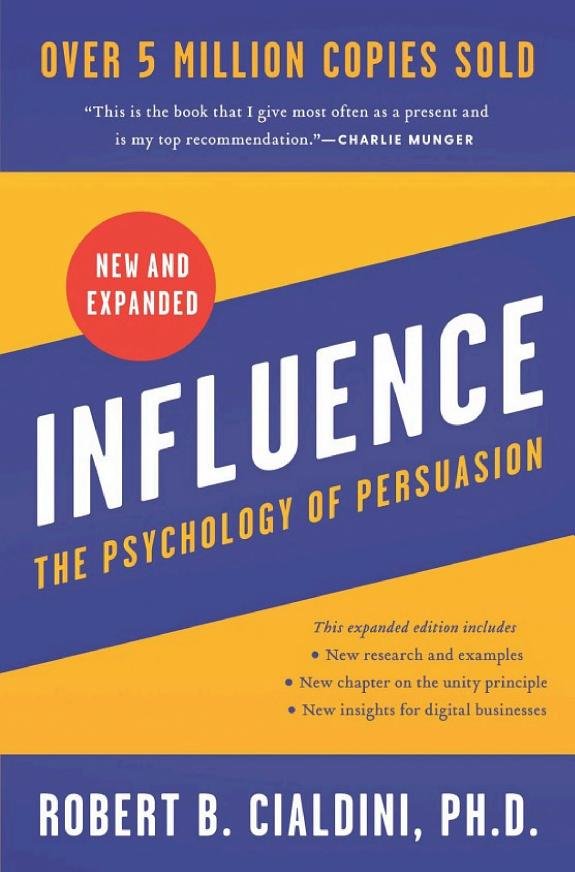
4. Influence: The Psychology of Persuasion by Robert B. Cialdini
Robert Cialdini spent years going undercover. Not in a trench coat and fake mustache kind of way, but by getting jobs at used car dealerships, fundraising organizations, and advertising agencies so he could watch persuasion techniques in action from the inside. The result of that research is Influence, a book that lays out six core principles that govern why people say yes, and that has quietly become one of the most referenced books in marketing, psychology, and sales since it was published in 1984.
The six principles, reciprocity, commitment and consistency, social proof, authority, liking, and scarcity, will probably feel familiar once you read about them, because you have been on the receiving end of all of them countless times. That is exactly what makes the book so useful. Once Cialdini names and explains these mechanisms, you start seeing them everywhere, in advertising, in political rhetoric, in the way a restaurant menu is laid out. It is the kind of knowledge that makes you a harder person to manipulate and a more thoughtful communicator.
Cialdini is a genuinely skilled explainer. The academic research is there, but it is always grounded in anecdotes and examples that make the concepts stick. He is also admirably balanced in how he presents the material, acknowledging that these principles can be used ethically or exploitatively, and encouraging readers to think carefully about the difference.
If you are already well-versed in behavioral economics or social psychology, some of this will feel like familiar territory. The book is also more descriptive than prescriptive, so readers looking for a detailed guide to becoming more persuasive themselves may want to supplement it. But as a clear-eyed account of how human beings actually get influenced, it holds up remarkably well.
“The weapons of influence are so effective because they work by exploiting the way human minds are built to take shortcuts.”
This is perfect for anyone who wants to understand the mechanics of persuasion, whether to use them more consciously in their own communication or simply to recognize when someone is using them on you.
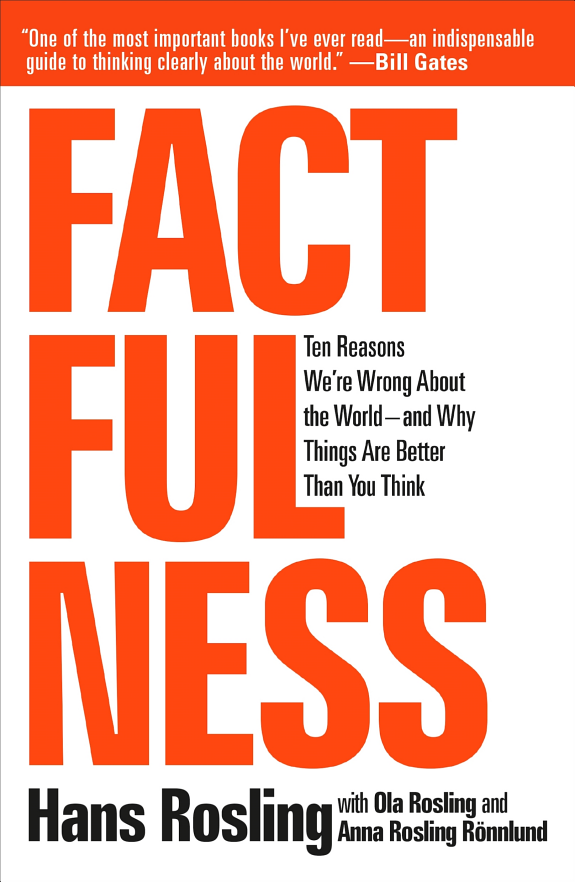
Factfulness
5. Factfulness by Hans Rosling
Hans Rosling opens Factfulness with a quiz. Thirteen questions about global health, poverty, literacy, and population trends. Questions that seem like they should be easy for any reasonably informed person. And then he shows you that most people, including doctors, journalists, and professors, score worse than random chance. Worse than a chimpanzee picking answers at random, which Rosling points out with a cheerfulness that somehow makes it more rather than less humbling.
The book is about why our picture of the world is so systematically wrong, and it turns out the answer is not stupidity or ignorance. It is a set of deeply human cognitive tendencies that Rosling calls instincts, things like our attraction to dramatic narratives, our tendency to divide the world into two categories when reality is a spectrum, and our habit of assuming that things are getting worse when the data often shows the opposite. He identifies ten of these instincts and explains each one with clarity and a warmth that feels rare in a book this rigorous.
Rosling was a global health professor and a gifted communicator, and this book was finished by his son and daughter-in-law after his death in 2017. There is something moving about reading it with that context in mind. He was genuinely excited about data and genuinely believed that a more accurate picture of the world would help people make better decisions, and that enthusiasm comes through on every page.
This is not a comfortable book if you are attached to a particular political narrative about the state of the world, whether that narrative is optimistic or pessimistic. Rosling is not interested in making you feel good or bad. He is interested in making you accurate. Readers who prefer their worldview unchallenged will find it annoying. Everyone else will find it quietly clarifying.
“The world cannot be understood without numbers. But the world cannot be understood with numbers alone.”
This is perfect for curious, intellectually honest readers who want to stress-test their assumptions about global development, poverty, and progress, and who are willing to discover that they have been wrong about quite a few things.
None of these books require a syllabus or a teacher. They just require a few hours and a willingness to sit with ideas that occasionally make you reconsider something you thought you already understood. That is, honestly, a better description of education than most formal schooling ever managed.
The five subjects covered here, money psychology, negotiation, emotional intelligence, persuasion, and clear thinking about the world, are things that shape your life whether you study them or not. The only question is whether you understand the forces at work or just experience them. These books make a strong case for the former.
Pick the one that feels most relevant to where you are right now. There is no wrong starting point.