
5 Books That Make You Smarter About Life
Some books you finish and think, “that was nice.” Others sit with you for weeks, quietly rearranging the furniture in your head. The five books on this list belong to the second category. They are not quick fixes or self-help cheerleading sessions. They are the kind of reading that makes you pause mid-page, stare at the wall for a moment, and then keep going.
What ties them together is not a genre or a style. It is the fact that each one offers a sharper lens for looking at your own thinking, your own choices, and your own time on earth. Some are ancient. Some are rooted in psychology. One came out of a concentration camp. None of them are easy reads in the breezy sense, but all of them are deeply worth the effort. Grab a good cup of coffee before you start any of these.
Man’s Search for Meaning
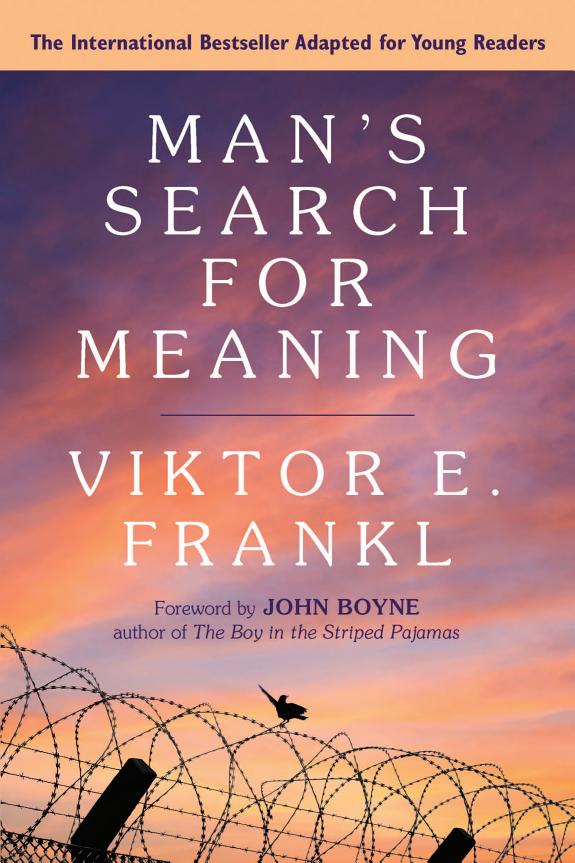
1. Man’s Search for Meaning by Viktor E. Frankl
Viktor Frankl was a psychiatrist and Holocaust survivor who spent years in Nazi concentration camps, including Auschwitz. What he wrote afterward was not a memoir in the conventional sense. It is part testimony, part psychological theory, and part philosophical argument for why human beings can endure almost anything if they have a reason to. The first half of the book describes his experiences in the camps with a clarity that is almost unbearable. The second half introduces logotherapy, his school of thought built around the idea that meaning, not pleasure or power, is the central drive of human life.
Frankl’s voice is measured and precise. He is not dramatic about his suffering, which somehow makes it hit harder. He writes like a scientist observing his own despair, and that restraint gives the book a strange kind of authority. The central argument, that we cannot always choose our circumstances but we can always choose our response to them, has been quoted so many times it risks sounding like a bumper sticker. Read it in context, surrounded by the full weight of what Frankl witnessed, and it lands very differently.
This is not a comfortable read. It should not be. If you are looking for something that pats you on the back and tells you everything will be fine, this is the wrong book. But if you are willing to sit with a difficult question, namely what actually gives your life meaning, Frankl offers one of the most serious and earned answers in all of modern literature. It is short, which makes the density of ideas even more striking.
“Everything can be taken from a man but one thing: the last of the human freedoms, to choose one’s attitude in any given set of circumstances.” This line is not inspirational decoration. In Frankl’s hands, it is a hard-won conclusion backed by evidence most of us will never have to face.
This is perfect for readers going through a difficult period, anyone grappling with questions of purpose, and people who want their reading to carry genuine weight rather than easy comfort.
Meditations
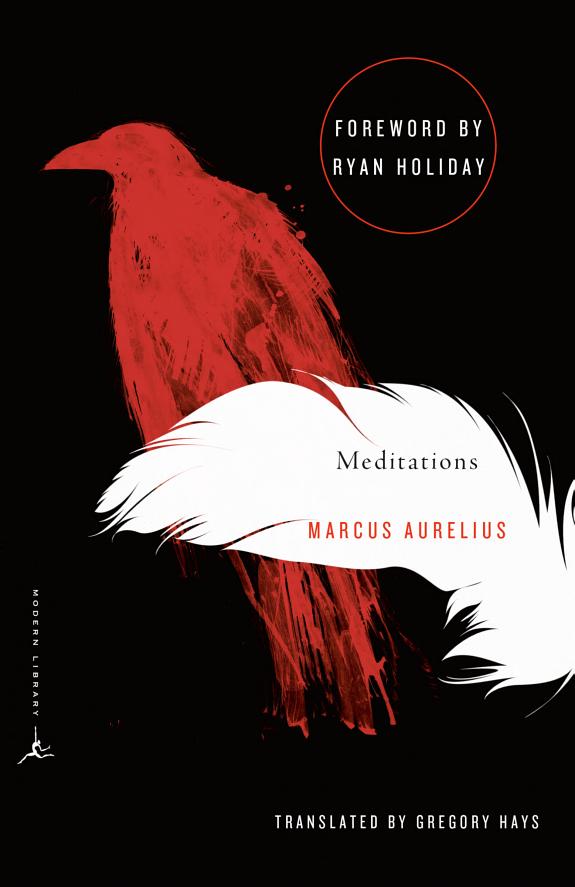
2. Meditations by Marcus Aurelius
Here is a book that was never meant to be published. Marcus Aurelius, Roman emperor and Stoic philosopher, wrote these notes to himself over many years, essentially as a private journal of self-correction and moral reasoning. He was one of the most influential men in the ancient world, and he spent his private moments reminding himself not to be arrogant, not to waste time, and not to lose his temper over things he could not control. There is something quietly funny about that, if you think about it long enough.
The Stoic framework at the heart of Meditations is built around a few core ideas. Focus on what is within your control. Accept what is not. Do your duty without complaint. Treat other people with patience, because they are doing their best with whatever reasoning they have. These ideas are simple to state and genuinely difficult to practice, which is probably why Aurelius kept writing them down over and over again, as if trying to talk himself into believing them.
The translation you choose matters here. Gregory Hays’s modern version is widely regarded as the most readable, and it strips away the archaic language that can make older translations feel like homework. The book does not have a single argument or narrative arc. It is more like spending time in the company of a thoughtful, self-critical mind. Some passages will feel repetitive. That is partly the point. Aurelius was drilling these ideas into himself, and reading along, you start to feel the same effect.
Meditations works best not as a book you read once but as one you return to. Open it on a bad day and you will almost certainly find something that cuts right through whatever is bothering you.
This is perfect for people drawn to philosophy but intimidated by academic texts, anyone interested in Stoicism, and readers who want something they can dip into rather than read cover to cover.
Thinking, Fast and Slow
3. Thinking, Fast and Slow by Daniel Kahneman
Daniel Kahneman is a Nobel Prize-winning psychologist who spent decades studying the ways human beings make decisions, and the news is not entirely flattering. Thinking, Fast and Slow is his comprehensive account of two modes of thought he calls System 1 and System 2. System 1 is fast, intuitive, and automatic. System 2 is slow, deliberate, and effortful. The problem, as Kahneman patiently demonstrates across hundreds of pages, is that we rely on System 1 far more than we realize, even in situations that genuinely require System 2.
The book covers an enormous range of cognitive biases and errors, from anchoring and availability heuristics to the planning fallacy and loss aversion. Kahneman walks through each one with research studies, thought experiments, and examples drawn from medicine, finance, and everyday life. The cumulative effect is a fairly humbling portrait of human rationality. By chapter ten or so, you start second-guessing decisions you made years ago, which is either illuminating or mildly distressing, depending on your temperament.
Fair warning: this is a long book and a dense one. Kahneman is a rigorous thinker and he does not rush. Some sections, particularly the later chapters on economic behavior, require real concentration. Readers who want breezy summaries of psychological research will find this frustrating. But readers willing to go slowly and actually engage with the material will come away with a genuinely different understanding of how their own minds work, and where those minds tend to go wrong.
The most unsettling insight in the book is not any single bias. It is the consistent finding that we are often least aware of our errors precisely when we are most confident we are right.
This is perfect for curious readers who enjoy psychology and behavioral economics, professionals who make high-stakes decisions regularly, and anyone who has ever wondered why smart people do such reliably irrational things.
The Art of Thinking Clearly
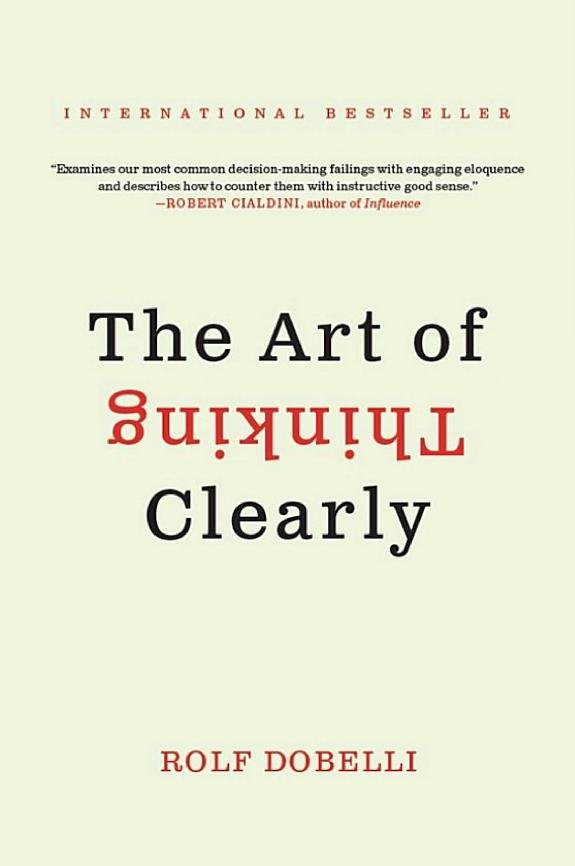
4. The Art of Thinking Clearly by Rolf Dobelli
If Kahneman’s book is the deep academic dive, Rolf Dobelli’s The Art of Thinking Clearly is the more accessible companion. Dobelli, a Swiss entrepreneur and novelist, catalogs 99 cognitive errors and logical fallacies in short, punchy chapters, each one focused on a single bias. Survivorship bias. The sunk cost fallacy. Social proof. The halo effect. He explains each one clearly, gives a real-world example, and then moves on. The whole thing reads almost like a collection of very useful essays.
Dobelli is a fluid and engaging writer, which helps. He does not get bogged down in academic language or lengthy methodological explanations. Each chapter is a few pages long, which makes the book easy to pick up and put down without losing your place. You could read one chapter a day for three months and come out the other side with a genuinely sharper sense of where your thinking tends to slip. That said, readers who want deep dives into the research behind each bias will find the format frustrating. Dobelli is synthesizing, not proving.
Some critics have noted that Dobelli drew heavily from Kahneman and other researchers without always making that clear, which is a legitimate concern worth knowing about before you read. The book is best approached as a practical field guide rather than an original work of scholarship. On those terms, it delivers. It is the kind of book you find yourself referencing in conversation, remembering a specific chapter when you catch yourself making exactly the mistake Dobelli described three weeks ago.
The value of this book is not in any single insight but in the accumulated habit it builds. Read enough of these chapters and you start to notice your own errors in something closer to real time, which is rarer and more useful than it sounds.
This is perfect for busy readers who want practical cognitive tools without a textbook commitment, people new to the subject of behavioral psychology, and anyone who enjoyed Thinking, Fast and Slow but wants a lighter follow-up.
The Power of Now: A Guide to Spiritual Enlightenment
5. The Power of Now by Eckhart Tolle
Eckhart Tolle is a different kind of writer from everyone else on this list, and The Power of Now is a different kind of book. It is not rooted in psychology or philosophy in the academic sense. It is closer to spiritual teaching, structured as a dialogue between Tolle and an imagined reader full of questions. The central argument is that most human suffering comes from living inside our own heads, either replaying the past or anxiously projecting into the future, rather than actually inhabiting the present moment. The solution, Tolle suggests, is to become aware of this pattern and learn to rest in the now.
Tolle’s writing is calm and repetitive in a way that is either soothing or maddening depending on your patience for that kind of thing. He circles back to the same core ideas from different angles, which is consistent with his teaching style but can feel slow to readers used to more linear arguments. The book draws loosely from Buddhism, Christianity, and other traditions without fully belonging to any of them. Some readers find this spiritually inclusive. Others find it vague. Both reactions are reasonable.
It would be dishonest not to mention that this book is not for everyone. Skeptical readers, particularly those with a strong preference for empirical evidence, will likely find Tolle’s framework frustrating. He is not building a scientific case. He is describing an experience and inviting you to have it. Readers who approach it on those terms, as an invitation rather than an argument, often find something genuinely useful here, especially those dealing with anxiety, chronic overthinking, or a nagging sense of disconnection from their own lives.
Whatever you think of Tolle’s spiritual framework, the core observation is hard to dismiss: most of us spend very little time actually present in our own lives, and that absence has real costs.
This is perfect for readers open to spiritual or contemplative ideas, people struggling with anxiety or mental noise, and anyone curious about mindfulness who wants something more substantial than a meditation app.
These five books cover a lot of ground, from ancient Rome to modern neuroscience, from a Nazi concentration camp to the question of whether you are really paying attention to your own life. They do not all agree with each other, and that is part of what makes reading them worthwhile. Frankl finds meaning in suffering. Aurelius counsels acceptance. Kahneman and Dobelli warn you that your confident intuitions are often wrong. Tolle suggests the whole mental chatter might be the problem to begin with. Put them together and you get something like a full picture of what it means to think carefully and live deliberately.
You do not have to read all five in sequence or treat this as a curriculum. Pick the one that speaks to where you are right now. Come back to the others when the time feels right. The best reading tends to happen that way anyway, when a book finds you rather than the other way around. Any one of these is a good place to start.