

6 Books That Help You Speak Up for Yourself
Most of us have walked away from a conversation replaying everything we should have said. The meeting where you nodded along even though you disagreed. The friend who asked for a favor you really did not want to give. The moment you said yes when every part of you wanted to say no. It is a remarkably common experience, and it tends to leave a specific kind of residue, a low-grade frustration with yourself that builds over time.
The good news is that speaking up is a skill, not a personality trait you either have or do not have. It can be learned, practiced, and gradually made into something that feels natural rather than terrifying. The books on this list approach that skill from different angles, some through communication frameworks, some through the psychology of people-pleasing, and some through the surprisingly nuanced art of saying no without burning everything down. Together, they cover a lot of ground. Pick the one that speaks to where you are right now.
Crucial Conversations: Tools for Talking When Stakes Are High
1. Crucial Conversations: Tools for Talking When Stakes Are High by Kerry Patterson, Joseph Grenny, Ron McMillan, Al Switzler
There is a particular kind of conversation that most people avoid for as long as humanly possible. The performance review that needs to happen. The relationship issue that keeps circling back. The disagreement with a colleague that everyone pretends is fine. Kerry Patterson and his co-authors built an entire framework around exactly these moments, and the result is one of the more practically useful books on communication you are likely to find.
The central idea is that when conversations get high-stakes, most people do one of two things: they go silent or they go aggressive. Neither works. The authors lay out a method for staying in dialogue even when emotions are running hot, starting with the concept of a “pool of shared meaning,” the idea that good conversations expand what both people understand rather than just winning a point. The writing is clear and the examples feel real, drawn from workplaces and relationships that most readers will recognize immediately.
The four-author team brings a background in organizational behavior and leadership development, and that shows in how the book is structured. It is methodical without being dry. Each chapter builds on the last, and there are enough concrete tools that you can actually try something different the next time a hard conversation comes up, rather than just feeling vaguely inspired and then defaulting to your old habits.
If you are someone who tends to either explode or go completely quiet under pressure, this book gives you a third option. It is not about being conflict-free. It is about being able to stay present and honest when things get uncomfortable. That distinction matters more than it might sound.
The authors make a quietly radical argument: the conversations you keep avoiding are usually the ones your relationships and career most need you to have.
This is perfect for managers, partners, and anyone who has ever rehearsed a difficult conversation in the shower and then completely chickened out in the actual moment.
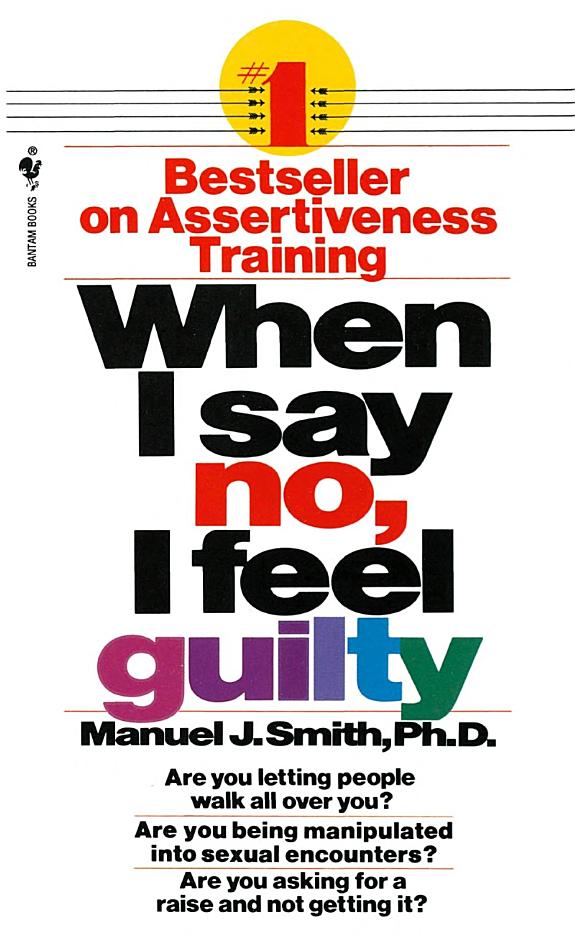
When I Say No, I Feel Guilty
2. When I Say No, I Feel Guilty by Manuel J. Smith
Published in 1975, this book has the kind of longevity that only happens when something genuinely works. Manuel J. Smith was a clinical psychologist who got tired of watching his patients get pushed around, talked out of their own opinions, and manipulated by people who had figured out how to exploit social politeness. His response was to write a book that is essentially a field guide to not getting steamrolled.
The backbone of the book is what Smith calls “Assertiveness Rights,” a list of basic entitlements that most people intellectually agree with but emotionally struggle to act on. Things like the right to change your mind, the right to say you do not understand, the right to make mistakes. Reading them feels almost embarrassingly obvious, and yet the recognition that you have been living as though these rights do not apply to you can be genuinely startling.
Smith also introduces specific verbal techniques, the most famous being “broken record,” which involves calmly repeating your position without escalating or getting drawn into debates about whether your position is reasonable. It sounds almost too simple, and some readers find the techniques a bit mechanical. That is a fair critique. The book can feel like it is teaching you scripts rather than genuine confidence. But for people who go completely blank when someone pushes back on them, having a script is not a bad place to start.
The writing is dated in places, and some of the examples feel like they belong to a very specific era of American social life. But the underlying psychology is sound, and the core message, that you are allowed to hold your ground without justifying yourself endlessly, has not aged at all.
Smith’s most useful insight is that manipulation almost always works by making you feel obligated to explain and defend yourself. Once you realize you do not have to, a lot of the pressure dissolves.
This is perfect for people who find themselves over-explaining every decision they make, or who feel a wave of guilt the moment they decline something.
Your Perfect Right: Assertiveness and Equality in Your Life and Relationships
3. Your Perfect Right: Assertiveness and Equality in Your Life and Relationships by Robert Alberti, Michael Emmons
Robert Alberti and Michael Emmons essentially helped invent the modern concept of assertiveness training. The first edition of this book came out in 1970, and it has been updated and revised many times since, which tells you something about its staying power. It is often used in clinical settings and recommended by therapists, and it has the feel of something that has been tested against real human experience rather than just theorized in an office.
The book makes a careful and important distinction between assertiveness, aggression, and passivity. That triangle gets muddled surprisingly often. A lot of people who think they are being assertive are actually being aggressive, and a lot of people who think they are being polite are actually being passive in ways that quietly damage their relationships and self-respect. Alberti and Emmons spend real time helping readers figure out where they actually fall on that spectrum, which is more useful than just telling everyone to speak up more.
There is a strong emphasis on equality throughout, the idea that assertiveness is not about getting your way but about treating yourself and others as having equal standing. That framing keeps the book from feeling like it is coaching you to be demanding or self-centered. Instead it positions speaking up as something you do out of respect, for yourself and for the people around you who deserve honest communication.
The book is not the most gripping read. It is thorough and earnest rather than entertaining, and if you are looking for something with a lot of narrative drive this is not it. But as a comprehensive, thoughtful introduction to assertiveness as a practice, it is hard to beat.
The authors argue that staying silent to avoid conflict is not actually kind. It denies the other person the chance to know what you really think, which is its own form of disrespect.
This is perfect for readers who want a grounded, research-informed introduction to assertiveness, especially if they are working through these ideas with a therapist or counselor.
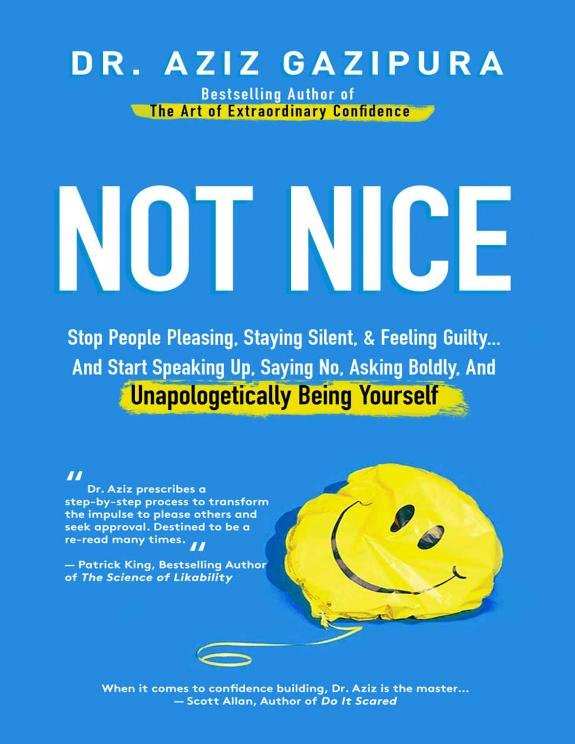
Not Nice: Stop People Pleasing, Staying Silent, & Feeling Guilty… And Start Speaking Up, Saying No, Asking Boldly, And Unapologetically Being Yourself
4. Not Nice: Stop People Pleasing, Staying Silent, and Feeling Guilty… And Start Speaking Up, Saying No, Asking Boldly, And Unapologetically Being Yourself by Aziz Gazipura
Aziz Gazipura is a clinical psychologist who spent years helping people with social anxiety and confidence, and this book is the fullest expression of what he learned doing that work. The title is deliberately provocative, and the book earns it. Gazipura is not interested in helping you be more diplomatically assertive. He is interested in helping you stop organizing your entire life around what other people think of you.
The central argument is that people-pleasing is not a character quirk or a politeness habit. It is a fear-based strategy for managing other people’s emotions, and it comes at enormous cost to your own authenticity and wellbeing. Gazipura traces the roots of this pattern back to childhood, where most of us learned that being agreeable kept things safer and smoother, and he is genuinely compassionate about why so many people end up there. The tone is warm rather than confrontational, even when the content is challenging.
Where this book stands apart from more clinical assertiveness texts is in how directly it deals with the emotional experience of change. Gazipura does not just give you techniques. He prepares you for the discomfort that comes when you start saying no to people who are used to hearing yes from you. Some of them will not like it. He is honest about that, and he helps you think through how to tolerate that discomfort without immediately backpedaling.
The book is long and occasionally repetitive, and readers who prefer a tighter, more structured approach may find it sprawling. It also skews toward personal relationships more than professional ones, so if your primary struggle is workplace communication, other books on this list might serve you better. But for anyone whose people-pleasing has roots in deeper anxiety or fear of rejection, this is one of the more honest and useful books available.
Gazipura makes the case that being “nice” in the people-pleasing sense is not actually about caring for others. It is about managing your own fear of their disapproval, which is a very different thing.
This is perfect for chronic people-pleasers who know intellectually that they need to set limits but feel a wave of dread every time they try.
Set Boundaries, Find Peace: A Guide to Reclaiming Yourself
5. Set Boundaries, Find Peace: A Guide to Reclaiming Yourself by Nedra Glover Tawwab
Nedra Glover Tawwab is a therapist who built a substantial following on Instagram by posting clear, direct content about boundaries, and this book is the expanded version of those ideas. It arrived at a moment when the word “boundaries” was everywhere, often used in vague or slightly weaponized ways, and one of Tawwab’s real contributions is making the concept concrete and usable rather than just a piece of therapy-speak.
The book covers a wide range of relationships including family, friendships, romantic partnerships, and work, and it is unusually specific about what poor limits actually look like in each context. Tawwab is good at describing the feelings that signal a limit has been crossed, the resentment, the exhaustion, the sense of being perpetually put-upon, and connecting those feelings back to specific patterns of behavior that can be changed. Reading it, many people will have the slightly uncomfortable experience of recognizing themselves in the examples of both the person whose limits are being ignored and the person doing the ignoring.
The writing is accessible and warm, and Tawwab brings her clinical experience to bear without making the book feel like a textbook. She is also refreshingly honest about the fact that setting limits is not a one-time event. It is an ongoing practice, and it often gets harder before it gets easier, particularly with people who have benefited from your lack of them.
If you are someone who has read a lot about this topic already, some of the material will feel familiar. The book is pitched toward readers who are relatively new to thinking about this subject, and it works very well at that level. It is not the place to go if you want deep psychological theory, but as a practical, compassionate guide it is one of the clearest available.
Tawwab’s most grounding point is that setting a boundary is not an act of aggression toward someone else. It is an act of honesty about what you need to keep showing up well in the relationship.
This is perfect for people who feel chronically drained by their relationships and suspect that their difficulty saying no is at the center of it.
The Power of a Positive No: How to Say No and Still Get to Yes
6. The Power of a Positive No: How to Say No and Still Get to Yes by William Ury
William Ury co-wrote “Getting to Yes,” one of the most widely read negotiation books ever published, so it is fitting that he eventually wrote a book about the other side of that coin. The premise here is that saying no does not have to be a dead end. Done well, it can actually be the beginning of a better agreement for everyone involved.
Ury introduces a three-part structure he calls “Yes, No, Yes.” The first yes is the value or need you are protecting by saying no. The no itself is the clear, firm refusal. The second yes is a proposal for an alternative path forward that might work for both parties. It sounds almost too tidy when described that way, and Ury is aware of that. He spends considerable time on the messiness of real situations, including what to do when the other person reacts badly, pushes back hard, or simply refuses to engage.
What distinguishes this book from most assertiveness literature is its focus on relationships and long-term outcomes. Ury is not just helping you get through an uncomfortable moment. He is helping you think about how to decline in a way that preserves the relationship and your own integrity at the same time. That is a genuinely different and more sophisticated goal than simply learning to say no without apologizing seventeen times.
The book draws on negotiation theory and is probably most useful for people navigating professional or complex personal situations where the relationship has real stakes. If you are primarily dealing with casual social pressure or low-stakes requests, this might be more framework than you need. But for anyone who has ever felt that saying no inevitably means damaging something important, Ury offers a genuinely encouraging alternative view.
Ury’s core insight is that the most effective no is not a wall. It is a door that opens onto something better, and knowing that changes how you deliver it.
This is perfect for negotiators, managers, and anyone who needs to decline requests from people they genuinely care about or depend on professionally.
None of these books will hand you a new personality. What they will do is give you a clearer picture of why speaking up feels so hard, and some honest, tested ideas for making it feel less impossible. The particular book that helps you most will probably depend on where you are starting from. If you struggle most in high-stakes professional conversations, start with Crucial Conversations. If the pattern goes deeper into people-pleasing and fear of rejection, Gazipura or Tawwab might resonate more. If you want a framework for saying no without ending relationships, Ury is worth your time.
The common thread running through all six is that your voice matters, not because of some motivational poster logic, but because honest communication is what makes relationships and workplaces actually function. Staying quiet to keep the peace is a short-term strategy with long-term costs. These books, each in their own way, are about deciding those costs are no longer worth paying.