8 Books for Anxiety and Overthinking That Actually Help
There is a particular kind of exhaustion that comes from living inside your own head too much. You replay conversations from three days ago. You catastrophize about things that have not happened yet. You lie awake at 2am running through every possible way something could go wrong. If any of that sounds familiar, you are not alone, and more importantly, you are not broken.
The books on this list were chosen because they actually do something. They are not vague collections of feel-good affirmations. They come from therapists, neuroscientists, and researchers who have spent careers understanding why anxious brains behave the way they do and, crucially, what you can do about it. Some are workbook-style and hands-on. Others are more narrative and explanatory. A few will make you rethink the way you have been approaching anxiety altogether. All of them are worth your time if worry has been taking up more than its fair share of rent in your mind.
The Anxiety and Phobia Workbook
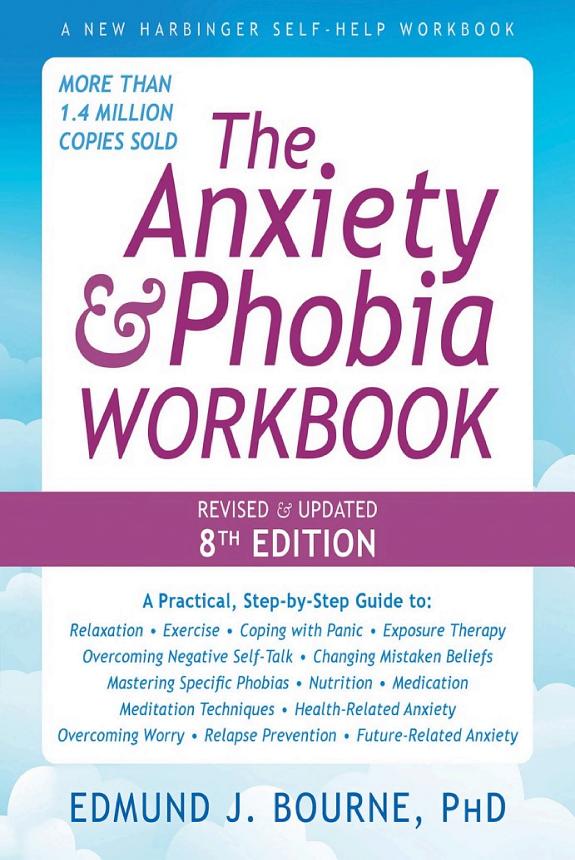
1. The Anxiety and Phobia Workbook by Edmund J. Bourne
Edmund Bourne has been revising and updating this workbook for decades, and the fact that it keeps selling says something real about its staying power. This is one of the most comprehensive self-help resources for anxiety available, covering everything from generalized anxiety and panic disorder to social anxiety and specific phobias. It is thick, thorough, and structured like a proper course of treatment rather than a casual read.
Bourne draws heavily on cognitive behavioral therapy, relaxation techniques, and lifestyle approaches, walking readers through exercises they can actually complete at home. The writing is clear without being condescending. Each chapter builds on the last, and the workbook format means you are not just absorbing information passively. You are doing something with it, which is exactly the point.
That said, this book is not for everyone. If you are looking for a breezy, narrative-style read you can finish on a Sunday afternoon, this is not it. It asks for real engagement and real effort. Some sections will feel more relevant to your specific experience than others, and that is fine. Treat it like a toolkit and take what you need.
The Anxiety and Phobia Workbook is one of the rare self-help books that earns the word “comprehensive” without using it as an excuse to be unfocused. It is structured, practical, and built around the idea that understanding your anxiety is only half the job.
This is perfect for readers who want a thorough, structured approach to anxiety and are willing to put in the work that comes with a genuine workbook format.
Don’t Feed the Monkey Mind: How to Stop the Cycle of Anxiety, Fear, and Worry
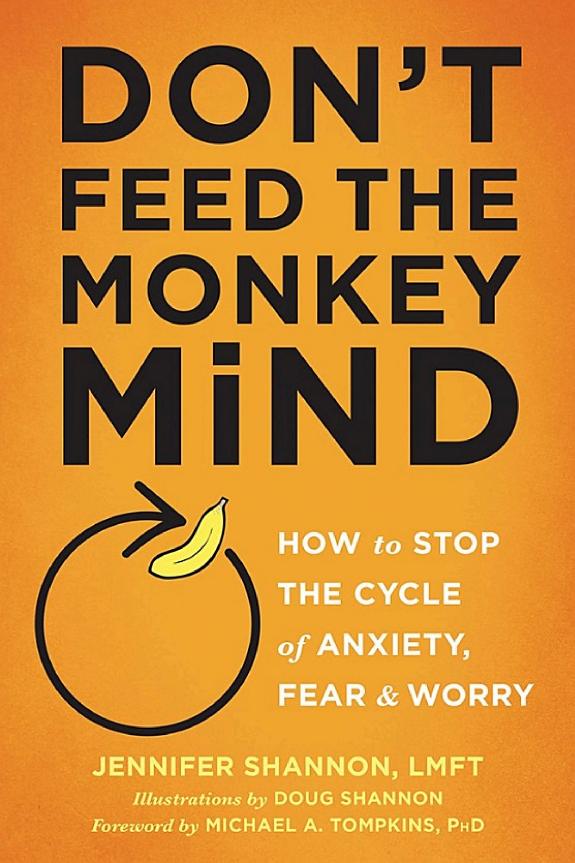
2. Don’t Feed the Monkey Mind: How to Stop the Cycle of Anxiety, Fear, and Worry by Jennifer Shannon
The title alone is doing a lot of work here, and Jennifer Shannon earns it. The “monkey mind” metaphor, borrowed from Buddhist tradition, describes that restless, chattering part of your brain that cannot stop scanning for threats. Shannon uses it as the central framework for a book that is surprisingly accessible and even, at moments, a little fun. There are illustrations throughout, which sounds gimmicky until you realize they actually help clarify the concepts.
Shannon is a licensed marriage and family therapist, and her clinical background shows in the way she structures the material. The book is rooted in CBT and acceptance-based approaches, explaining how avoidance feeds anxiety rather than relieving it. The core argument is that when you keep trying to reassure the monkey, you are actually making it louder. The solution involves learning to sit with discomfort rather than running from it, which is easier said than done but explained here with genuine care and clarity.
This is not the most rigorous or academically dense book on this list, and that is intentional. Shannon is writing for people who need concepts explained simply and strategies they can start using quickly. If you prefer your self-help books to feel more like textbooks, you might find the tone a touch too light. But for many readers, that lightness is exactly what makes it approachable.
Shannon makes a compelling case that the way most of us try to manage anxiety, by seeking reassurance and avoiding discomfort, is precisely what keeps it alive. It is the kind of insight that feels obvious in retrospect and genuinely useful in practice.
This is perfect for people who are new to anxiety self-help and want an approachable, illustrated guide that explains the cycle of worry without overwhelming them.
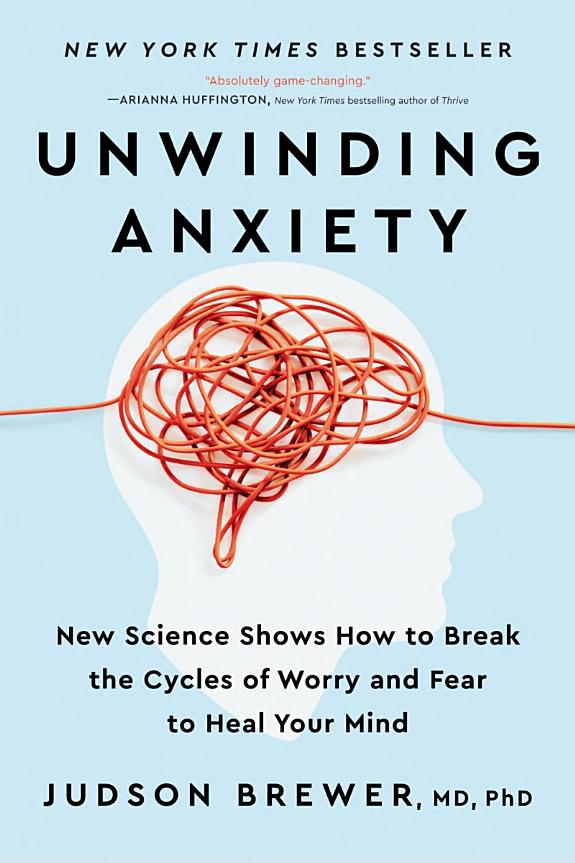
Unwinding Anxiety: New Science Shows How to Break the Cycles of Worry and Fear to Heal Your Mind
3. Unwinding Anxiety: New Science Shows How to Break the Cycles of Worry and Fear to Heal Your Mind by Judson Brewer
Judson Brewer is a psychiatrist and neuroscientist who has spent years studying habit loops and addiction, and in this book he applies that research directly to anxiety. The central argument is that anxiety is not just a feeling but a habit, one that your brain has learned to run automatically, and that the way to disrupt it is through curiosity and awareness rather than willpower or suppression. It is a genuinely interesting reframe.
Brewer writes well for a scientist. The book is engaging rather than dry, and he moves fluidly between explaining the neuroscience and offering practical techniques grounded in mindfulness. His work on the brain’s reward-based learning system gives the book a conceptual backbone that sets it apart from more purely therapeutic approaches. You come away feeling like you actually understand something about why your brain does what it does, which makes the strategies feel more credible.
Where the book has limits is in depth of practical application. Brewer gestures toward an app he developed, which some readers find useful and others find a bit promotional. The techniques are sound, but readers looking for a comprehensive workbook experience may want to pair this with something more exercise-heavy. As a conceptual guide to understanding and beginning to shift anxious habits, though, it is excellent.
Brewer reframes anxiety as a learned habit rather than a character flaw or chemical imbalance, and that shift in perspective alone is worth the read. The neuroscience is accessible, and the approach is refreshingly non-judgmental.
This is perfect for curious readers who want to understand the science behind their anxiety and are drawn to mindfulness-based approaches over purely CBT-focused ones.
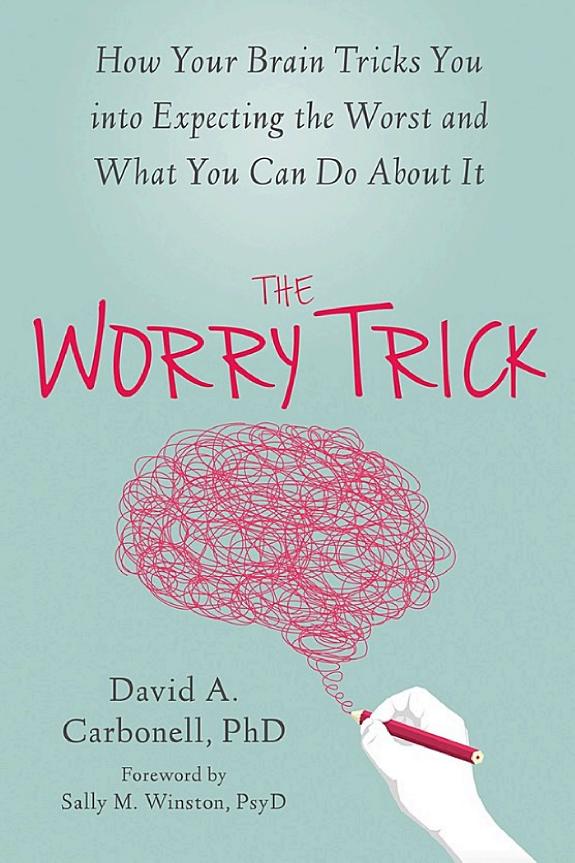
The Worry Trick: How Your Brain Tricks You into Expecting the Worst and What You Can Do About It
4. The Worry Trick: How Your Brain Tricks You into Expecting the Worst and What You Can Do About It by David A. Carbonell
David Carbonell is a psychologist who specializes in anxiety disorders, and this book reflects that specialization in the best possible way. He has a knack for explaining the counterintuitive mechanics of worry in plain, even slightly wry language. The core insight of the book is that the brain treats worry as a useful protective behavior, which means the harder you try to stop worrying, the more your brain doubles down. Fighting it makes it worse. Carbonell calls this the worry trick, and once you see it, you cannot unsee it.
The approach here draws on ACT (Acceptance and Commitment Therapy) as well as CBT, and the blend works well. Carbonell is particularly good at explaining why so many common strategies for managing worry, like distraction, reassurance-seeking, and avoidance, backfire over time. He offers concrete alternatives that involve changing your relationship with worrisome thoughts rather than trying to eliminate them, which is a more honest and ultimately more effective approach.
The tone is warm and occasionally funny in a dry, self-aware way. Carbonell clearly likes his patients and respects the real difficulty of what he is asking them to do. If you are someone who has already read a few anxiety books and feels frustrated that the advice never quite sticks, this one might be the missing piece. It is not for people who want a gentle, reassuring read. Carbonell is honest about the fact that getting better requires tolerating discomfort.
The Worry Trick does something genuinely useful: it explains why your instincts about how to handle worry are almost perfectly wrong, and it does so without making you feel foolish for having had those instincts in the first place.
This is perfect for chronic worriers who have tried other approaches without lasting success and are ready to understand why their coping strategies might be keeping them stuck.
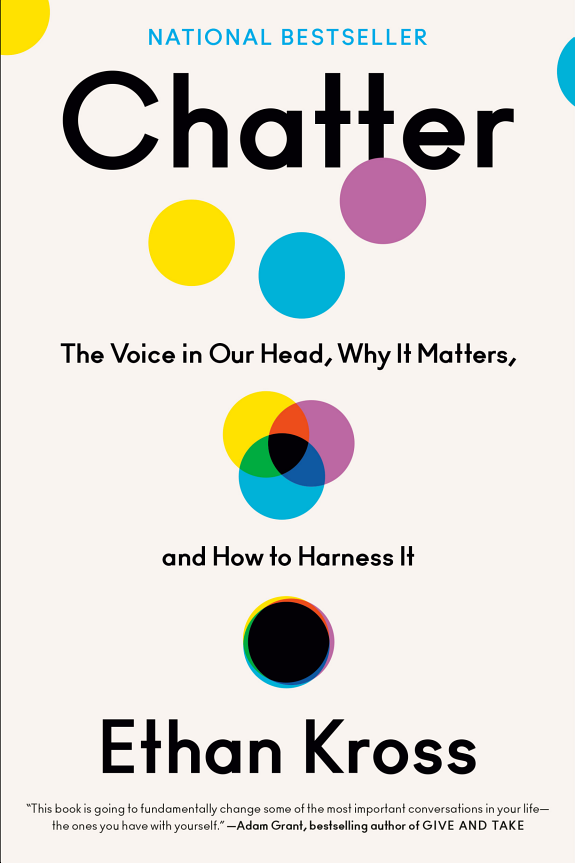
Chatter: The Voice in Our Head, Why It Matters, and How to Harness It
5. Chatter: The Voice in Our Head, Why It Matters, and How to Harness It by Ethan Kross
Ethan Kross is a psychologist and researcher at the University of Michigan, and Chatter is one of the more intellectually satisfying books on this list. It is less a self-help manual and more a deeply researched exploration of the inner voice, what it is, when it helps us, and when it spirals into the kind of repetitive negative thinking that makes anxiety worse. It is the sort of book that makes you feel smarter for having read it, which is not nothing.
Kross draws on his own lab research as well as a wide range of psychology and neuroscience to explain why the voice in your head can be both your greatest asset and your worst tormentor. He covers concepts like distanced self-talk (referring to yourself by name when thinking through a problem, which sounds strange but has real research behind it), the role of physical environment in shaping mental state, and the social dynamics of venting versus processing. The breadth is impressive without feeling scattered.
What Chatter is not is a clinical workbook. If you are in the thick of acute anxiety and need structured exercises to get through the day, this book alone will not be enough. It is better suited to someone who wants to understand the phenomenon of overthinking at a deeper level and pick up a handful of evidence-based tools along the way. Think of it as the intellectually curious companion to the more therapeutic books on this list.
Kross makes a compelling case that the goal is not to silence your inner voice but to learn when to trust it and when to recognize that it has gone off the rails. That distinction matters more than most of us realize.
This is perfect for intellectually curious readers who want to understand the psychology and neuroscience of overthinking rather than follow a step-by-step therapeutic program.
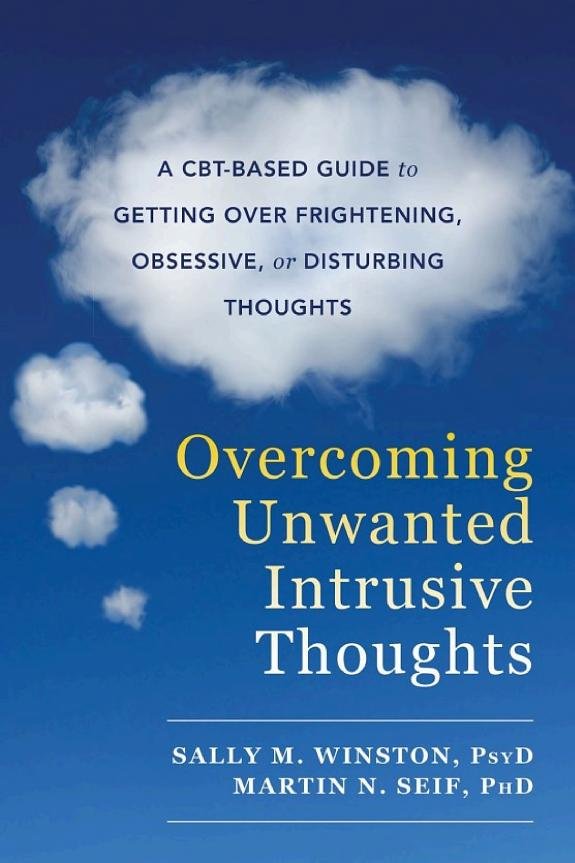
Overcoming Unwanted Intrusive Thoughts: A CBT-Based Guide to Getting Over Frightening, Obsessive, or Disturbing Thoughts
6. Overcoming Unwanted Intrusive Thoughts: A CBT-Based Guide to Getting Over Frightening, Obsessive, or Disturbing Thoughts by Sally M. Winston and Martin N. Seif
This book fills a gap that most general anxiety books leave wide open. Intrusive thoughts, those sudden, unwanted, often disturbing images or ideas that seem to come from nowhere, are extremely common and extremely distressing, particularly because people rarely talk about them. Sally Winston and Martin Seif are both anxiety specialists, and they write about this topic with the kind of directness and compassion that comes from years of helping people who thought they were uniquely broken.
The book explains clearly and without judgment why certain people get stuck on intrusive thoughts while others brush them off, and why the effort to suppress or analyze them tends to make them stickier. The CBT framework here is well-applied, and the authors are careful to distinguish between intrusive thoughts (which are ego-dystonic, meaning they feel foreign and upsetting) and genuine intentions or desires. That distinction is enormously reassuring for readers who have been quietly terrified by their own minds.
This is a specialized book, and it knows it. If your anxiety is more generalized worry or social anxiety without a strong intrusive thought component, there are better starting points on this list. But for readers who have been haunted by thoughts they are too embarrassed to mention to anyone, this book is likely to feel like a genuine relief. Finally, someone is talking about the thing.
Winston and Seif do something quietly important: they normalize a category of experience that many people carry in complete isolation, and they explain it in a way that replaces shame with understanding.
This is perfect for people who are specifically troubled by intrusive, disturbing, or obsessive thoughts and want a compassionate, research-grounded explanation of why this happens and how to respond.
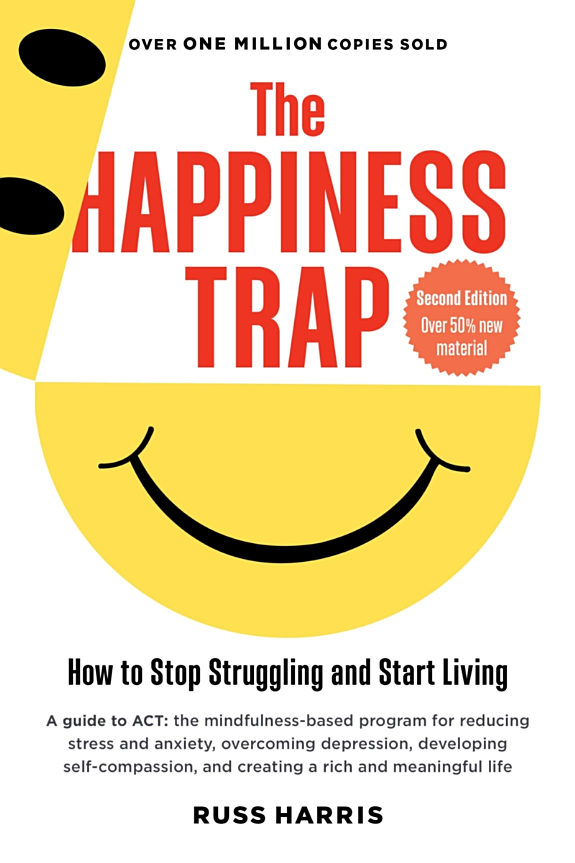
The Happiness Trap: How to Stop Struggling and Start Living
7. The Happiness Trap: How to Stop Struggling and Start Living by Russ Harris
Russ Harris is one of the clearest writers working in the ACT space, and The Happiness Trap is probably the most widely read introduction to Acceptance and Commitment Therapy available. The central premise is both simple and slightly uncomfortable: the relentless pursuit of happiness, and the belief that you should feel good most of the time, is actually a significant source of human suffering. The goal is not to feel better but to live better, which turns out to be a more useful target.
Harris walks readers through the core ACT concepts, including defusion (learning to observe your thoughts rather than fuse with them), acceptance, values clarification, and committed action, in a way that is accessible without being dumbed down. The exercises throughout the book are practical and, in some cases, genuinely surprising. There is one involving imagining your thoughts as leaves floating down a stream that sounds like something you would roll your eyes at but ends up being oddly effective.
The book is not a quick fix, and Harris does not pretend it is. Some readers find the ACT philosophy a shift that takes time to absorb, particularly if they have been steeped in more traditional CBT approaches that focus on changing thought content rather than changing your relationship with thoughts. If you prefer concrete, checklist-style strategies over philosophical reframing, the approach here might feel frustrating. But for many readers, it is exactly the perspective shift that makes everything else click.
Harris makes the case that struggling against difficult thoughts and feelings is often what keeps us stuck, and that learning to make room for discomfort while still moving toward what matters is both harder and more freeing than it sounds.
This is perfect for readers who feel like they have been fighting their anxiety for years without winning and are open to a fundamentally different way of thinking about what mental wellbeing actually means.
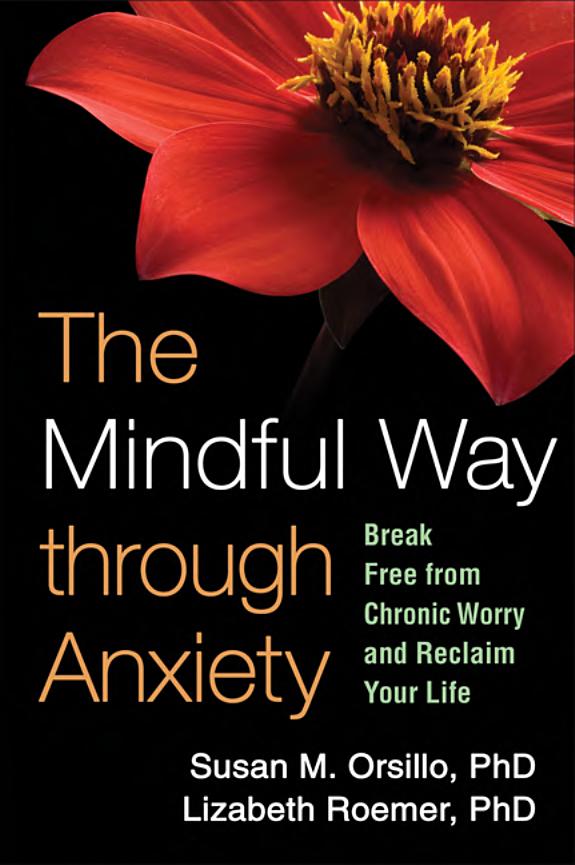
The Mindful Way Through Anxiety: Break Free from Chronic Worry and Reclaim Your Life
8. The Mindful Way Through Anxiety: Break Free from Chronic Worry and Reclaim Your Life by Susan M. Orsillo and Lizabeth Roemer
Susan Orsillo and Lizabeth Roemer are clinical psychologists who helped develop the mindfulness-based behavioral therapy approach for anxiety, so this is not a book written by enthusiastic outsiders. It is written by two of the researchers who built the framework. That background gives the book a kind of quiet authority that is reassuring without being stiff.
The book weaves together mindfulness practice and behavioral strategies in a way that feels genuinely integrated rather than bolted together. Orsillo and Roemer are careful to acknowledge how hard mindfulness can be for anxious people, who often find sitting quietly with their thoughts more distressing than helpful at first. They address this directly and compassionately, offering guidance on how to approach the practice in a way that does not immediately backfire.
The writing is warm and the case studies throughout the book are specific enough to be genuinely relatable. Readers will likely recognize themselves in the examples, which is both a little uncomfortable and deeply validating. The book does require a real commitment to the practices it describes, including regular mindfulness exercises, so it is not suited to readers looking for a purely intellectual overview. But for those willing to engage with it fully, it offers one of the more complete and well-grounded approaches to anxiety on this list.
Orsillo and Roemer understand that telling an anxious person to “just be present” is about as helpful as telling a drowning person to relax. They actually show you how, step by careful step, which makes all the difference.
This is perfect for readers who are drawn to mindfulness as an approach but have struggled to make it work for anxiety, and who want a structured, research-backed guide written by the people who developed the method.
Anxiety is one of those things that has a way of convincing you it is just who you are, that the worry and the overthinking are permanent features of your personality rather than patterns you can actually change. These books, taken together or individually depending on what you need, push back against that idea pretty effectively. They do not promise a cure, and the good ones are honest about the fact that getting better involves some discomfort along the way.
If you are not sure where to start, it depends on what you are looking for. If you want something comprehensive and workbook-style, begin with Bourne. If you want a conceptual reframe that changes how you think about anxiety altogether, try Carbonell or Harris. If you are dealing specifically with intrusive thoughts, go straight to Winston and Seif. There is no wrong entry point, and more than one of these books is likely to be worth returning to over time.
The fact that you are looking for help with this is already the harder step. The reading is the easy part, relatively speaking. Take it at whatever pace makes sense for you.