

5 Books for Creating a Better Future
There is a particular kind of restlessness that comes from caring about the future. You read the news, you feel the weight of it, and then you wonder what any of it actually means for the decades ahead. Books can not fix that feeling entirely, but the right ones can at least give you a sharper lens to look through.
The five books gathered here are not cheerful distractions. They are serious, sometimes uncomfortable, and occasionally quite hopeful in ways that feel earned rather than hollow. They come from economists, climate negotiators, statisticians, and strategists, and together they make a surprisingly coherent case that how we think about the future matters just as much as what we do about it. If you have ever wanted to move past vague anxiety and toward something more useful, this is a reasonable place to start.
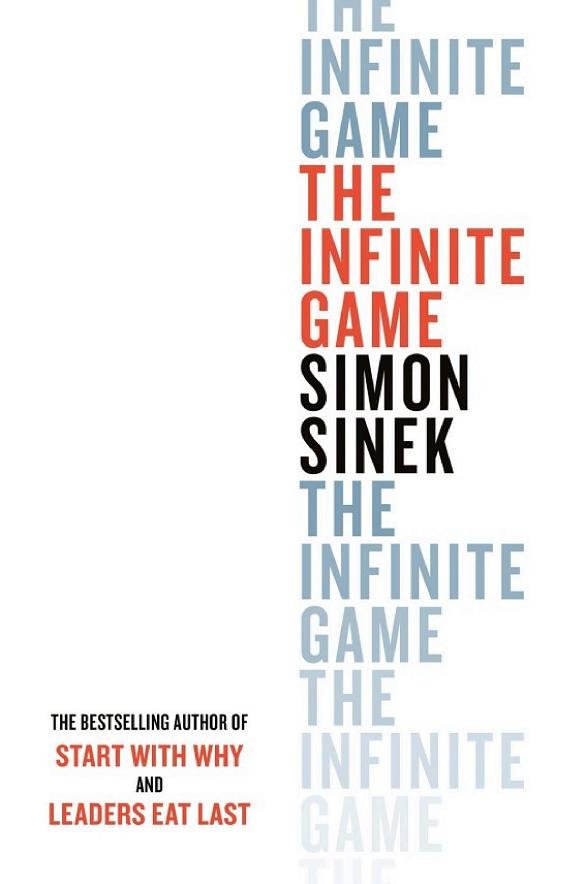
The Infinite Game
1. The Infinite Game by Simon Sinek
Simon Sinek has built a career on making leadership ideas feel accessible without dumbing them down, and this book is one of his more interesting efforts. Drawing on the philosopher James Carse’s distinction between finite and infinite games, Sinek argues that most of our institutions, companies, and even governments are playing the wrong game entirely. They are chasing wins in a contest that has no final whistle, no scoreboard, and no agreed-upon set of rules.
The central idea is deceptively simple. A finite player wants to beat the competition. An infinite player wants to keep the game going and keep getting better at it. Sinek applies this to business, but the implications stretch into how we think about policy, education, and social progress. The writing is clean and the examples are well chosen, even if you occasionally wish he would linger longer on the harder implications of his own argument.
Where the book earns its place on this list is in how it reframes ambition. Building a better future is not a project with a finish line. It is an ongoing commitment, and Sinek makes a convincing case that treating it like one changes everything about how you make decisions. That is a genuinely useful shift in perspective, particularly for anyone in a position of leadership or institutional influence.
This book is not for readers who want detailed policy prescriptions or data-heavy analysis. It is a conceptual book, and it wears that openly. If you find motivational frameworks frustrating, you may want to start elsewhere on this list.
The goal is not to win. The goal is to still be playing, and to be playing better, long after your competitors have forgotten why they started.
This is perfect for managers, founders, and anyone who feels like they are grinding toward a goal that keeps moving, and wants a framework for thinking about long-term purpose instead of short-term wins.
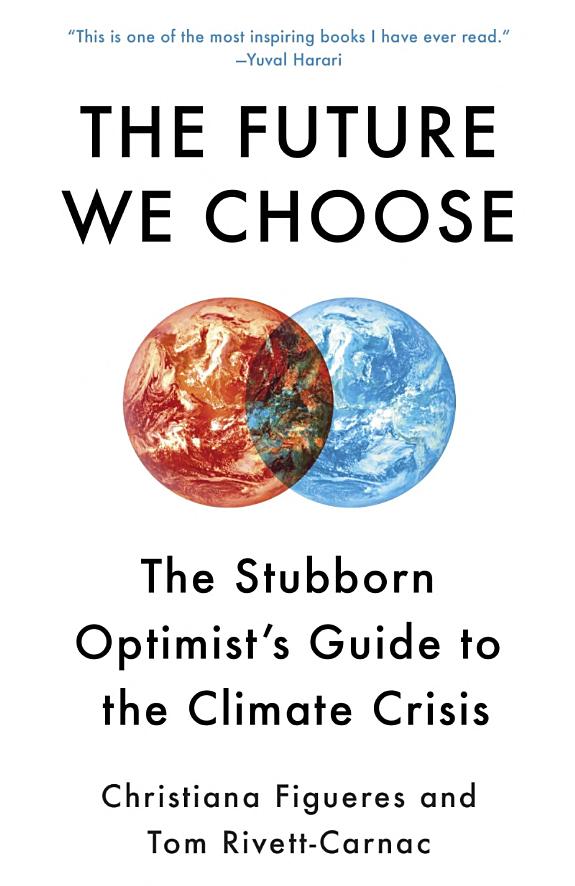
The Future We Choose: Surviving the Climate Crisis
2. The Future We Choose: Surviving the Climate Crisis by Christiana Figueres and Tom Rivett-Carnac
Christiana Figueres was one of the chief architects of the Paris Agreement, which means she has sat in rooms where the future of the planet was being negotiated in real time. That background gives this book a weight that most climate writing simply does not have. She and Tom Rivett-Carnac are not theorizing from the outside. They have seen how change actually happens at the highest levels, and that experience shapes every page.
The book opens with two scenarios. In the first, we fail to act and the authors describe, in unflinching terms, what 2050 looks like. In the second, we succeed, and the picture is genuinely worth reading. The contrast is not meant to terrify or to comfort. It is meant to make the stakes feel real and the choices feel concrete. It works rather well, which is not something you can say about every piece of climate communication.
The second half of the book is where Figueres and Rivett-Carnac make their most distinctive contribution. They argue that the inner work, the shift in mindset and emotional orientation toward the crisis, is not soft or secondary. It is foundational. Stubbornness, optimism, and collaboration are treated not as personality traits but as deliberate practices. That framing will resonate with some readers and puzzle others, but it is at least a different angle than most books in this space.
If you are looking for a technical deep-dive into carbon capture or renewable energy systems, this is not that book. It is more concerned with how people think and feel about the crisis than with the engineering details of solving it.
We are the last generation that can prevent the worst, and the first generation that will live with the consequences of not doing so. That is not a burden. It is a mandate.
This is perfect for readers who already accept the reality of climate change and want a book that helps them figure out how to act with intention rather than despair, especially those in advocacy, policy, or education.
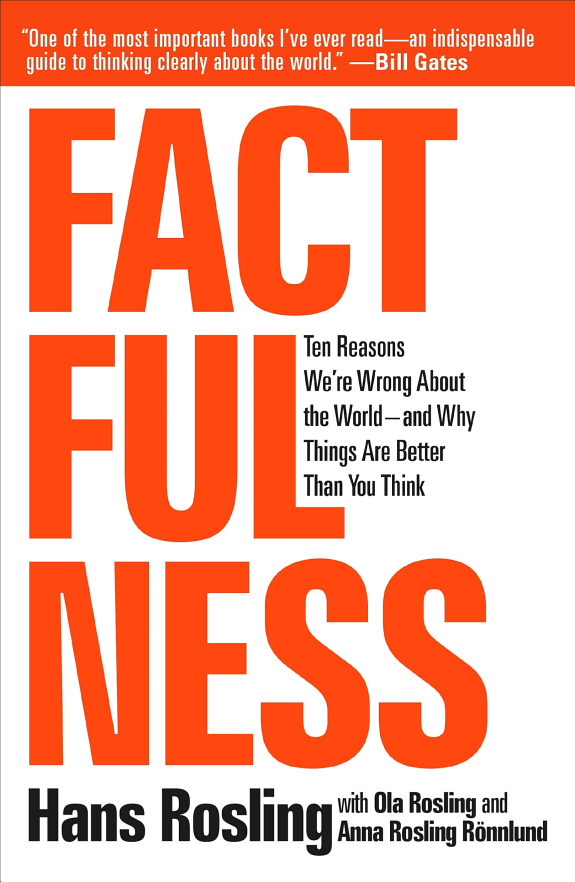
Factfulness: Ten Reasons We’re Wrong About the World – and Why Things Are Better Than You Think
3. Factfulness: Ten Reasons We’re Wrong About the World and Why Things Are Better Than You Think by Hans Rosling
Hans Rosling spent decades watching audiences fail basic questions about global health, poverty, and child mortality, not because people were uninformed, but because their mental models were badly out of date. Factfulness is his attempt to fix that, and it is one of the more quietly subversive books on this list. It does not argue that everything is fine. It argues that our picture of the world is so distorted that we cannot even begin to solve problems we do not accurately understand.
Rosling identifies ten instincts that lead us astray, things like the gap instinct that makes us see the world as divided into two groups when the reality is a spectrum, or the negativity instinct that causes us to overweight bad news and underweight gradual improvement. Each chapter is grounded in data, but the data is presented with the kind of warmth and wit that Rosling was famous for in his TED talks. He is a rare thing: a statistician who is genuinely fun to read. That said, he finished the manuscript while terminally ill, and his son and daughter completed it after his death in 2017, which gives the book a quietly moving quality alongside its intellectual rigor.
The reason this book belongs in a conversation about building a better future is that it makes a compelling case for calibrated optimism. Not naive optimism, not the kind that ignores suffering, but the kind that is grounded in actual trends and actual numbers. If you want to work toward a better world, Rosling argues, you have to see the current world clearly first. That seems obvious, but the book demonstrates repeatedly that most of us are not doing it.
Readers who find quantitative arguments dry or who are already deeply familiar with development economics may find some sections cover familiar ground. And if you are hoping for a book that validates a purely pessimistic worldview, Rosling will frustrate you at almost every turn, which is rather the point.
The world cannot be understood without numbers. But the world cannot be understood with numbers alone. You have to love the people behind the data to make sense of what they mean.
This is perfect for journalists, educators, policy wonks, and anyone who wants to argue more effectively about global progress because they have replaced gut feeling with something closer to actual evidence.
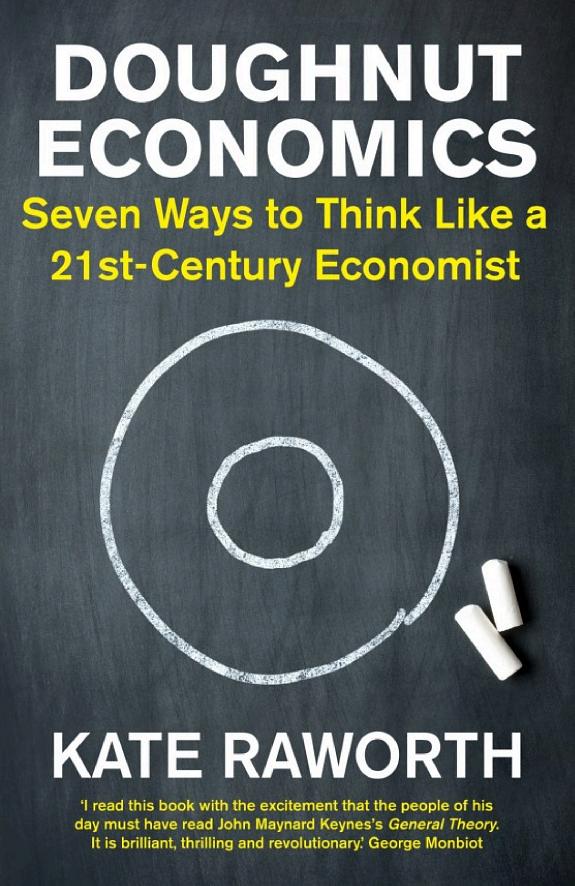
Doughnut Economics: Seven Ways to Think Like a 21st-Century Economist
4. Doughnut Economics: Seven Ways to Think Like a 21st-Century Economist by Kate Raworth
Kate Raworth has a talent for making you realize how strange it is that we have been measuring human progress with a single number, GDP, that was never designed to measure human wellbeing at all. Doughnut Economics is a patient, well-argued case for replacing that framework with something that actually accounts for both human needs and planetary limits. The doughnut in question is a visual model with a social foundation on the inside and an ecological ceiling on the outside, and the goal is to keep humanity thriving in the space between them.
The seven ways of thinking that structure the book are each a direct challenge to a piece of standard economic orthodoxy. Raworth takes on the rational economic actor, the obsession with growth, the idea that markets naturally find equilibrium, and several other assumptions that have been baked into mainstream economics for so long that most people treat them as laws of nature rather than choices. She is not dismissive of economics as a discipline. She clearly loves it. But she is relentless about distinguishing between what the evidence supports and what has simply become conventional wisdom through repetition.
The writing is accessible without being simplistic, which is a genuine achievement given the material. Raworth draws on complexity theory, feminist economics, ecological science, and behavioral research, and she weaves them together without making the reader feel like they are sitting through a graduate seminar. There is also a welcome willingness to sit with uncertainty. She does not have all the answers, and she says so plainly, which makes the book feel more trustworthy, not less.
This is not a book for readers who want a step-by-step policy blueprint. It is a book about how to think differently, and if you are not in the mood for that kind of foundational rethinking, it may feel abstract. It also assumes a reader who is at least open to questioning free-market orthodoxy, so committed libertarians may spend most of the book writing notes in the margins.
Today’s economy is divisive and degenerative by default. It can become distributive and regenerative by design. But only if we are willing to change the picture in our heads.
This is perfect for students of economics, urban planners, sustainability professionals, and curious generalists who want a coherent alternative framework for thinking about how societies can meet human needs without destroying the systems they depend on.
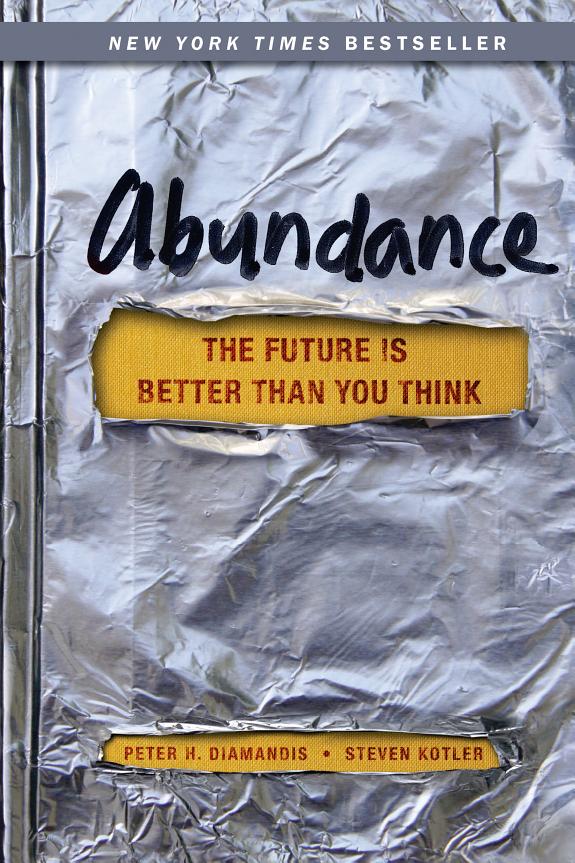
Abundance: The Future Is Better Than You Think
5. Abundance: The Future Is Better Than You Think by Peter H. Diamandis and Steven Kotler
Peter Diamandis is the founder of the XPRIZE and a figure who has spent his career betting on technological solutions to large problems. Abundance is his extended argument that the exponential growth of technology, combined with the rising influence of small groups and individuals, is creating genuine conditions for solving humanity’s greatest challenges within a generation or two. It is an optimistic book, sometimes bracingly so, and it will not suit every reader’s temperament.
The book covers a lot of ground, from water and food security to education and health, and in each domain Diamandis and Kotler make the case that the tools either exist or are close enough to see. The writing is energetic and the examples are well researched, even if the overall tone occasionally tips into the kind of Silicon Valley enthusiasm that can feel slightly disconnected from the messiness of actual implementation. The authors are aware of this critique, to their credit, and they spend some time engaging with it, though perhaps not as much as skeptics would like.
What makes this book valuable alongside the others on this list is that it provides a counterweight to the doom that can creep into even the most constructive writing about the future. Rosling makes a similar argument from a data perspective, but Diamandis and Kotler are more interested in the specific mechanisms, the technologies, the innovators, and the incentive structures that are actively pushing toward better outcomes. Read in conversation with a book like Doughnut Economics, it becomes a more interesting object than it might be on its own.
If you are skeptical of techno-optimism or feel that systemic and political change matters more than innovation, this book will test your patience in places. The authors have genuine faith in entrepreneurship and technology as primary drivers of progress, and they do not spend much time on the structural inequalities that can prevent good technology from reaching the people who need it most.
For most of human history, the future has been a place of scarcity. What changes everything is the recognition that it does not have to be.
This is perfect for entrepreneurs, engineers, and optimists who want a detailed, evidence-backed case for why the next few decades could see real progress on the problems that feel most intractable, and who are energized rather than put off by big-picture thinking.
None of these books will hand you a complete blueprint for a better world, and any that claimed to would be lying. What they offer instead is something more durable: better questions, sharper frameworks, and a more honest picture of where we actually are and what is genuinely possible. That is a reasonable place to start.
If you are not sure where to begin, Factfulness is probably the most universally accessible entry point, and it has the useful quality of making almost every other book on the list easier to read with clear eyes. From there, the order matters less than simply picking something up and staying with it. The future gets built one well-considered decision at a time, and books like these are part of how those decisions get made.