

6 Books for Couples Who Keep Having the Same Arguments
Every couple has that one argument. The one that starts about dishes or scheduling or money and somehow ends up in the same place it always does, with the same feelings, the same frustration, and the same exhausted silence afterward. If you have ever looked at your partner mid-disagreement and thought, “we have had this exact conversation before,” you are not alone, and you are not doomed.
The books on this list were written by therapists, researchers, and clinicians who have spent careers studying what actually happens between two people when things get hard. They are not about fixing a broken relationship so much as understanding why the same patterns keep showing up, and what to do differently. Some are research-heavy, some are deeply emotional, and a couple will probably make you feel uncomfortably seen. All of them are worth your time.
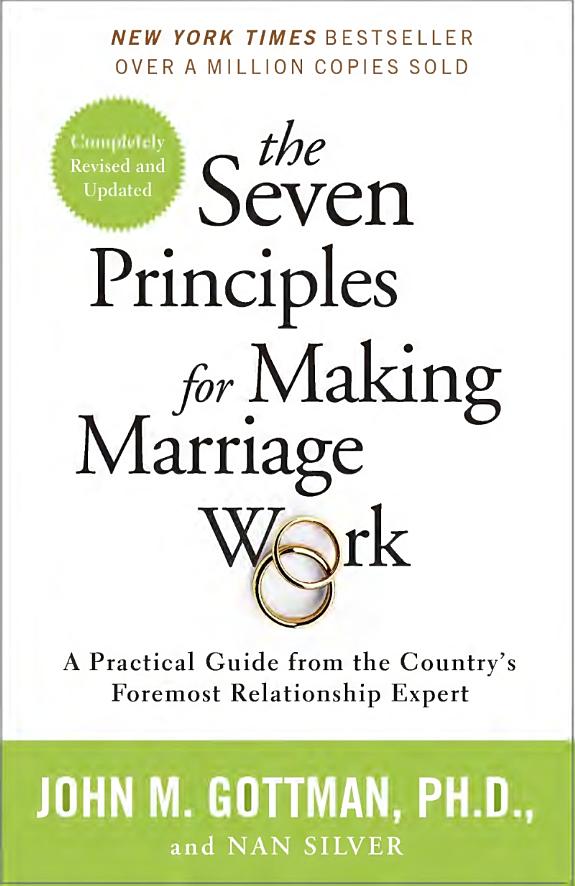
The Seven Principles for Making Marriage Work
1. The Seven Principles for Making Marriage Work by John M. Gottman and Nan Silver
John Gottman spent decades in a research lab watching couples interact, and what he found was both sobering and oddly reassuring. He could predict divorce with startling accuracy just by observing how partners talked to each other during conflict. But the flip side of that research is this: the patterns that predict failure are learnable, and so are the ones that predict success. This book is the distillation of all of that work, written in plain language and structured around seven concrete principles that stable, happy couples tend to practice.
Gottman’s voice, co-written with Nan Silver, is warm but grounded in evidence. He does not traffic in vague advice. The chapters are specific, the exercises are practical, and the explanations of concepts like “flooding” and “contempt” will probably make you pause and think about your last argument in a new way. Contempt, he argues, is the single greatest predictor of relationship breakdown. That is not a comfortable thing to read, but it is useful.
The book does lean heavily on heterosexual married couples in its examples, which can feel a little dated depending on who you are. And if you are someone who bristles at any hint of self-help structure, the worksheets and quizzes scattered throughout might test your patience. But for most readers, those tools are genuinely helpful rather than performative.
“Gottman does not promise that conflict will disappear. He promises that you can learn to fight in ways that do not slowly erode the foundation underneath you.”
This is perfect for couples who want research-backed guidance, appreciate structured exercises, and are ready to look honestly at the patterns they have been repeating for years.
Getting the Love You Want: A Guide for Couples
2. Getting the Love You Want: A Guide for Couples by Harville Hendrix
Harville Hendrix opens with a premise that is a little unsettling and a lot clarifying: we tend to fall in love with people who recreate the emotional dynamics of our childhoods. Not because we are masochists, but because the unconscious mind is drawn toward familiar territory, even when that territory is painful, because it holds out the hope that this time, things might go differently. If you have ever wondered why you keep having the same argument with your partner that you once had with a parent, this book starts to answer that question.
The therapeutic framework here is called Imago Relationship Therapy, and Hendrix developed it over many years of clinical practice. The writing is accessible without being dumbed down, and the exercises, particularly the structured dialogue exercises, have become genuinely well-regarded in couples therapy circles. The idea of intentional, mirrored conversation sounds a little clinical on paper, but in practice, many couples find it quietly revelatory.
This book asks a lot of you emotionally. It wants you to look at your childhood wounds, your unmet needs, and the ways you have unconsciously assigned your partner the role of emotional healer. That is meaningful work, but it is also heavy, and readers who are not ready to go there may find it overwhelming rather than helpful. It is also worth noting that the book has a distinctly spiritual undertone in places, which resonates with some readers and feels out of place to others.
“The argument you keep having with your partner may have very little to do with your partner, and everything to do with something much older. Hendrix makes that case gently but persistently.”
This is perfect for couples who sense that their recurring conflicts are rooted in something deeper than the surface issue, and who are open to doing some honest personal reflection alongside their partner.
Hold Me Tight: Seven Conversations for a Lifetime of Love
3. Hold Me Tight: Seven Conversations for a Lifetime of Love by Dr. Sue Johnson
Sue Johnson is the developer of Emotionally Focused Therapy, which is one of the most well-researched approaches to couples counseling in existence. At the center of her work is attachment theory, the idea that human beings are wired for emotional connection, and that when that connection feels threatened, we panic in very predictable ways. Some of us pursue and demand and push. Others withdraw and shut down. And then we blame each other for the dynamic, when really we are both just frightened.
“Hold Me Tight” is built around seven conversations that Johnson believes are essential for couples to have, not arguments, but genuine emotional conversations that get underneath the surface of conflict. Her writing is compassionate and clear, and the case studies she uses throughout the book are drawn from real therapy sessions, which makes the concepts feel grounded rather than theoretical. You will likely recognize yourself and your partner in these pages, possibly more than once, possibly with a small sinking feeling that quickly turns into relief.
This is not a quick fix book, and Johnson does not pretend otherwise. The conversations she describes take real vulnerability, and some couples may find that the material surfaces emotions they were not prepared to deal with on their own. If your relationship is in serious distress, this book pairs well with actual therapy rather than replacing it. It is also more emotionally oriented than practically oriented, so readers looking for step-by-step communication scripts may want to pair it with something more tactical.
“Johnson reframes the same old argument not as a character flaw in either partner, but as two people reaching for each other in ways the other person cannot quite recognize.”
This is perfect for couples who feel emotionally disconnected, who fight in cycles they cannot seem to break, and who are willing to be genuinely vulnerable with each other in order to get somewhere new.
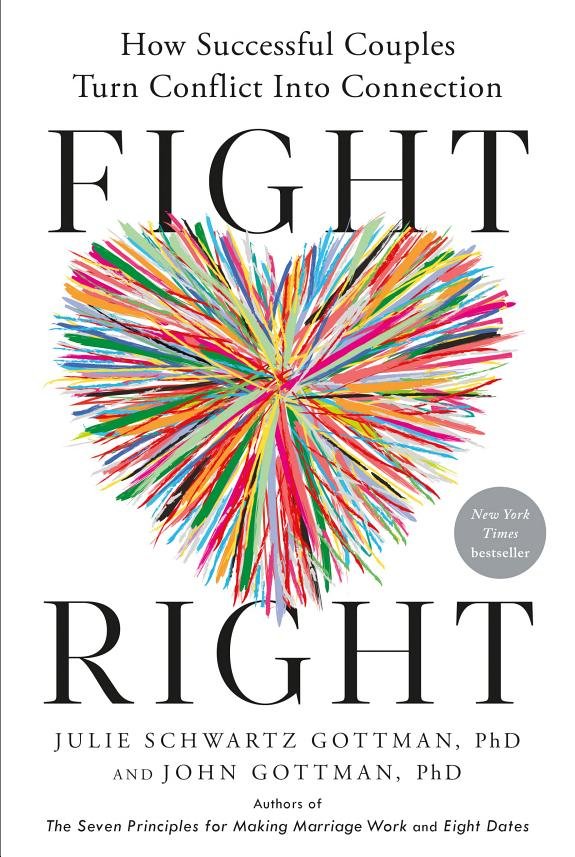
Fight Right: How Successful Couples Turn Conflict Into Connection
4. Fight Right: How Successful Couples Turn Conflict Into Connection by Julie Schwartz Gottman and John Gottman
The Gottmans are back, this time as co-authors, and this book feels like a more direct, modern companion to John’s earlier work. Where “The Seven Principles” is broad and foundational, “Fight Right” zeroes in on conflict itself, specifically on the moment-to-moment mechanics of what happens when couples argue and what the most functional couples do differently. The central argument is that conflict is not the problem. How you fight is.
Julie Schwartz Gottman brings her own clinical perspective to the collaboration, and the book benefits from that dual authorship. It reads like two thoughtful people who have both spent decades in this work and actually talk to each other about it, which, given that they are married, is presumably accurate. The tone is direct without being harsh, and the book does a good job of categorizing different types of conflict and explaining which ones are genuinely solvable and which ones are what the Gottmans call “perpetual problems,” meaning they will never fully go away but can be managed with enough mutual understanding.
If you are someone who already has a solid grounding in relationship psychology, some of this material will feel familiar. The Gottman framework appears across several of their books, and readers who have already worked through “The Seven Principles” may find some overlap here. That said, the conflict-specific focus makes this a useful standalone read, and the practical guidance on de-escalation is among the most concrete available in this genre.
“The Gottmans are not interested in helping you avoid conflict. They are interested in helping you use it, which turns out to be a completely different and considerably more useful goal.”
This is perfect for couples who have already done some relationship reading and want a focused, practical guide to the actual mechanics of arguing better rather than avoiding arguments altogether.
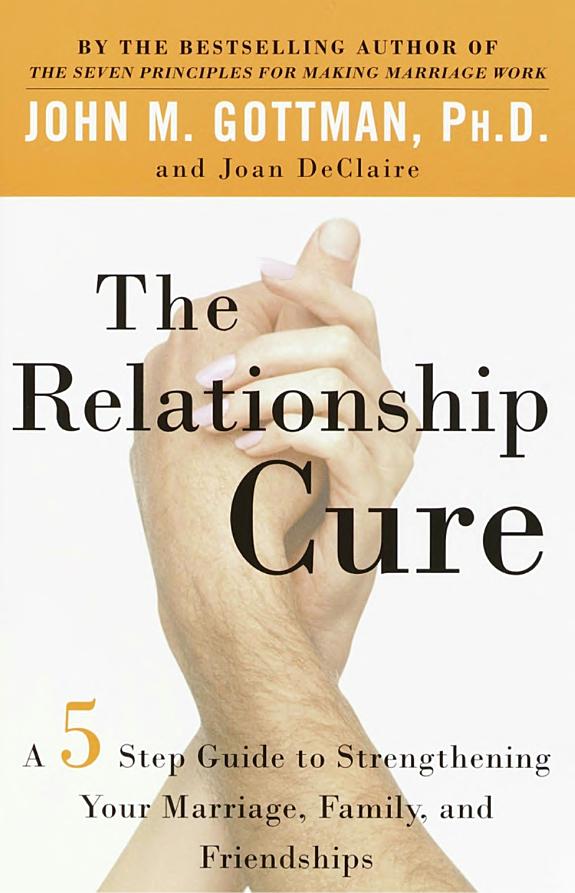
The Relationship Cure: A 5 Step Guide to Strengthening Your Marriage, Family, and Friendships
5. The Relationship Cure: A 5 Step Guide to Strengthening Your Marriage, Family, and Friendships by John M. Gottman
This one is a little different from Gottman’s other couples-focused work, and that difference is worth noting upfront. “The Relationship Cure” is not exclusively about romantic partnerships. It applies the same research-backed thinking to marriages, yes, but also to friendships, family dynamics, and workplace relationships. The central concept here is what Gottman calls “bids for connection,” the small, often invisible moments when one person reaches out for emotional engagement and the other either turns toward them, turns away, or turns against them.
Once you understand the bid framework, you will start seeing it everywhere. The partner who mentions something interesting they read and gets a distracted “mm-hmm” in response. The spouse who makes a joke during a tense moment and gets met with silence. These are not small things, Gottman argues. They accumulate. And the patterns that form around how couples respond to each other’s bids go a long way toward explaining why some relationships feel warm and connected even during conflict, and others feel cold and distant even during calm.
Because the book casts a wider net than romantic relationships, it occasionally feels less focused than Gottman’s other work. Readers who came specifically for couples content may find the chapters on workplace relationships a bit of a detour. But the core concept is so genuinely useful, and so applicable to the recurring arguments most couples have, that it more than earns its place on this list. Understanding bids for connection can quietly shift how you interpret your partner’s behavior, which turns out to matter quite a lot.
“Most recurring arguments are not really about the topic at hand. They are about whether or not each person feels seen and responded to. Gottman gives that idea a structure you can actually work with.”
This is perfect for couples who want to understand the small, everyday moments that either build or erode connection, and who are curious about how the same principles show up across all their relationships, not just their romantic one.
Wired for Love: How Understanding Your Partner’s Brain and Attachment Style Can Help You Defuse Conflict and Build a Secure Relationship
6. Wired for Love: How Understanding Your Partner’s Brain and Attachment Style Can Help You Defuse Conflict and Build a Secure Relationship by Stan Tatkin
Stan Tatkin brings a neuroscience lens to the attachment conversation, and the result is a book that feels both scientifically grounded and surprisingly tender. The premise is that your nervous system, shaped by your earliest experiences of being cared for or not cared for, runs a lot of the show during conflict. Your partner is not just being difficult. Their brain is doing something very specific and very automatic, and so is yours, and understanding that can change the entire texture of a disagreement.
Tatkin introduces a memorable framework of “anchors,” “islands,” and “waves” to describe different attachment styles and how they interact in relationships. Anchors are securely attached and tend to be stabilizing. Islands are avoidant and often withdraw under stress. Waves are anxious and tend to pursue. When an island and a wave get into a fight, you can practically predict the script before it starts. Naming the dynamic does not make it disappear, but it makes it considerably less personal, which turns out to be a significant relief.
The neuroscience explanations are accessible rather than academic, which will please most readers and may frustrate those who want more depth on the science itself. The book also leans toward the idea that becoming a “secure-functioning couple” is the goal, which is a framework Tatkin returns to repeatedly. Some readers find that repetition reassuring. Others find it a bit circular. It is also worth saying that this book is most useful when both partners read it, or at least discuss it together, because the framework only fully makes sense in the context of two specific people and how their styles interact.
“Tatkin makes a compelling case that your partner’s worst moments in conflict are not a reflection of who they are, but of what their nervous system learned to do a very long time ago. That reframe alone is worth the read.”
This is perfect for couples who are curious about the science behind their patterns, who have tried communication strategies before without lasting success, and who want to understand what is actually happening in their bodies and brains during conflict.
None of these books will end conflict in your relationship. That is not actually the goal, and any book that promises otherwise is selling something you should not buy. What these authors are offering is something more honest and more durable: a way to understand why you keep landing in the same place, and enough new language and perspective to start landing somewhere different.
Some couples will read one of these books and feel like it was written specifically for them. Others will work through two or three before something really clicks. That is fine. Reading about your relationship together, even just talking about what a chapter brought up, is itself a form of the connection these books are pointing toward. Start wherever feels right, and go from there.