7 Books That Sharpen Your Decision-Making
Every day you make hundreds of decisions. What to eat, what to prioritize, whether to trust your gut or slow down and think. Most of them happen so fast you barely notice. A few of them keep you up at night. And occasionally, you look back at a choice you made and wonder what on earth you were thinking.
The good news is that decision-making is a skill, not a fixed trait. It can be studied, practiced, and genuinely improved. The books on this list approach that challenge from different angles, some through behavioral science, some through probability, some through the quieter art of knowing what actually matters to you. None of them promise to make you a perfect decision-maker. They do promise to make you a more honest one. That turns out to be more useful anyway.
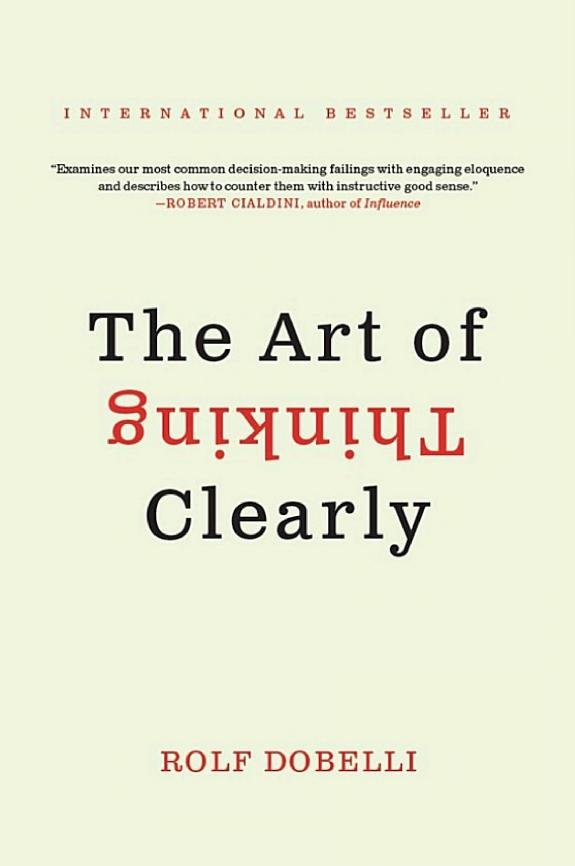
The Art of Thinking Clearly
1. The Art of Thinking Clearly by Rolf Dobelli
Rolf Dobelli is a Swiss author and entrepreneur who spent years cataloguing the ways human thinking goes wrong. The result is a book structured around 99 cognitive errors, from survivorship bias to the sunk cost fallacy, each given its own short chapter. The writing is crisp and direct, almost clinical, which suits the subject perfectly. Dobelli does not waste your time with lengthy storytelling. He names the bias, explains it with a tight example, and moves on.
What makes this book genuinely useful is its breadth. Most books on cognitive bias focus on a handful of the classics. Dobelli casts a much wider net. By the time you finish, you have a working vocabulary for dozens of mental traps, and that vocabulary alone changes how you observe your own thinking. You start catching yourself mid-rationalization, which is uncomfortable and also extremely helpful.
The format does have a trade-off. Because each chapter is so short, the book can feel more like a reference guide than a sustained argument. If you prefer a narrative that builds from chapter to chapter, this one may feel choppy. It is better read slowly, a few entries at a time, than consumed in long sittings.
“You are not the rational agent you think you are. The first step to thinking more clearly is accepting that with some humility.”
This is perfect for readers who want a broad, accessible survey of cognitive biases without wading through academic psychology, and for anyone who enjoys the satisfaction of finally having a name for something they have always done wrong.
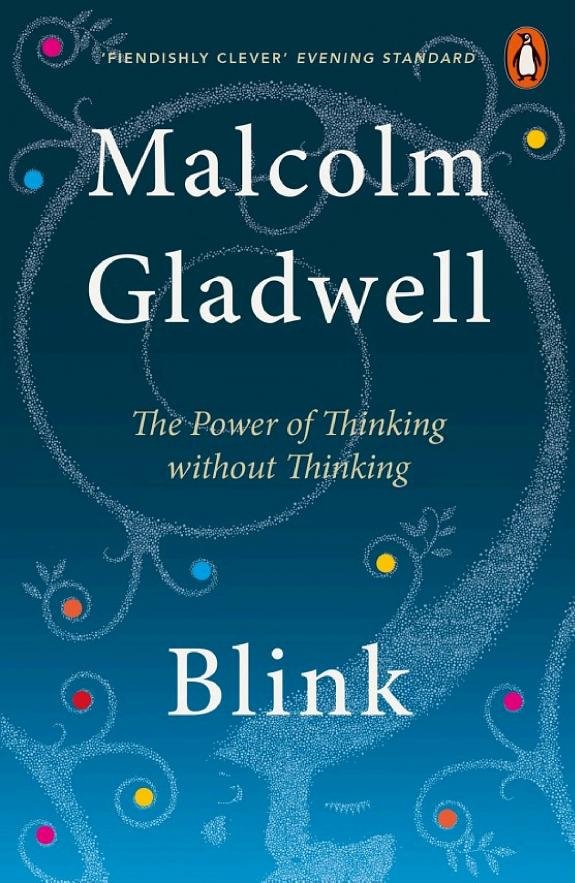
Blink: The Power of Thinking Without Thinking
2. Blink: The Power of Thinking Without Thinking by Malcolm Gladwell
Malcolm Gladwell has a gift for making research feel like a story, and Blink is one of his most entertaining exercises in that skill. The central idea is that rapid, unconscious judgments, the kind made in the first two seconds of encountering something, can be surprisingly accurate. He calls this “thin-slicing,” the ability of the unconscious mind to find patterns in very thin slices of experience. The book moves through art forgery, speed dating, military simulations, and tennis coaching with the kind of restless curiosity that makes Gladwell so readable.
Where the book earns its place on a decision-making shelf is in its nuanced treatment of when to trust those quick judgments and when they betray you. Gladwell does not simply celebrate intuition. He also examines how snap judgments go badly wrong, particularly when they are contaminated by prejudice or stress. The chapter on the tragic police shooting of Amadou Diallo is sobering and careful, a reminder that fast thinking carries real moral weight.
Critics, and there are legitimate ones, point out that Gladwell leans heavily on anecdote and that some of the research he cites has not held up well under replication. If you are looking for a rigorous scientific framework, this is not quite it. Think of it instead as a set of vivid entry points into questions about intuition and expertise that are worth taking seriously.
“The best decision-makers are not those who process the most information, but those who have learned to read the right information quickly.”
This is perfect for readers who are new to the psychology of decision-making and want an engaging, story-driven introduction, or for anyone curious about the relationship between expertise and instinct.
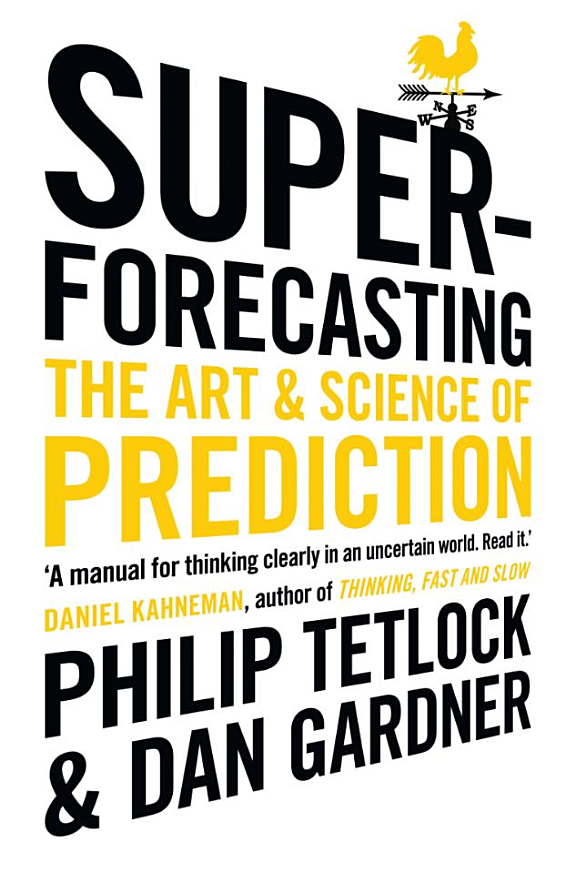
Superforecasting: The Art and Science of Prediction
3. Superforecasting: The Art and Science of Prediction by Philip E. Tetlock and Dan Gardner
Philip Tetlock spent decades studying political experts and found, famously, that most of them were barely better than chance at predicting future events. That finding could have been purely deflating. Instead, it led him to a more interesting question: are there people who actually are good at forecasting, and if so, what makes them different? Superforecasting answers that question with rigor and genuine enthusiasm. Tetlock, along with co-author Dan Gardner, draws on data from the Good Judgment Project, a large-scale forecasting tournament, to identify the habits of mind that separate the best predictors from the rest.
The portrait of a superforecaster that emerges is specific and a little surprising. They are not necessarily the most credentialed people in the room. They tend to be intellectually curious, comfortable with uncertainty, willing to update their beliefs when new evidence arrives, and obsessive about calibration, meaning they care deeply about whether their confidence levels actually match their accuracy rates. That last quality is rarer than it sounds.
The book is dense in the best way. It rewards careful reading. Tetlock does not condescend to his audience, and the statistical concepts are explained clearly without being dumbed down. If you find probability and prediction genuinely interesting, this book will hold your attention all the way through. If you are looking for quick tips you can apply by Tuesday, you may find the pace a little slow.
“The most accurate forecasters treat their beliefs as hypotheses to be tested, not positions to be defended.”
This is perfect for analytically minded readers who want to genuinely improve their ability to reason about uncertain futures, and for anyone who has ever wondered why confident experts are so often wrong.
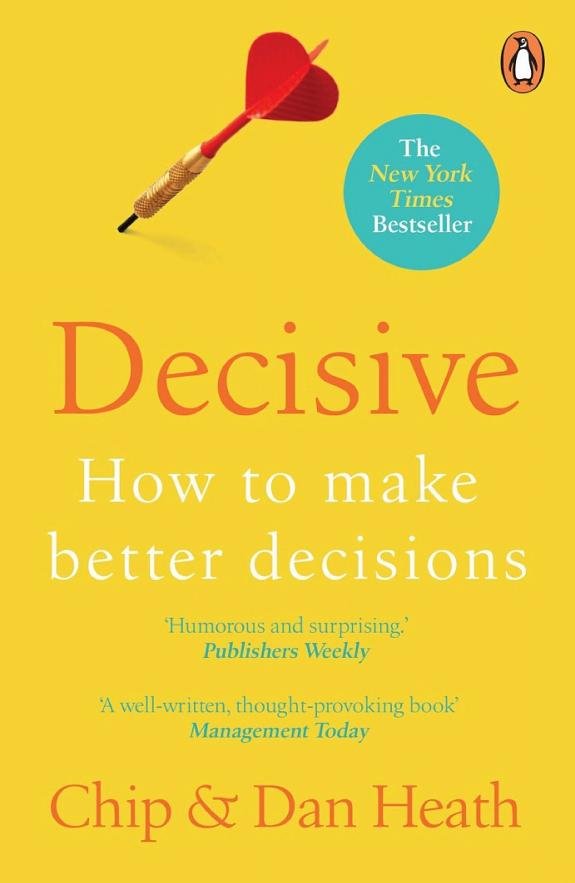
Decisive: How to Make Better Choices in Life and Work
4. Decisive: How to Make Better Choices in Life and Work by Chip Heath and Dan Heath
Chip and Dan Heath have a talent for organizing ideas into frameworks that actually stick, and Decisive is one of their more practical efforts. The book is built around what they call the WRAP process, a four-step approach to counteracting the most common decision-making pitfalls. The steps involve widening your options, reality-testing your assumptions, attaining distance before deciding, and preparing to be wrong. It sounds tidy on paper, and to their credit, the Heaths fill each step with enough real-world examples that it does not feel like an airport poster.
The chapter on “attaining distance” is particularly worth your time. The Heaths introduce the concept of the “10/10/10” test, asking how you will feel about a decision ten minutes, ten months, and ten years from now. It is a simple reframe, but it does something useful: it pulls you out of the emotional urgency of the present moment and gives you a slightly wider view. Small interventions like that are what this book does best.
Readers who have already spent time with behavioral economics literature may find some of the ground familiar. The Heaths are synthesizers more than original researchers, and the book draws heavily on work that Kahneman, Thaler, and others have covered in greater depth. That said, the Heath brothers write with warmth and clarity, and for readers coming to these ideas fresh, Decisive is an excellent starting point.
“Most bad decisions are not the result of bad information. They are the result of a process that never considered the right questions.”
This is perfect for readers who want actionable frameworks they can apply to real decisions at work or at home, and for managers or team leaders who want to improve how their groups make choices together.
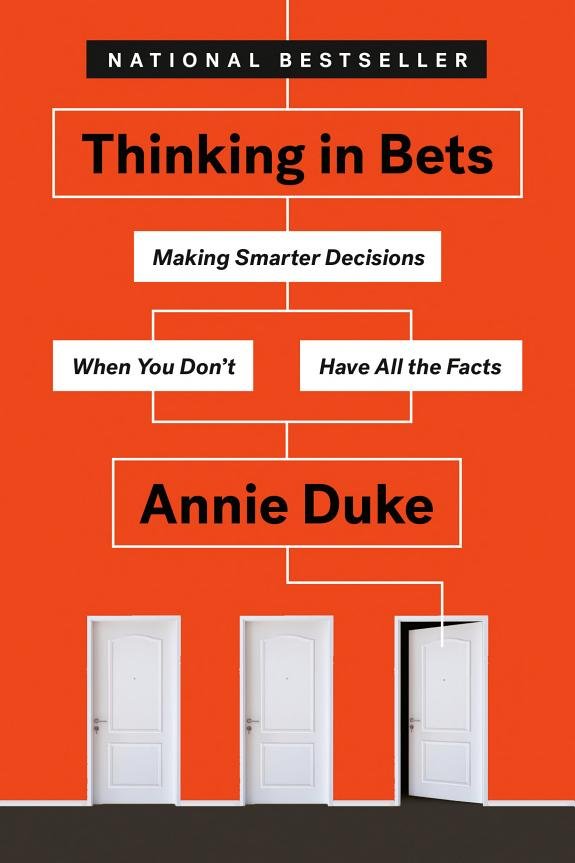
Thinking in Bets: Making Smarter Decisions When You Don’t Have All the Facts
5. Thinking in Bets: Making Smarter Decisions When You Don’t Have All the Facts by Annie Duke
Annie Duke was a professional poker player before she became a decision-making consultant, and that background gives this book a perspective you do not often find in the genre. The central argument is that we habitually confuse the quality of a decision with the quality of its outcome, and that this confusion, which Duke calls “resulting,” is one of the most persistent obstacles to clear thinking. A good decision can lead to a bad outcome. A bad decision can get lucky. Judging your choices by what happened rather than by the reasoning behind them will lead you astray every time.
The poker frame works surprisingly well throughout the book. Duke uses it to illustrate concepts like expected value, uncertainty, and the role of luck without making the whole thing feel like a gambling manual. She is also honest about the emotional difficulty of the ideas she is describing. Admitting you made a good decision that turned out badly, or a bad decision that happened to work out, requires a level of intellectual honesty that most people find genuinely uncomfortable. Duke does not pretend otherwise.
The book does occasionally repeat its core ideas more than necessary, and some readers may wish Duke had pushed further into the more complex territory she opens up. But as an introduction to probabilistic thinking applied to everyday life, it is clear, engaging, and refreshingly free of the self-help smugness that sometimes creeps into this genre. You might even forgive the poker metaphors after a while. Almost.
“Resulting is the enemy of good thinking. The outcome tells you what happened. It does not tell you whether you made the right call.”
This is perfect for readers who want to develop a more probabilistic mindset and for anyone who has ever beaten themselves up over a decision that, in hindsight, was actually quite reasonable given what they knew at the time.
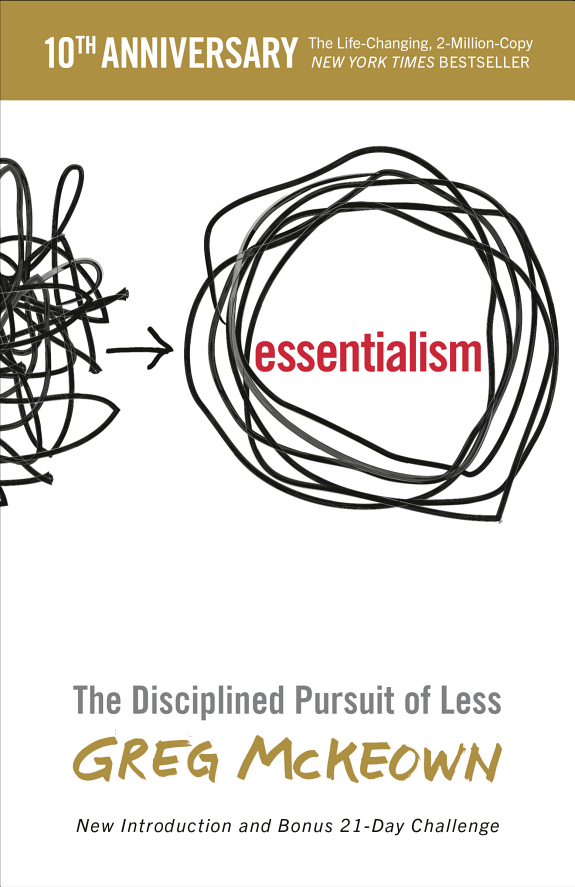
Essentialism: The Disciplined Pursuit of Less
6. Essentialism: The Disciplined Pursuit of Less by Greg McKeown
Greg McKeown is not primarily writing about decision-making in the narrow sense. He is writing about the prior question: how do you figure out what is worth deciding about in the first place? The core argument of Essentialism is that most of us are living by default, saying yes to too many things, spreading our attention too thin, and mistaking busyness for progress. The essentialist approach involves ruthlessly identifying what actually matters and protecting your time and energy for that, and almost nothing else.
What connects this to decision-making is the insight that decision fatigue is real. Every choice you make draws on a limited pool of cognitive and emotional resources. If you are spending that resource on trivial commitments, you have less left for the choices that actually shape your life. McKeown’s prescription is less about any single decision and more about designing a life in which fewer decisions need to be made because you have already established clear priorities.
The book is written with genuine conviction, which is part of its appeal and occasionally part of its limitation. McKeown can sound almost evangelical about the essentialist path, and readers who are not in a position to radically simplify their professional lives may find some of the advice difficult to translate into practice. The ideas are sound, but the examples tend to skew toward executives and entrepreneurs with a fair amount of structural freedom. If you are working three jobs, the advice to “say no more often” may land differently.
“If you don’t prioritize your life, someone else will.”
This is perfect for readers who feel chronically overcommitted and overwhelmed, and for anyone who suspects that the volume of their decisions is itself a problem worth solving.
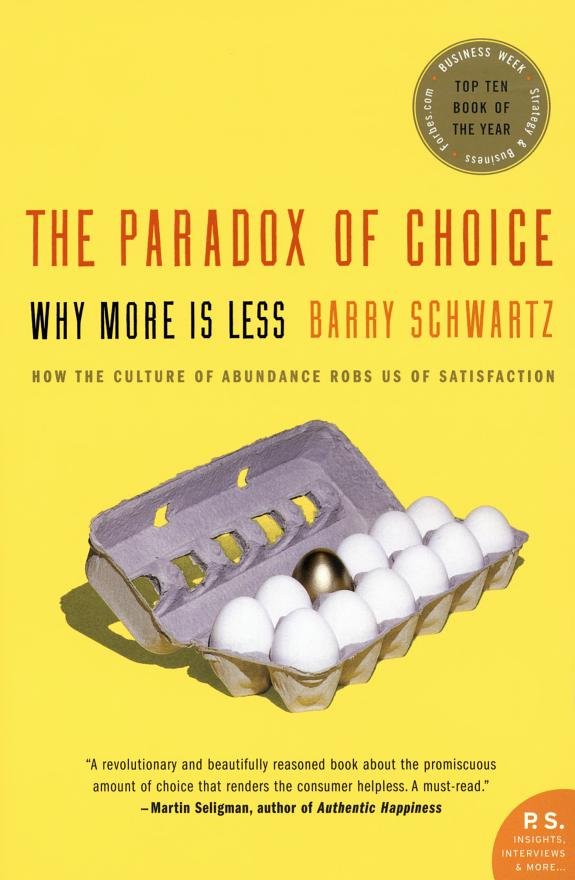
The Paradox of Choice: Why More Is Less
7. The Paradox of Choice: Why More Is Less by Barry Schwartz
Barry Schwartz opens with a trip to the jeans store, where a simple errand to buy pants turns into an exhausting confrontation with dozens of cuts, rises, and fits. It is a mundane example, but Schwartz uses it to introduce an argument that has real depth: the expansion of choice, which we tend to assume is always a good thing, can actually make us less satisfied, less decisive, and more prone to regret. More options means more opportunity cost. More opportunity cost means more second-guessing. More second-guessing means less enjoyment of whatever you actually chose.
The book draws on a substantial body of psychological research, including the famous jam study by Sheena Iyengar, which found that shoppers were more likely to buy when presented with six jam options than with twenty-four. Schwartz extends this finding into domains ranging from career choices to medical decisions, arguing that the burden of unlimited choice is not a trivial inconvenience but a genuine source of anxiety and unhappiness in modern life. He also introduces the useful distinction between “maximizers,” people who need to find the best possible option, and “satisficers,” people who are content with good enough. Maximizers, it turns out, tend to be less happy.
Some critics have argued that Schwartz overstates his case and that the research base has been complicated by replication issues in the years since the book was published. That is a fair point. The jam study, in particular, has proven harder to replicate consistently. Even so, the core intuition that choice overload is a real phenomenon with real costs holds up reasonably well, and the book remains a thoughtful provocation about what we actually want from freedom.
“Learning to accept ‘good enough’ is not settling. It is a form of wisdom that maximizers spend their whole lives trying to avoid and never quite achieving happiness as a result.”
This is perfect for readers who find themselves paralyzed by options or perpetually dissatisfied after making choices, and for anyone interested in the psychology of happiness and what actually drives it.
What strikes you after spending time with all seven of these books is how differently they approach the same underlying problem. Dobelli catalogs the errors. Gladwell celebrates the fast mind while warning you about it. Tetlock asks you to be honest about your track record. The Heaths give you a process. Duke asks you to separate luck from skill. McKeown tells you to simplify before you even get to the decision. And Schwartz reminds you that having more options is not the same as having more freedom.
None of these books will fix your judgment overnight, and none of them claim to. What they offer is something more durable: a set of lenses through which to examine how you think. Read one and you will notice things you did not notice before. Read several and those observations start to build on each other in ways that are quietly useful for a long time. That seems like a reasonable return on a few weeks of reading.