
8 Books for Finding Meaning in Life
At some point, most of us sit with a cup of coffee that has gone cold and wonder what we are actually doing with our lives. Not in a dramatic, crisis-level way, necessarily. Sometimes it is just a quiet Tuesday afternoon and the question arrives uninvited. What is this all for? These moments are not signs that something is wrong with you. They are signs that you are paying attention.
The books on this list approach that question from very different angles. Some come from psychology, some from philosophy, some from spirituality, and at least one from a place of cheerful irreverence. None of them will hand you a neat answer, because a neat answer would be useless anyway. What they will do is give you better tools for sitting with the question, and maybe for moving forward with a little more intention. Whether you are rebuilding after a loss, feeling stuck in a life that looks fine on paper, or just genuinely curious about what a meaningful existence might look like, there is something here for you.
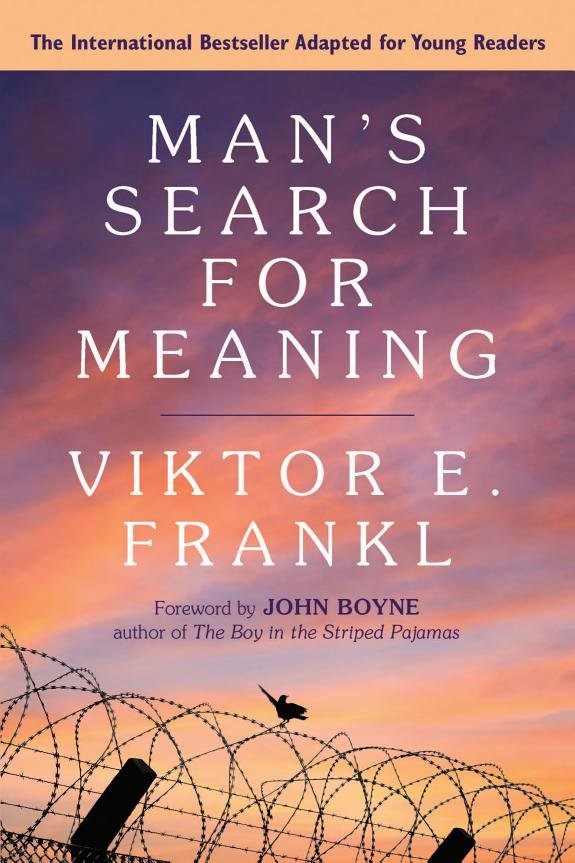
Man’s Search for Meaning
1. Man’s Search for Meaning by Viktor E. Frankl
Viktor Frankl was a psychiatrist and Holocaust survivor, and this book is the account of what he observed about human endurance in the Nazi concentration camps, including Auschwitz. It is not an easy read, but it is a profoundly important one. Frankl noticed that the prisoners who managed to hold on were often not the physically strongest. They were the ones who had found something to live for, a person waiting for them, a work left unfinished, a reason that gave suffering a shape.
From those observations, Frankl developed logotherapy, a form of psychotherapy centered on the idea that the primary human drive is not pleasure or power, but meaning. The second half of the book outlines this framework in clear, accessible terms. It is surprisingly readable for something rooted in clinical psychology, and Frankl’s voice is warm rather than cold or academic. He writes with the authority of someone who tested his own theories in the worst possible laboratory.
The central argument is simple but not simplistic: we cannot always choose our circumstances, but we can choose our response to them. That idea sounds like a motivational poster until Frankl shows you exactly what it looked like in practice, under conditions most of us will never face. After that, it is harder to dismiss.
“When we are no longer able to change a situation, we are challenged to change ourselves.” Frankl’s insight is not about optimism. It is about the stubborn human capacity to find footing even when the ground has been taken away.
This is perfect for anyone rebuilding after grief, trauma, or a period of serious disorientation, as well as readers drawn to psychology and philosophy. It is not for those looking for light, feel-good reading or quick practical tips.
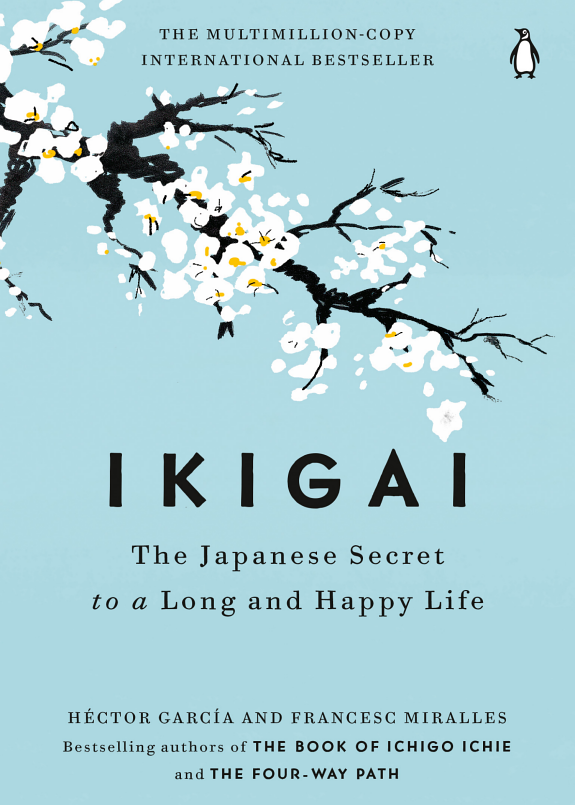
Ikigai: The Japanese Secret to a Long and Happy Life
2. Ikigai: The Japanese Secret to a Long and Happy Life by Hector Garcia and Francesc Miralles
Ikigai is a Japanese concept that roughly translates to “reason for being,” and this book explores it through the lens of the residents of Okinawa, Japan, one of the world’s so-called Blue Zones where people regularly live past one hundred. Garcia and Miralles spent time in the village of Ogimi interviewing elderly locals about their daily lives, habits, and what keeps them going. The result is a gentle, curious book that feels more like a travel essay than a self-help manual.
The authors draw on a range of sources, from flow theory to Stoic philosophy to Japanese dietary habits, weaving them together around the central idea that a meaningful life is usually not a grand one. It is a life built from small rituals, genuine community, purposeful work, and a reason to get out of bed in the morning. The Okinawan elders they interview are not famous or wealthy. They are gardeners, fishermen, and craftspeople who simply love what they do and feel connected to the people around them.
The book is short and easy to read in a single sitting, which is either a strength or a weakness depending on what you are looking for. It does not go very deep into any single idea, but it offers a genuinely appealing vision of what a well-lived life might look like, without requiring a dramatic reinvention of yourself.
The book’s quiet argument is that meaning is not found in a single dramatic revelation. It is assembled slowly, from the things you already love, if you are paying close enough attention.
This is perfect for readers who feel burnt out or disconnected from daily life and want a gentle, optimistic reframe. It is not for those seeking rigorous research or a structured program for personal change.
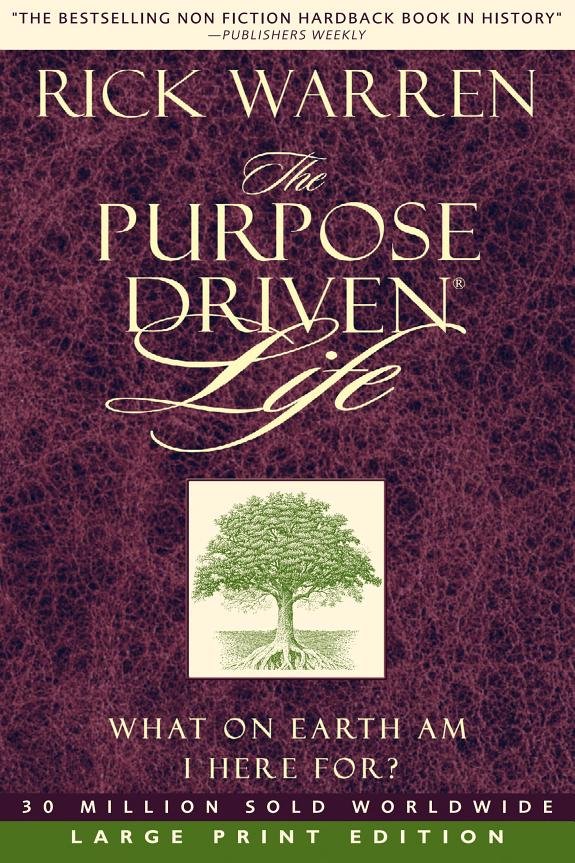
The Purpose Driven Life
3. The Purpose Driven Life by Rick Warren
Rick Warren’s book opens with a line that is either reassuring or provocative depending on your worldview: “It’s not about you.” Warren, a pastor and founder of Saddleback Church in California, argues that human purpose cannot be discovered by looking inward. It can only be understood in relation to God. This is a book written explicitly from within a Christian framework, and that context shapes every chapter. If you know that going in, you will have a much clearer sense of whether it is for you.
For readers who share Warren’s faith, or who are open to exploring a theologically grounded approach to meaning, the book offers a structured forty-day journey through five core purposes: worship, fellowship, discipleship, ministry, and mission. Each short chapter ends with a scripture verse and a point to reflect on. The writing is accessible and warm, and Warren has a genuine gift for making theological ideas feel personal rather than abstract.
The book has sold tens of millions of copies, which tells you something about how deeply it has resonated with a large audience. It is not trying to be universally applicable. It is trying to be honest about its own foundation, which is actually a kind of intellectual integrity. Warren is not pretending to offer a secular framework with a thin spiritual gloss. He is straightforwardly saying that his answer to the meaning question begins with God.
Whether or not you share Warren’s beliefs, the book raises a genuine challenge: if meaning is not self-generated, where does it come from? That question is worth sitting with regardless of your answer.
This is perfect for Christian readers or those spiritually curious about faith-based approaches to purpose. It is not for secular readers or those who find religious frameworks uncomfortable, as the theology is central rather than optional.
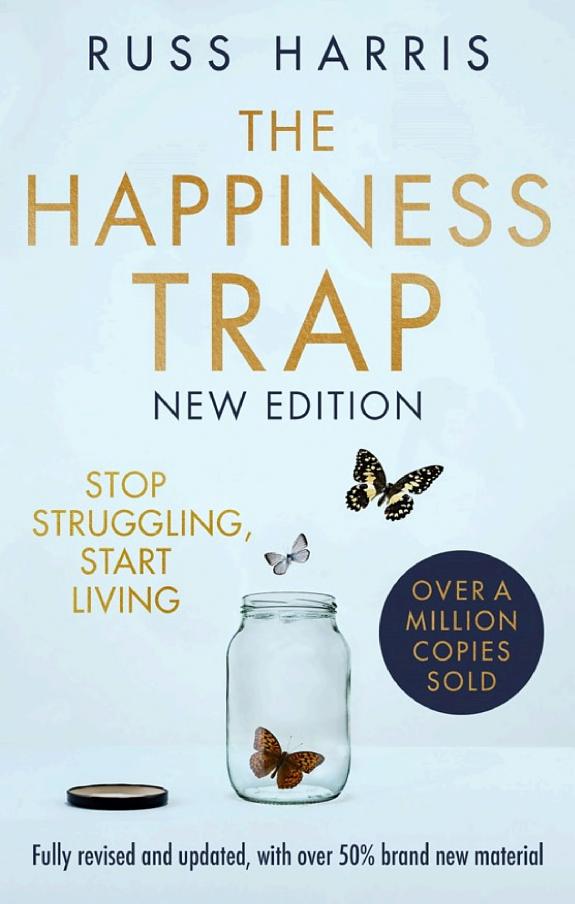
The Happiness Trap
4. The Happiness Trap by Russ Harris
Russ Harris is an Australian physician and therapist trained in Acceptance and Commitment Therapy, which goes by the mercifully pronounceable acronym ACT. His central argument is one that many people find quietly shocking: the relentless pursuit of happiness is itself a significant source of unhappiness. We have been sold the idea that normal human functioning means feeling good most of the time, and when we do not, we assume something has gone wrong. Harris says that assumption is the trap.
The book is practical in a way that a lot of meaning-focused books are not. It gives you specific exercises for defusing unhelpful thoughts, clarifying your values, and taking action toward a life that feels worthwhile even when it does not feel particularly pleasant. The distinction between a happy life and a meaningful life runs through the whole book, and Harris makes a compelling case that chasing the former at the expense of the latter tends to leave people feeling emptier, not fuller.
The writing is clear and unpretentious, and Harris has a good instinct for anticipating the reader’s objections. The exercises can feel a little clinical if you are not in the mood for worksheets, and some readers find the ACT framework a bit repetitive by the end. But for anyone who has noticed that positive thinking has not actually made them feel better, this book offers a genuinely different approach.
Harris makes a point that is easy to miss in a culture obsessed with good vibes: a rich, full life is not the same as a comfortable one, and confusing the two is an expensive mistake.
This is perfect for readers dealing with anxiety, chronic dissatisfaction, or a sense that self-help has not worked for them. It is not for those looking for spiritual or philosophical depth, as the focus is firmly on practical psychological tools.
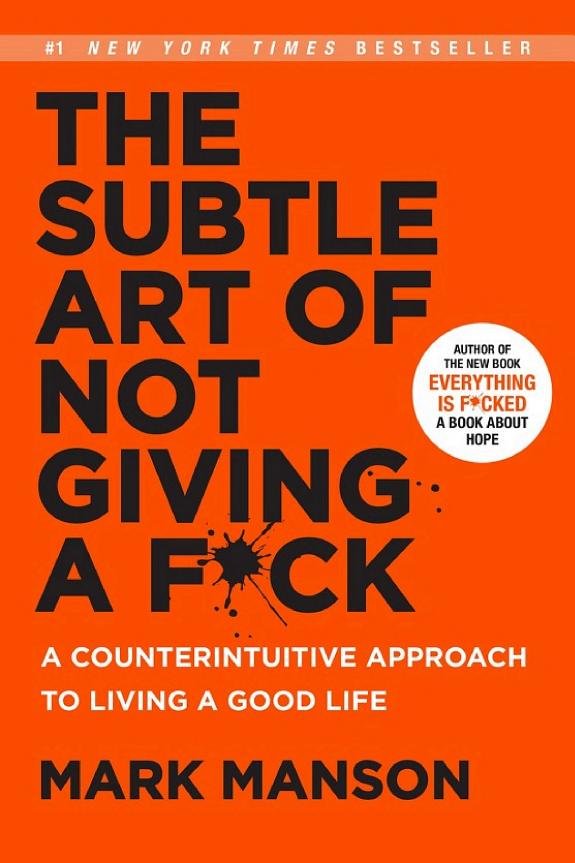
The Subtle Art of Not Giving a F*ck
5. The Subtle Art of Not Giving a F*ck by Mark Manson
The title does a lot of work before you even open the cover, and either it appeals to you or it does not. Manson writes with a deliberately casual, profanity-laced voice that some readers find refreshing and others find exhausting. Underneath the irreverence, though, is a fairly serious argument rooted in Stoic and existentialist thinking. The book is essentially about choosing what matters to you carefully, because you only have a limited number of things you can genuinely care about, and filling that budget with things that do not actually align with your values is a reliable path to misery.
Manson is good at puncturing certain varieties of toxic positivity. He takes aim at the idea that self-esteem should be unconditional, that everyone is special, and that suffering is always a problem to be solved rather than a signal to be read. These are not original observations, but he makes them with enough wit and energy that they land freshly. He draws on his own experiences and failures with a candor that feels genuine rather than performed.
The book is not particularly deep, and Manson himself would probably not claim otherwise. It is a brisk, entertaining read that offers a useful corrective to a certain kind of motivational excess. Think of it as philosophy with the academic pretension removed, for better and for worse. You will not come away with a complete framework for meaning, but you might come away with a clearer sense of what you should probably stop caring about.
The book’s most honest insight is that choosing your values is choosing your problems. There is no version of a meaningful life that does not involve struggle. The question is only which struggles are worth it to you.
This is perfect for younger readers or anyone feeling suffocated by relentless positivity culture who wants a more grounded perspective on what matters. It is not for those seeking depth, nuance, or a gentle tone.
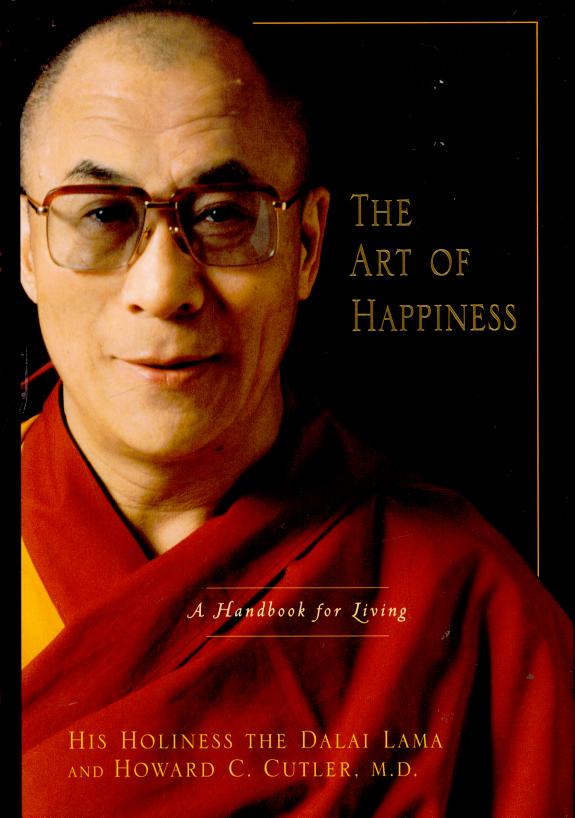
The Art of Happiness
6. The Art of Happiness by Dalai Lama and Howard C. Cutler
This book came out of a series of conversations between the Dalai Lama and Howard Cutler, an American psychiatrist, and the format works better than you might expect. Cutler asks the questions a skeptical Western reader would ask, and the Dalai Lama answers with a combination of Buddhist philosophy, practical common sense, and the occasional observation that seems almost startlingly simple until you realize you have never actually applied it. The dialogue structure keeps the book from feeling like a lecture.
The central argument is that happiness is not a feeling that happens to you. It is a skill that can be cultivated through training the mind. The Dalai Lama distinguishes between pleasure, which is fleeting and dependent on external circumstances, and a deeper sense of well-being that comes from compassion, mental discipline, and a clear-eyed understanding of suffering. He is not dismissive of difficulty. He takes pain seriously, which makes his optimism feel earned rather than naive.
Cutler’s contributions are sometimes a little thin, and the book occasionally has the slightly awkward quality of a translated conversation, where you sense something was lost between languages. But the Dalai Lama’s perspective is genuinely distinctive, and his warmth comes through clearly. This is not a book that will tell you to hustle harder or optimize your morning routine. It is a book that asks you to consider whether the way you are thinking about your own life might be the main obstacle to living it well.
One of the book’s quieter points is that the pursuit of meaning and the cultivation of compassion are not separate projects. They tend to arrive together, or not at all.
This is perfect for readers curious about Buddhist perspectives on happiness and meaning, or anyone who wants a thoughtful, unhurried approach to the subject. It is not for those who find spiritual frameworks frustrating or who prefer data-driven approaches.
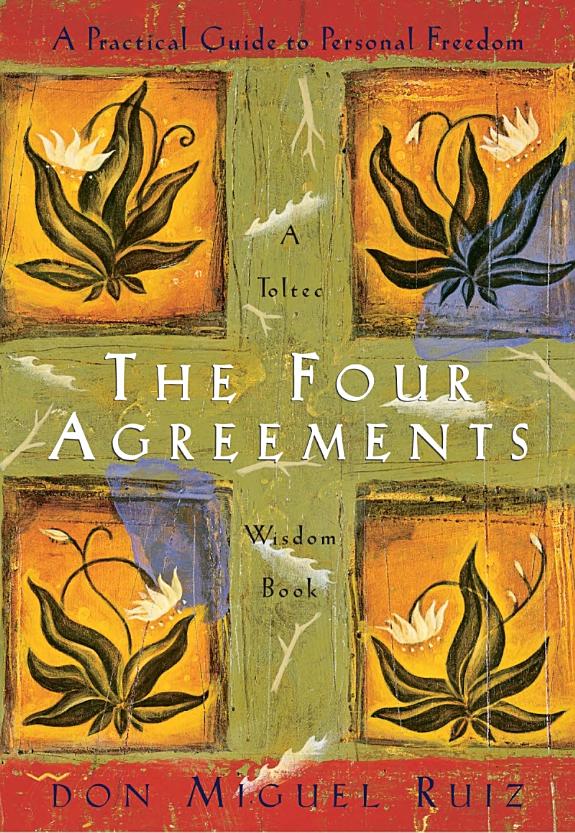
The Four Agreements
7. The Four Agreements by Don Miguel Ruiz
Don Miguel Ruiz draws on the Toltec wisdom tradition of ancient Mexico to offer four principles for living with more freedom and less suffering. The agreements are: be impeccable with your word, do not take anything personally, do not make assumptions, and always do your best. Written out like that, they sound almost comically simple. The book’s achievement is making you feel the weight of how rarely most of us actually live by any of them.
Ruiz’s writing has a quality that is hard to pin down. It is direct without being harsh, and it has a kind of rhythmic repetition that some readers find hypnotic and others find monotonous. He argues that most human suffering comes from a set of agreements we made in childhood without realizing it, internal rules about who we are and what the world expects of us, and that becoming free means renegotiating those agreements consciously. It is a simple idea, but the implications are not small.
The book is short, and it does not pretend to be comprehensive. Ruiz is not trying to build a complete philosophy of life. He is offering four handles that you can actually grab onto. Some readers find the spiritual framework, which blends indigenous wisdom with something approaching new age spirituality, a little vague. But even those readers often find the core ideas useful, because the agreements function as practical ethics regardless of whether you accept the metaphysical scaffolding around them.
The agreement not to take anything personally sounds like a minor adjustment until you try it for a week and realize how much of your emotional energy has been spent on things that were never actually about you.
This is perfect for readers who want a short, accessible spiritual framework for reducing unnecessary suffering and living with more integrity. It is not for those who prefer rigorous philosophical argument or evidence-based approaches.
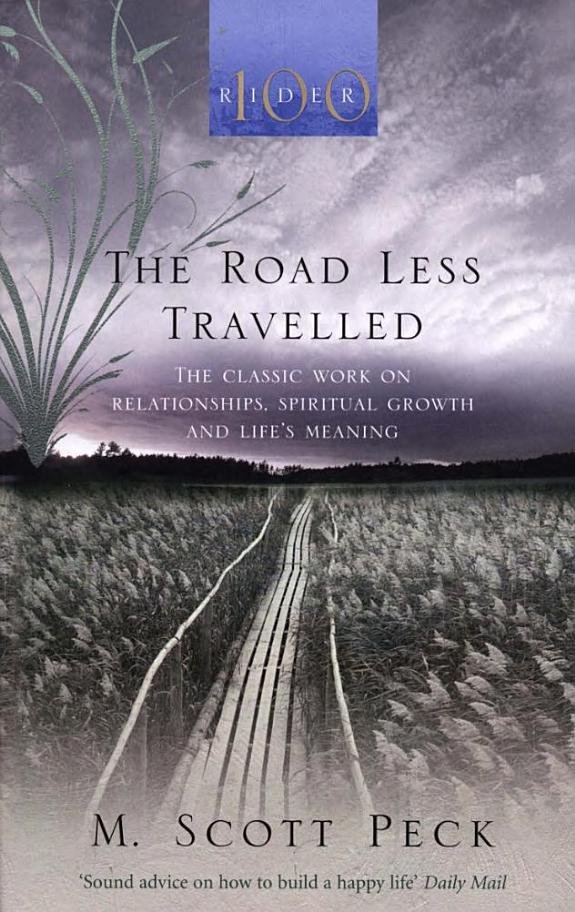
The Road Less Traveled
8. The Road Less Traveled by M. Scott Peck
M. Scott Peck opens with three words that have become something of a touchstone: “Life is difficult.” He then argues that the moment we truly accept this, rather than fighting it or feeling victimized by it, we begin to grow. Peck was a psychiatrist, and the book draws heavily on his clinical experience, blending psychology with spirituality in a way that was somewhat unusual when it was published in 1978 and remains distinctive today. It is a long book, and it earns its length.
The book is divided into four sections covering discipline, love, growth and religion, and grace. Peck’s treatment of love is particularly worth noting. He argues that genuine love is not a feeling but an action, specifically the willingness to extend yourself for the spiritual growth of another person. This is not a romantic idea in the conventional sense, and some readers find it demanding. That is rather the point. Peck is not interested in easy comfort. He is interested in what actually helps people grow.
The sections on spirituality and grace are the most explicitly theological, and Peck’s framework is broadly Christian, though he draws on other traditions and approaches the subject with a psychiatrist’s curiosity rather than a preacher’s certainty. The book has a density and seriousness that sets it apart from most of what sits on the self-help shelf. It asks more of the reader than most, and it gives more in return. It is the kind of book that tends to find you at the right moment, and when it does, it stays with you.
Peck’s insistence that the path to meaning runs directly through difficulty rather than around it is not a popular message, but it is one that holds up under honest examination.
This is perfect for thoughtful readers willing to engage seriously with questions of psychology, love, and spiritual growth. It is not for those looking for quick answers or who are put off by a book that takes its time making its case.
None of these eight books will hand you a finished answer to the meaning question. Any book that claimed to do that should probably be approached with some suspicion. What these books offer instead is something more useful: different angles on a question that deserves to be looked at from more than one direction. Frankl approaches it from the depths of human suffering. The Dalai Lama approaches it from decades of contemplative practice. Manson approaches it from a barstool, more or less. All of them are worth hearing.
The best thing you can do is pick the one that feels most relevant to where you actually are right now, not where you think you should be. A book about finding meaning only works if you are honest about what kind of meaning you are actually looking for. Start there, and let the reading do the rest.