

6 Books That Improve Focus and Concentration
There is a particular kind of frustration that comes from sitting down to work, fully intending to concentrate, and then somehow finding yourself forty minutes later reading about the history of a snack food you vaguely remembered eating in 2009. Focus is not just hard these days. It feels almost countercultural. Every app, notification, and open tab seems designed to chip away at the mental stillness that good work actually requires.
The books gathered here take that problem seriously. Some approach it through habit science, others through philosophy, and a few through the kind of blunt productivity advice that makes you want to close your laptop and actually do something. They do not all agree with each other, which is honestly part of what makes reading them worthwhile. What they share is a genuine conviction that attention is worth protecting, and that protecting it is a skill you can learn. Here are six books worth your time, and your focus.
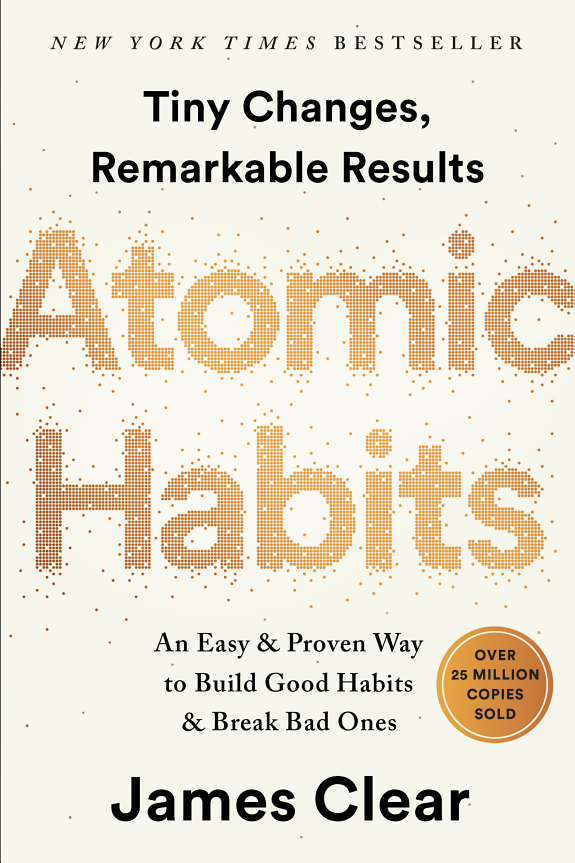
Atomic Habits: An Easy & Proven Way to Build Good Habits & Break Bad Ones
1. Atomic Habits: An Easy & Proven Way to Build Good Habits & Break Bad Ones by James Clear
James Clear is the kind of writer who makes you feel like you have been overcomplicating everything. His central argument is deceptively simple: small habits, repeated consistently, compound into remarkable results over time. The book is not really about willpower or motivation. It is about systems. Clear draws on behavioral science, psychology, and a handful of genuinely memorable stories to build a framework for understanding why habits form, why they stick, and why they break down.
When it comes to focus and concentration, the connection might not be immediately obvious, but it becomes clear quickly. If you cannot consistently sit down and begin focused work, that is a habit problem as much as it is an attention problem. Clear’s four laws of behavior change, cue, craving, response, and reward, give you a practical lens for redesigning your environment and routines so that deep concentration becomes something you drift toward rather than something you have to force.
The writing is clean and the examples are well chosen. Clear never talks down to the reader, but he also does not assume you have a PhD in neuroscience. The book moves at a good pace, and the chapters are short enough that you can read one during a lunch break without losing the thread. That said, if you are already well versed in habit science and have read Charles Duhigg’s work extensively, some of this will feel familiar.
“You do not rise to the level of your goals. You fall to the level of your systems.” This line alone is worth the price of the book for anyone who keeps setting intentions and wondering why nothing changes.
This is perfect for readers who struggle to build consistent routines around focused work, especially those who have tried motivation-based approaches and found them exhausting.
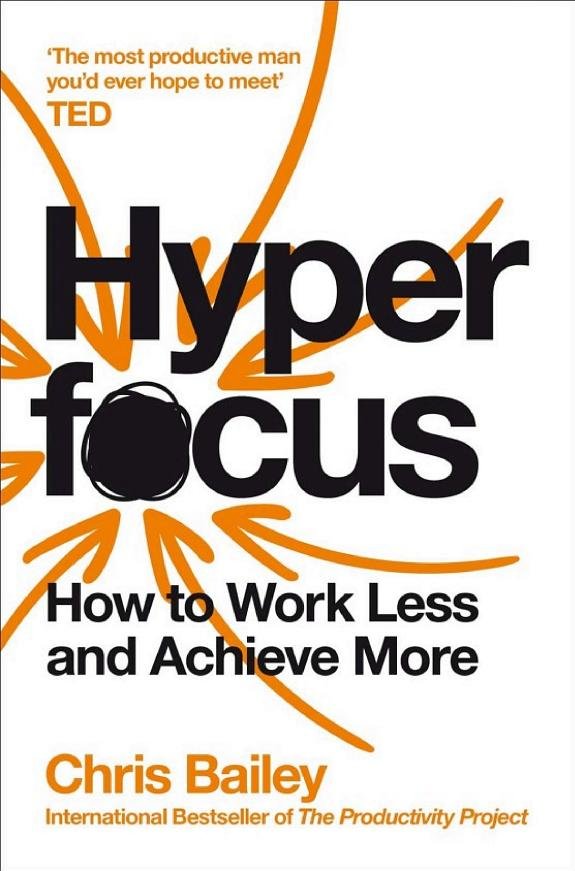
Hyperfocus: How to Manage Your Attention in a World of Distraction
2. Hyperfocus: How to Manage Your Attention in a World of Distraction by Chris Bailey
Chris Bailey spent a year conducting what he called productivity experiments on himself, and the resulting work is sharp, curious, and refreshingly honest about the limits of constant deep focus. Hyperfocus introduces two modes of attention that Bailey argues we need to alternate between: hyperfocus, which is deep, intentional concentration on a single task, and scatterfocus, which is a more open, wandering mental state that turns out to be essential for creativity and planning. The book’s big contribution is treating both as valuable rather than framing distraction as purely the enemy.
Bailey writes with a lot of energy. He is clearly someone who finds this stuff genuinely interesting, and that enthusiasm comes through without tipping into the kind of breathless self-help tone that makes you want to put a book down. He is also unusually willing to cite research while acknowledging its limitations, which is a small thing but a meaningful one in a genre that sometimes treats a single study as settled law.
The practical sections are solid. Bailey offers specific techniques for entering and sustaining hyperfocus, including setting intentions before starting work, limiting the number of things competing for your attention at once, and deliberately scheduling time for mind-wandering. It is not groundbreaking in every chapter, but it is consistently useful. Readers who prefer a more philosophical or literary approach to attention may find the tone a bit breezy.
The idea that scatterfocus, letting your mind wander on purpose, is not laziness but a legitimate cognitive tool is one of the more genuinely freeing reframes in this genre.
This is perfect for people who want a balanced, research-informed guide to attention that does not treat every moment of unfocused thought as a personal failure.
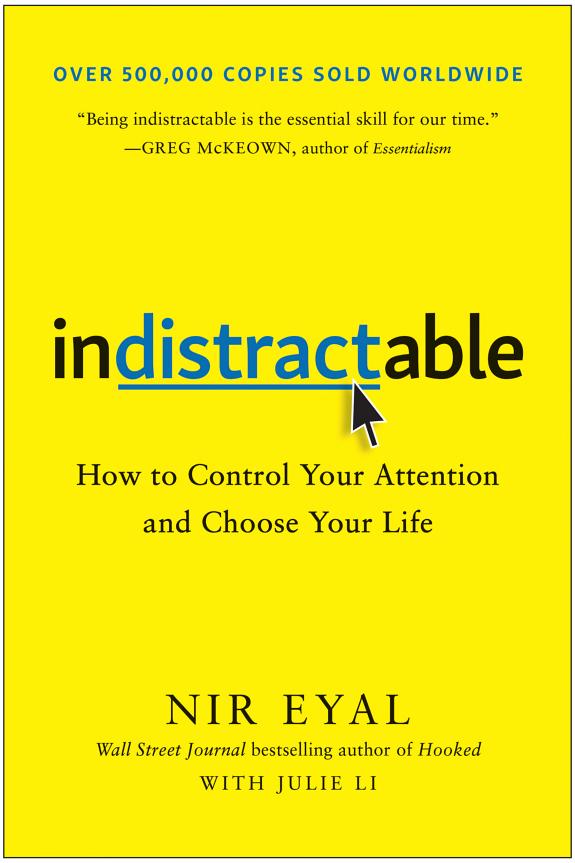
Indistractable: How to Control Your Attention and Choose Your Life
3. Indistractable: How to Control Your Attention and Choose Your Life by Nir Eyal
There is something pleasingly ironic about the fact that Nir Eyal, the man who wrote Hooked, a widely read guide to building habit-forming products, later wrote a book about resisting those exact products. Indistractable is not a book about blaming technology, though. Eyal’s central argument is that distraction is fundamentally an internal problem before it is an external one. We reach for our phones and our feeds because we are trying to escape discomfort, boredom, anxiety, or restlessness. Until you address those internal triggers, he argues, no amount of app-blocking will actually fix the problem.
This reframe is genuinely useful and a little uncomfortable, which is probably the point. Eyal walks through a four-part model covering internal triggers, making time for what matters, hacking back external triggers, and using commitment devices to prevent distraction. Each section is practical without being prescriptive, and the book is careful not to moralize excessively. Eyal is not interested in making you feel guilty. He is interested in helping you understand the mechanism and then giving you tools.
The writing is clear and the book moves quickly. Some readers find the framework a touch schematic, and there are moments where the case studies feel a little too tidy. The section on relationships and parenting, while thoughtful, may feel like a detour for readers who picked this up purely for work-related focus. But the core ideas are sound and well argued.
Eyal’s point that the opposite of distraction is not focus but traction, moving toward what you actually value, reorients the whole conversation in a way that sticks with you.
This is perfect for readers who have tried every productivity app and blocker and still find themselves distracted, and are ready to look at what is actually driving the behavior.
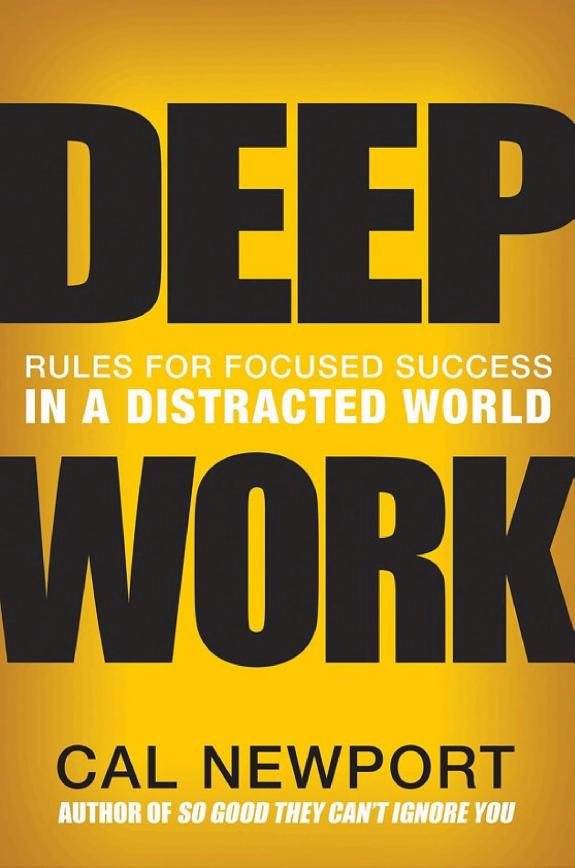
Deep Work: Rules for Focused Success in a Distracted World
4. Deep Work: Rules for Focused Success in a Distracted World by Cal Newport
Cal Newport does not have a social media account, which he will tell you about, though he makes the point without being smug about it. Deep Work is built around a single, well-developed argument: the ability to focus without distraction on cognitively demanding tasks is becoming increasingly rare and increasingly valuable, and most of us are letting it atrophy. Newport calls this capacity deep work, and he contrasts it with shallow work, the emails, meetings, and administrative tasks that fill our days and feel productive while producing relatively little of real value.
The first half of the book makes the case for deep work through a mix of economic reasoning and vivid examples drawn from writers, scientists, and thinkers who structured their lives around sustained concentration. Newport is a good prose stylist for a computer science professor, which is admittedly a low bar, but he genuinely writes well. The second half is more practical, offering four different scheduling philosophies for building deep work into your life, from Newport’s preferred monastic approach to the more realistic rhythmic method that most people with jobs and families will actually be able to use.
This book will not appeal to everyone. Newport’s tone can be stern, and his examples skew heavily toward academic and knowledge-worker contexts. If you work in a role that genuinely requires constant communication and collaboration, some of his prescriptions may feel impractical. But even then, the underlying argument about protecting your best cognitive hours is hard to dismiss.
“A deep life is a good life” is Newport’s quiet thesis, and by the time you finish the book, it is difficult to argue with him.
This is perfect for knowledge workers, writers, researchers, and anyone whose best output requires long, uninterrupted stretches of concentration that they are currently not getting.
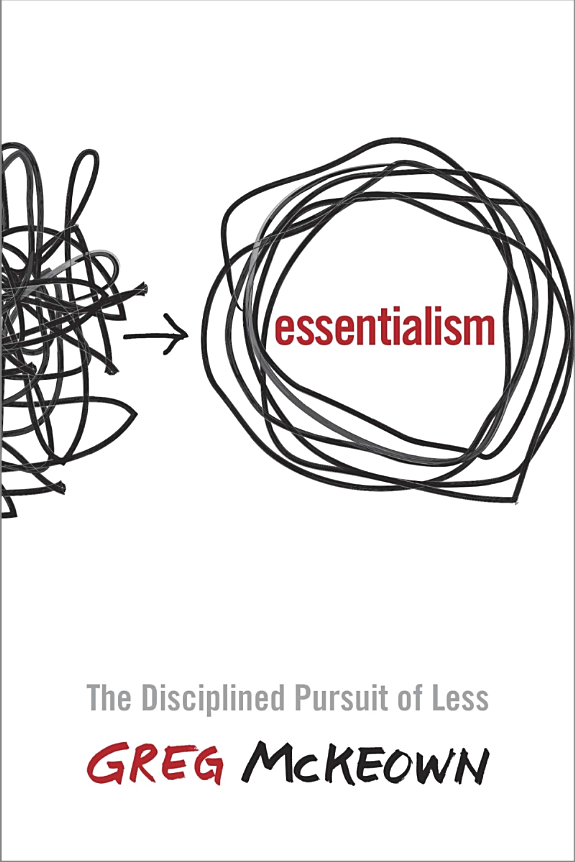
Essentialism: The Disciplined Pursuit of Less
5. Essentialism: The Disciplined Pursuit of Less by Greg McKeown
Greg McKeown’s argument is not complicated, but it is one that most people find surprisingly hard to actually live by. Essentialism is the practice of figuring out what is absolutely essential and then eliminating everything else. Not just from your to-do list, but from your commitments, your goals, your identity as a productive person. McKeown is asking you to trade the feeling of being busy for the reality of being effective, and he is aware that this is a harder trade than it sounds.
The book is organized around three core practices: explore, to discern the vital few from the trivial many; eliminate, to cut out everything that is not essential; and execute, to remove obstacles so the essential things happen easily. McKeown writes with warmth and clarity, and the book is full of well-chosen anecdotes and thought experiments that make the philosophy feel concrete rather than abstract. The chapter on the power of saying no is particularly good and will make you want to immediately cancel three things you agreed to out of vague social obligation.
Where Essentialism connects to focus is not always explicit, but the logic is tight. You cannot concentrate deeply on something if you have spread your attention across twenty competing priorities. The book is really about creating the conditions under which focus becomes possible. Readers who want granular time-management tactics may find it too conceptual. It is more philosophy than instruction manual, and it is better for it.
McKeown’s observation that if you do not prioritize your life, someone else will, is one of those sentences that is obvious the moment you read it and somehow still catches you off guard.
This is perfect for high-achievers who feel perpetually overwhelmed despite working hard, and who suspect the problem might be doing too much rather than doing it wrong.
The One Thing: The Surprisingly Simple Truth Behind Extraordinary Results
6. The One Thing: The Surprisingly Simple Truth Behind Extraordinary Results by Gary Keller and Jay Papasan
Gary Keller built one of the largest real estate companies in the world, which gives him a certain credibility when he talks about getting things done. The One Thing, co-written with Jay Papasan, is built around a focusing question that the authors return to throughout the book: what is the one thing you can do such that by doing it, everything else will be easier or unnecessary? It sounds almost too simple, but the book does a good job of showing why simplicity is precisely the point.
Keller and Papasan argue that extraordinary results come from narrowing your focus to a single priority and giving it your best time and energy before anything else gets a look in. They push back against the myth of multitasking, the idea of a balanced life as a daily achievement, and the notion that willpower is a fixed resource you either have or do not. The book is brisk and readable, structured around debunking what the authors call the six lies between you and success, which include things like everything matters equally and you can do it all.
The writing is punchy and the book moves fast, sometimes a little too fast. There are moments where the argument would benefit from more nuance, and the tone occasionally tips into motivational-poster territory, which some readers will find energizing and others will find grating. It is also worth noting that the model works better for entrepreneurs and self-directed workers than for people operating within complex organizational structures. But the core idea is genuinely clarifying.
The authors’ point that success is sequential, not simultaneous, and that you build one domino at a time, is a useful corrective to the everything-at-once approach that quietly exhausts most people.
This is perfect for entrepreneurs, freelancers, and self-directed professionals who want a clear, no-frills framework for deciding where to put their attention and then actually putting it there.
None of these books will fix your focus by sitting on a shelf, which is the kind of obvious thing that still somehow needs saying. But taken together, they offer a genuinely varied set of lenses for thinking about attention, from the habit systems that make concentration possible, to the internal triggers that pull us away from it, to the broader question of whether we are even focused on the right things in the first place. You do not need to read all six. Pick the one that speaks to where you actually are right now.
If your problem is building consistent routines, start with Atomic Habits. If you feel spread too thin, Essentialism or The One Thing might be the right entry point. If you are doing the work but still getting pulled away constantly, Indistractable or Hyperfocus will probably resonate. And if you want the most rigorous case for why deep concentration matters at all, Deep Work is hard to beat. Read slowly. Take notes. And maybe, just this once, put your phone in another room.