
10 Best Books for Anxiety That Actually Help
Anxiety has a way of making you feel like you are the only person who has ever lain awake at 3am rehearsing a conversation from two weeks ago. You are not. And while no book is a substitute for professional support, the right one can feel like sitting down with someone who genuinely gets it, someone who explains what is happening in your brain without making you feel broken, and who offers something practical to hold onto.
The books on this list cover a wide range of approaches. Some are rooted in neuroscience, some in cognitive behavioral therapy, some in mindfulness, and one is a deeply personal memoir that reads more like a long letter from a friend. A few are workbooks that ask you to put in real effort. Others are the kind you read curled up on the couch, underlining sentences that feel embarrassingly accurate. Whatever your relationship with anxiety looks like right now, there is something here worth picking up.
Rewire Your Anxious Brain
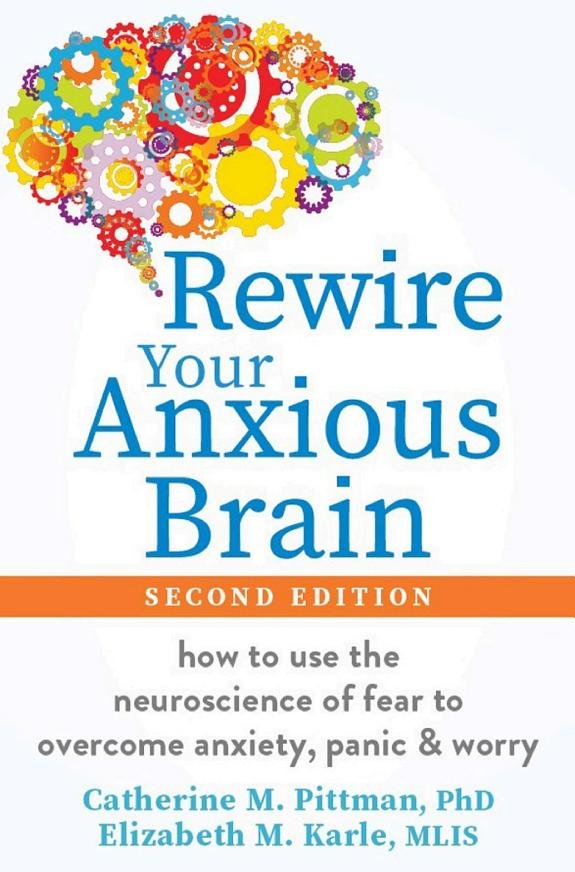
1. Rewire Your Anxious Brain by Catherine M. Pittman and Elizabeth M. Karle
If you have ever wanted someone to explain what is actually happening inside your head when anxiety strikes, this is the book that does it without requiring a neuroscience degree. Pittman, a clinical psychologist, and Karle, a therapist, walk you through the roles of the amygdala and the cortex in generating anxious responses. It sounds dry on paper, but the explanations are genuinely clear and the writing never talks down to you.
What makes this book stand out is that understanding the mechanism of anxiety is itself therapeutic. When you realize your amygdala is firing off alarm signals that your cortex then tries to make sense of, you stop feeling like your anxiety is a personal failing and start seeing it as a brain process you can actually influence. The authors offer concrete strategies tied directly to that science, which gives the advice a grounding that a lot of self-help books lack.
The tone is warm but clinical enough to feel credible. It is not a book that promises to fix everything. It promises to help you understand what is going on, and from that understanding, to make small, meaningful changes. That honesty is refreshing. If you are someone who needs to know the why before you can engage with the how, this book will feel like a relief.
“Understanding whether your anxiety is driven by the amygdala or the cortex changes which strategies will actually work. This book makes that distinction accessible and genuinely useful.”
This is perfect for readers who want a science-based explanation of anxiety before diving into coping strategies, and who prefer understanding over simple reassurance. It is not the right fit for those who find brain anatomy discussions tedious or who are looking for a more narrative, story-driven read.
The Anxiety Toolkit
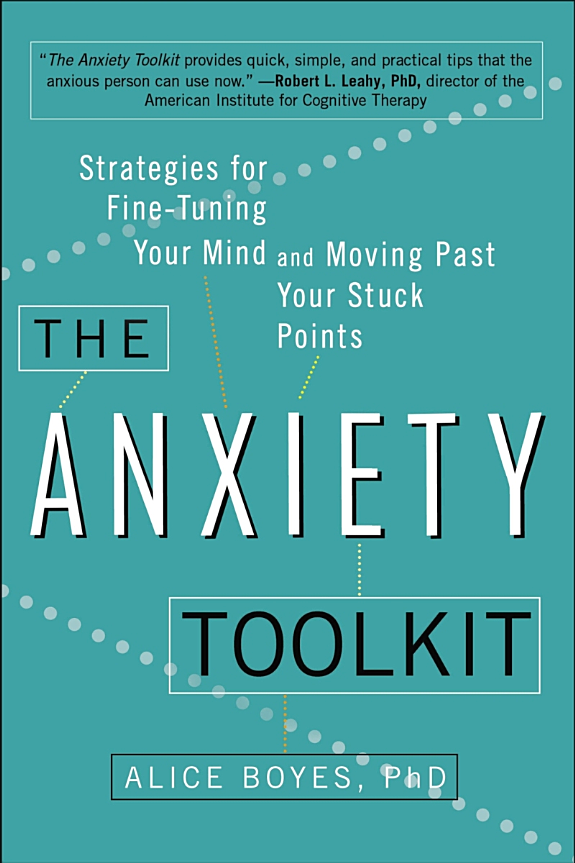
2. The Anxiety Toolkit by Alice Boyes
Alice Boyes has a background in research psychology, and it shows in the best possible way. This book is organized around specific anxiety patterns, things like overthinking, avoidance, perfectionism, and reassurance-seeking, and it offers targeted tools for each one. The structure makes it easy to skip straight to whatever is eating at you most, which is genuinely useful when anxiety has already shortened your attention span.
Boyes writes with a kind of no-nonsense warmth. She is not trying to hype you up or convince you that change is easy. She acknowledges that anxious patterns are often deeply ingrained and that the tools she offers require practice and repetition. There is something almost refreshing about a self-help author who does not oversell the process. She also does a good job of acknowledging that some anxiety is functional and that the goal is not to eliminate it but to keep it from running the show.
The book is relatively short and reads quickly, which is a real virtue for someone whose anxiety makes sustained concentration difficult. Each section ends with practical exercises, and the writing is specific enough that the advice rarely feels generic. It is a good companion to therapy rather than a replacement for it, and Boyes is honest about that distinction.
“Boyes treats the reader as an intelligent adult who already knows their patterns. The tools she offers feel tailored rather than one-size-fits-all, which is rare in this genre.”
This is perfect for people who recognize their own anxiety patterns and want targeted, research-backed strategies for each one. It is less suited to readers who are new to thinking about anxiety and might benefit from a more foundational introduction first.
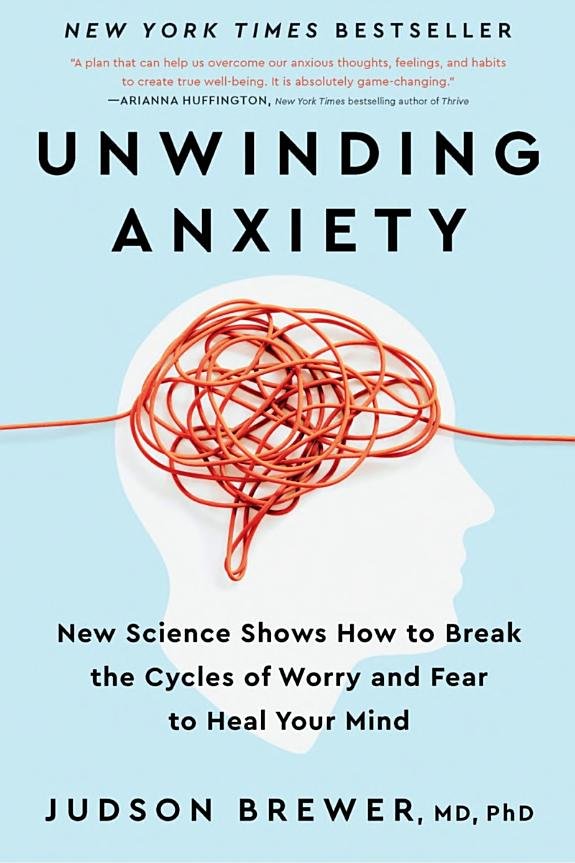
Unwinding Anxiety
3. Unwinding Anxiety by Judson Brewer
Judson Brewer is a psychiatrist and neuroscientist who has spent years studying habit loops and addiction, and in this book he makes a compelling case that anxiety operates on the same reward-based learning mechanisms as other habits. The central idea is that anxious behaviors like worrying, avoidance, and checking are reinforced because they offer a temporary sense of relief or control, and that mindfulness can interrupt that loop without requiring willpower.
The writing is accessible and Brewer has a good sense of humor, which helps when the subject matter gets heavy. He draws on his own clinical work and research throughout, giving the book a credibility that does not feel like showing off. The approach is rooted in mindfulness-based practices, specifically a technique called RAIN, and Brewer explains the science behind why curiosity about your own anxiety is more effective than trying to push it away.
This book will resonate most with readers who have already tried to think their way out of anxiety and found it did not work. The shift from control to curiosity is a real one, and Brewer makes it feel attainable rather than abstract. That said, if you are skeptical of mindfulness as a concept, the book may feel like it is asking you to take a leap of faith before you are ready.
“Brewer reframes anxiety not as a character flaw or a disorder to be conquered, but as a habit loop that can be gently, persistently interrupted. That reframe alone is worth the read.”
This is perfect for readers who are open to mindfulness-based approaches and want to understand the neuroscience behind why anxious habits form and persist. It is not ideal for those who prefer structured CBT exercises or who are deeply skeptical of mindfulness practices.
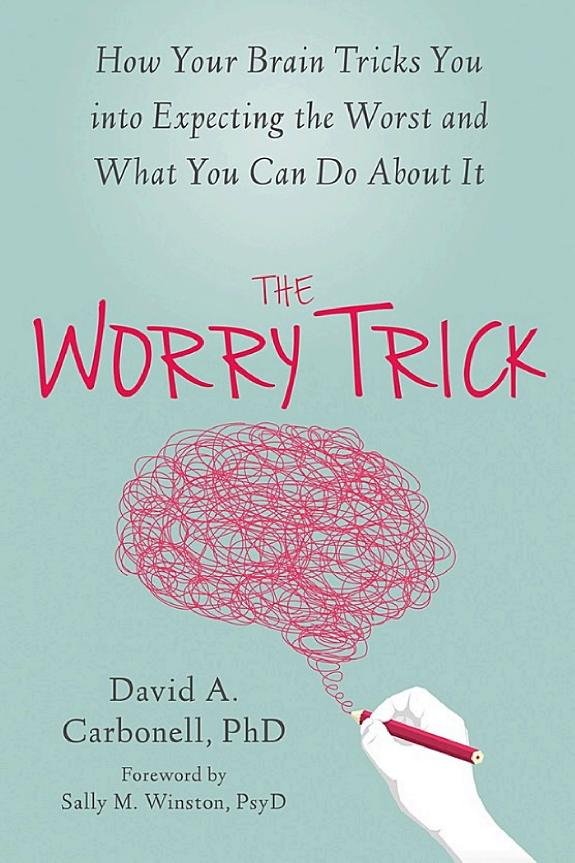
The Worry Trick
4. The Worry Trick by David A. Carbonell
David Carbonell is a psychologist who specializes in anxiety disorders and has a genuinely funny writing style, which turns out to be a significant asset when you are writing about chronic worry. The central premise of this book is that worry is a trick your brain plays on you, convincing you that the act of worrying is somehow productive or protective, when in fact it tends to make things worse. Carbonell uses Acceptance and Commitment Therapy and CBT principles to help readers recognize and step out of that trick.
The book is full of specific, practical techniques, including a technique called the Worry Break, where you deliberately schedule worry time rather than trying to suppress it. It sounds counterintuitive, and Carbonell knows that. He walks you through the reasoning carefully, with enough humor along the way that you never feel lectured at. He also does an excellent job of explaining why fighting anxiety tends to amplify it, which is one of those insights that feels obvious in retrospect but is surprisingly hard to internalize.
What Carbonell does particularly well is address the shame and frustration that often accompany chronic worry. He is not dismissive of how exhausting it is to be stuck in anxious loops, but he also refuses to treat it as hopeless. The tone is matter-of-fact and kind at the same time, which is a difficult balance to strike.
“The idea that trying harder to stop worrying is often exactly what keeps it going is one of the most useful things this book teaches. Carbonell makes it stick.”
This is perfect for chronic worriers who have tried to simply stop worrying and found that approach spectacularly unhelpful. It is less suited to readers dealing primarily with physical anxiety symptoms rather than repetitive anxious thoughts.
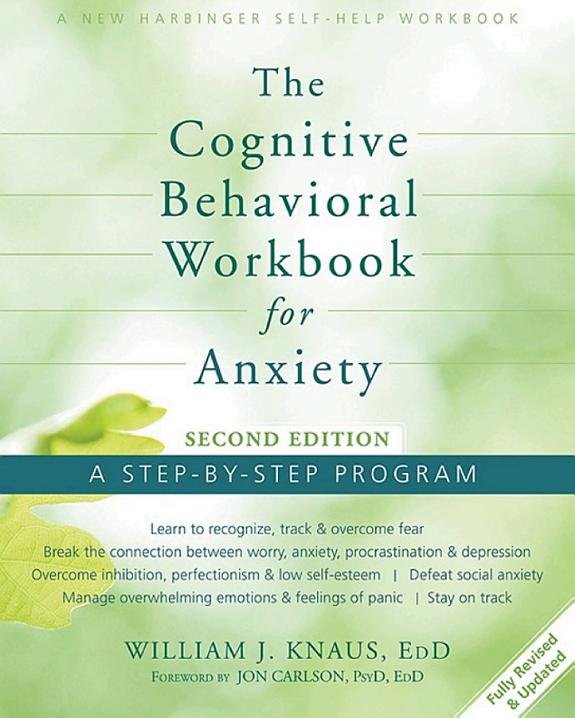
The Cognitive Behavioral Workbook for Anxiety
5. The Cognitive Behavioral Workbook for Anxiety by William J. Knaus
This is a proper workbook, which means it asks something of you. William Knaus is a psychologist with decades of experience in CBT and REBT, and the book reflects that depth. It is thorough in a way that can feel dense at first, but the comprehensiveness is also its strength. If you want to understand CBT not just as a set of techniques but as a coherent framework for understanding anxious thinking, this book delivers that.
The exercises are structured and sequential, building on each other as you move through the book. Knaus covers everything from identifying cognitive distortions to working through specific fears and phobias, and he does so with a clinical precision that is grounded in genuine empathy. He is not trying to be your cheerleader. He is trying to give you a working set of tools, and the tone reflects that.
It is worth being honest: this is not a quick read or a light one. Some sections require real effort and self-reflection, and if you are in a particularly acute phase of anxiety, sitting down to complete structured exercises may feel overwhelming. Used at the right pace, though, it is one of the more comprehensive self-help resources available in the CBT tradition.
“Knaus does not oversimplify CBT into a few catchy steps. The workbook respects both the complexity of anxiety and the reader’s capacity to do real work.”
This is perfect for readers who are committed to working through a structured CBT program at their own pace and want something more rigorous than a light self-help read. It is not the right choice for someone looking for a quick overview or who finds workbook-style formats frustrating.
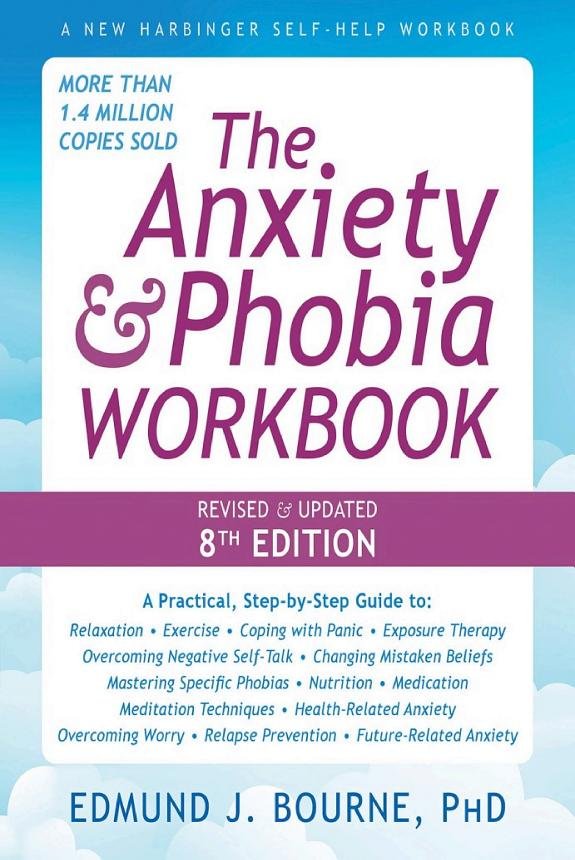
The Anxiety and Phobia Workbook
6. The Anxiety and Phobia Workbook by Edmund J. Bourne
Edmund Bourne’s workbook has been around since 1990 and has gone through multiple editions, which tells you something about its staying power. It is one of the most comprehensive single-volume resources on anxiety available, covering generalized anxiety, panic disorder, social anxiety, specific phobias, OCD, and PTSD. The scope is genuinely broad, and Bourne handles each area with care and specificity.
The writing is clear and methodical, and each chapter includes exercises, assessments, and worksheets. Bourne draws on CBT, relaxation techniques, nutrition, exercise, and even some discussion of medication, giving the book a holistic quality that more narrowly focused books lack. He is not prescriptive about which approach is right for you, which is respectful of the fact that anxiety looks different for different people.
The size of the book can feel intimidating, and it is definitely not something you sit down and read cover to cover in a weekend. It works better as a reference and a working document, something you return to over time as you move through different aspects of your anxiety. For that kind of long-term use, it is hard to beat.
“This workbook has earned its reputation not through hype but through sheer usefulness. It meets you where you are and offers something concrete no matter which form of anxiety you are dealing with.”
This is perfect for readers who want a comprehensive, long-term resource that addresses multiple forms of anxiety in depth. It is less suited to those who want something focused and concise, or who are looking for a narrative reading experience rather than a workbook format.
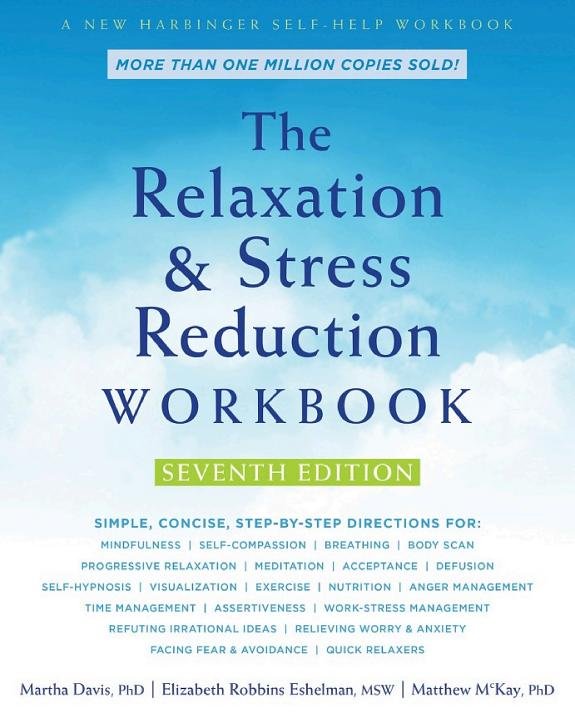
The Relaxation and Stress Reduction Workbook
7. The Relaxation and Stress Reduction Workbook by Martha Davis, Elizabeth Robbins Eshelman, and Matthew McKay
First published in 1980 and now in its seventh edition, this workbook has quietly become one of the most widely used stress and anxiety resources in clinical settings. The authors cover an impressive range of techniques, including progressive muscle relaxation, breathing exercises, meditation, visualization, autogenics, and biofeedback, and they do so with enough detail that you can actually practice them rather than just read about them.
The tone is calm and instructional, which suits the subject matter. This is not a book that tries to inspire you or tell you a story. It is a practical manual, and it does that job well. Each chapter explains the technique, the evidence behind it, and how to practice it step by step. The breadth means you are likely to find at least a few approaches that genuinely work for your particular nervous system, which is useful because relaxation techniques are not one-size-fits-all.
Some readers find the writing a little dry, and that is a fair observation. The book prioritizes usefulness over personality. But for someone who is overwhelmed by anxiety and wants clear, evidence-based guidance on how to physically calm their body, dry and clear is exactly what the situation calls for. Think of it less as something to read and more as something to use.
“Decades of clinical use have refined this workbook into something genuinely reliable. It does not dazzle, but it delivers, and in the context of anxiety, that matters more.”
This is perfect for readers who want a practical, technique-focused guide to physical relaxation and stress reduction, particularly those whose anxiety manifests strongly in the body. It is not suited to readers looking for emotional narrative or a more personal connection with the author.
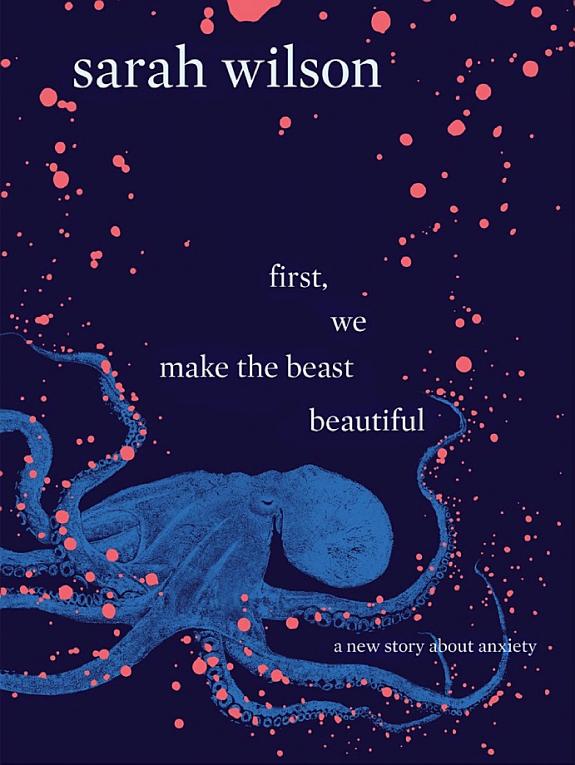
First, We Make the Beast Beautiful
8. First, We Make the Beast Beautiful by Sarah Wilson
Sarah Wilson’s book is unlike anything else on this list. It is part memoir, part philosophical exploration, and part practical guide, and it moves between all three registers with a restless, searching energy that feels entirely appropriate for a book about anxiety. Wilson, an Australian journalist and author, has lived with anxiety her whole life, and she writes about it with the kind of specificity that only comes from genuine experience.
The title comes from a Chinese proverb about riding the tiger, and that image runs through the book: the idea that anxiety is not just a problem to be solved but something that can be worked with, even, in some cases, something that carries its own gifts. Wilson is not romanticizing suffering. She is honest about how hard it has been. But she is also interested in what anxiety might be pointing toward, and that perspective gives the book a depth that purely clinical resources cannot offer.
The writing is beautiful in places and occasionally a little scattered, which feels honest rather than careless. Wilson’s mind moves quickly and associatively, and the book reflects that. Some readers will find this energizing. Others will wish for more structure. If you are in the latter camp, this is probably not your entry point into anxiety reading, but it might be a meaningful one later on.
“Wilson writes about anxiety from the inside, and that intimacy is the book’s greatest strength. It does not explain anxiety so much as it sits with it, which is sometimes exactly what you need.”
This is perfect for readers who want a personal, literary exploration of what it means to live with anxiety long-term, and who are open to a more philosophical approach alongside the practical. It is not suited to those who need structured techniques or are in an acute phase where they need immediate, concrete help.
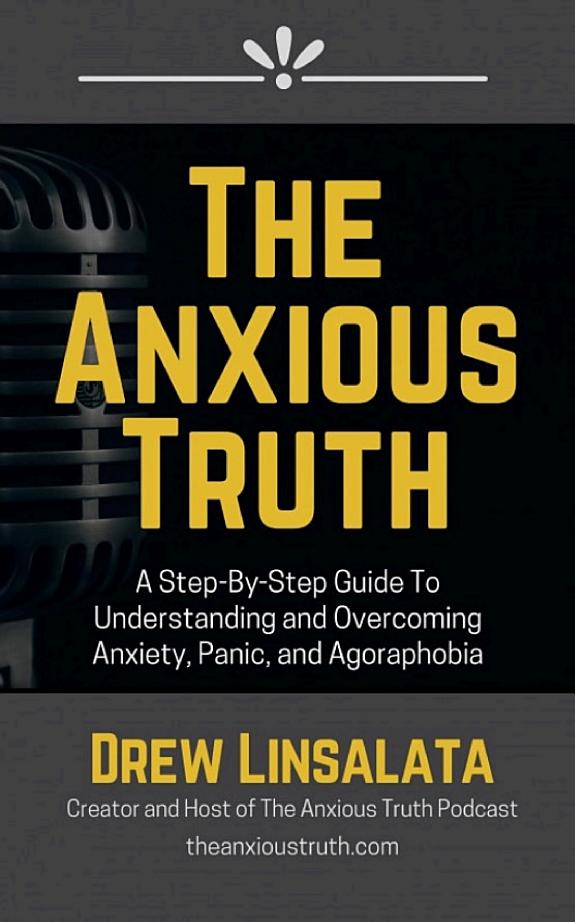
The Anxious Truth: A Step-by-Step Guide to Understanding and Overcoming Anxiety, Panic, and Worry
9. The Anxious Truth by Drew Linsalata
Drew Linsalata is not a therapist or a researcher. He is someone who spent years in the grip of severe anxiety and panic disorder, eventually found his way through it using evidence-based approaches, and then dedicated himself to explaining what actually worked and why. That background gives the book a credibility that is different from clinical expertise but equally valuable. He has been where the reader is, and that comes through on every page.
The book is built around the core principles of Acceptance and Commitment Therapy and exposure-based approaches, but Linsalata explains them in plain language without losing the substance. He is particularly good on the subject of panic attacks, specifically the way that fear of panic becomes its own self-sustaining loop, and how breaking that loop requires a counterintuitive willingness to move toward discomfort rather than away from it. It is not a comfortable message, but he delivers it with enough warmth and honesty that it lands rather than alienates.
The writing is direct and occasionally blunt, which some readers will appreciate and others might find a little abrupt. Linsalata does not spend much time softening difficult truths, and the book is better for it. He respects the reader enough to be straight with them, and for anyone who has spent years looking for a gentler path around anxiety, that directness can be genuinely clarifying.
“Linsalata writes from lived experience rather than a clinical distance, and that makes his explanations of why avoidance backfires feel less like a lecture and more like advice from someone who learned the hard way.”
This is perfect for people dealing with panic disorder or severe anxiety who want a clear, no-nonsense guide from someone who has navigated the same territory. It is less suited to readers who are in early stages of understanding anxiety and might need a gentler, more foundational introduction.
Hope and Help for Your Nerves
10. Hope and Help for Your Nerves by Claire Weekes
Claire Weekes was an Australian physician who wrote this book in 1969, and the fact that it is still in print and still being recommended by therapists more than fifty years later is a remarkable testament to how well she understood anxiety. Weekes was one of the first people to describe and explain panic disorder in terms that patients could actually understand, and her four-step approach, face, accept, float, and let time pass, remains one of the most cited frameworks in anxiety treatment.
The writing has the quality of a kind, experienced doctor speaking directly to a patient. It is gentle without being condescending, and it is specific without being overwhelming. Weekes understood that anxious people are often exhausted by the effort of fighting their symptoms, and her central message is essentially that the fight itself is part of the problem. The concept of floating through anxiety rather than battling it is simple to describe and genuinely difficult to practice, but Weekes explains it with a patience that makes you want to try.
Some passages feel dated in their phrasing, which is inevitable given the book’s age. And readers who have been through CBT or ACT-based therapy may find that Weekes anticipated many of those ideas in her own language decades earlier, which is either interesting or slightly redundant depending on where you are in your reading. For anyone encountering these ideas for the first time, though, this book has a quality of reassurance that is hard to find elsewhere. It is the kind of book people press into the hands of people they love.
“Weekes wrote this book before the modern anxiety treatment landscape existed, and yet it contains the seeds of almost everything that came after. The compassion in the writing is its own kind of medicine.”
This is perfect for anyone experiencing anxiety or panic for the first time, or for long-term sufferers who have never encountered the concept of acceptance-based approaches. It is less suited to readers who need a structured workbook or who find older, more conversational writing styles difficult to engage with.
Anxiety is one of those experiences that can make you feel profoundly alone even when you know, intellectually, that millions of people share it. One of the quieter gifts of reading about it is that the aloneness tends to ease a little. Whether you pick up a workbook and start filling in exercises, or you read a memoir and find your own experience reflected back at you, something shifts.
None of these books will do the work for you, and none of them are a substitute for professional support if that is what you need. But they can offer language for things that have felt unspeakable, frameworks for patterns that have felt random, and the simple, significant comfort of knowing that other people have been here too and found their way through. Start with whichever one speaks most directly to where you are right now. That is enough.