
6 Books That Help You Navigate Major Life Changes
Nobody hands you a manual when your life suddenly looks nothing like it used to. A job ends, a relationship dissolves, a move uproots everything familiar, or grief arrives uninvited and refuses to leave politely. You find yourself standing in the middle of something you didn’t plan for, trying to figure out what comes next.
Books won’t fix any of that, and the good ones don’t pretend to. What they can do is sit with you in the uncertainty, offer a framework when your own thoughts feel too tangled to follow, or simply remind you that other people have stood in the same uncomfortable place and found their footing again. The six books below do exactly that, each in its own distinct way. Some are philosophical, some are practical, some are deeply personal. None of them promise that change will be easy. They just help you understand what you’re actually going through.
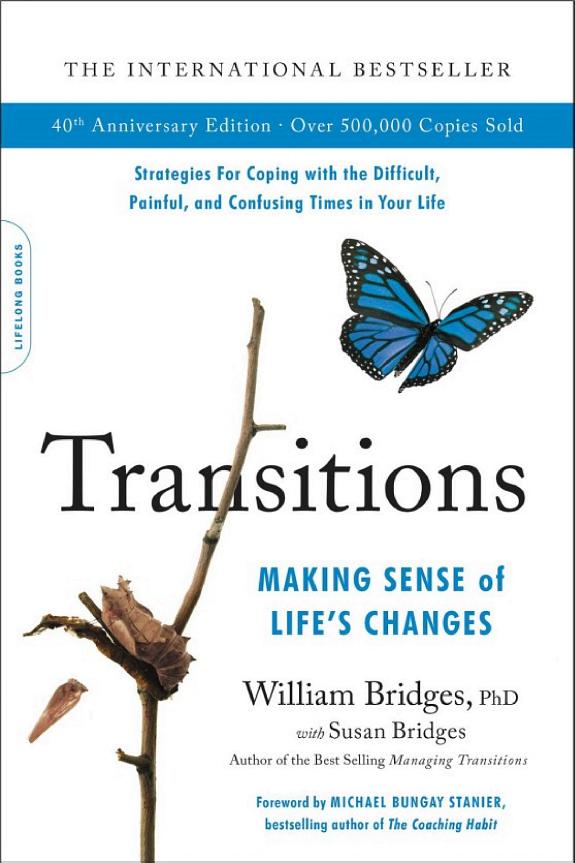
Transitions: Making Sense of Life’s Changes
1. Transitions: Making Sense of Life’s Changes by William Bridges
William Bridges wrote this book in 1980, revised it twice, and it still reads like someone who genuinely understands what you’re going through. His central argument is deceptively simple: change and transition are not the same thing. Change is the external event. Transition is the internal, psychological process of adjusting to it. Most people skip the internal work entirely because it’s uncomfortable, and then wonder why they feel stuck even after the external circumstances have shifted.
Bridges breaks transition into three phases: an ending, a confusing in-between he calls the neutral zone, and a new beginning. What makes this framework so useful is that he insists the neutral zone isn’t something to rush through. It’s actually where the real reorientation happens. Sitting with that discomfort, rather than frantically filling it with activity, is the point. That’s not the kind of advice that sells well on social media, which is probably why this book has quietly outlasted most of its competitors.
The writing is warm and clear without being simplistic. Bridges draws on mythology, psychology, and his own experience with major transitions to make his case, and it never feels like a lecture. He’s not telling you what to do so much as helping you understand what’s already happening to you.
“It isn’t the changes that do you in, it’s the transitions. Change is situational. Transition is the psychological process people go through to come to terms with the new situation.”
This is perfect for anyone who has made a significant external change but still feels oddly unmoored, or for people in the thick of an unwanted ending who need help understanding why they feel the way they do. It’s not the right fit for readers looking for quick, tactical advice or step-by-step action plans.
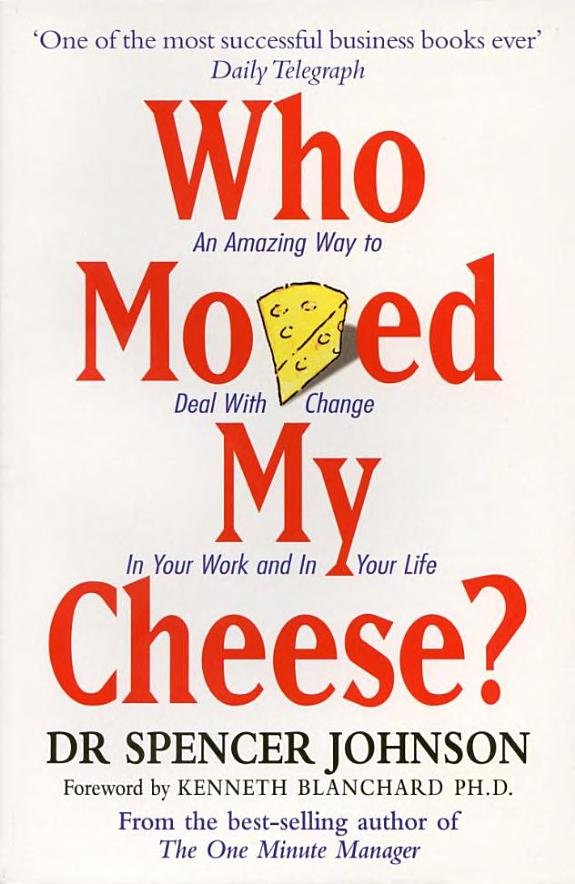
Who Moved My Cheese?
2. Who Moved My Cheese? by Spencer Johnson
Yes, this is the cheese book. The one your manager probably left on your desk during a corporate restructuring in 2003. That association is unfortunate, because when you read it outside of that context, it’s actually a sharp little parable about the stories we tell ourselves when our circumstances change and we don’t want them to.
The setup is simple: two mice and two tiny humans live in a maze and rely on a steady supply of cheese. When the cheese disappears, each character responds differently. Some adapt quickly. Others stand at the empty cheese station, furious that the cheese is gone, convinced it will return, or afraid to venture into the unfamiliar parts of the maze to find more. Johnson is not subtle about his metaphors, and that’s fine. The book is short enough to read in an afternoon, and its directness is part of its value.
What Johnson captures well is the way fear disguises itself as loyalty to the past. The characters who struggle most aren’t lazy or stupid. They’re attached, and they’ve built an identity around things staying the same. Watching them slowly, painfully reckon with that attachment is more relatable than the breezy packaging of the book suggests.
“What would you do if you weren’t afraid?” It’s a small question, but sitting with it honestly tends to reveal quite a lot.
This is perfect for someone who needs a fast, low-pressure entry point into thinking about change, or for a reader who knows they’re resisting a necessary shift but hasn’t quite named why. Readers who want depth, nuance, or literary prose will find it thin.
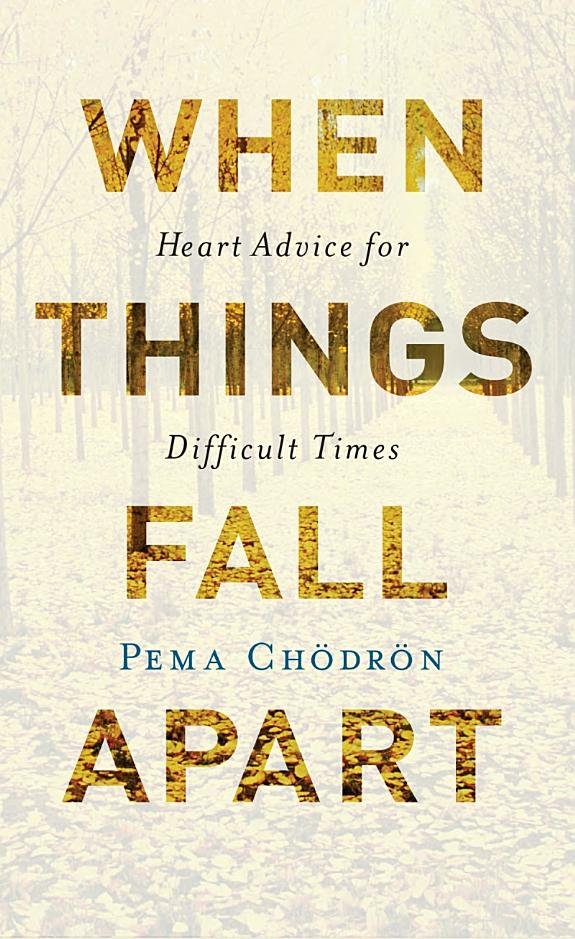
When Things Fall Apart: Heart Advice for Difficult Times
3. When Things Fall Apart: Heart Advice for Difficult Times by Pema Chödrön
Pema Chödrön is an American Buddhist nun, and this book is her most beloved work for good reason. It doesn’t offer comfort in the conventional sense. Instead, it gently, persistently argues that the discomfort of falling apart is not the problem. Running from that discomfort is. That’s either the most useful thing you’ve ever heard or the most annoying, depending on where you are right now.
The book grew out of talks Chödrön gave to students, and it retains that conversational quality throughout. She writes about groundlessness, about the impulse to reach for certainty when the floor drops out, and about why that impulse tends to make things worse. Her concept of “leaning into” difficult emotions rather than armoring against them is drawn from Tibetan Buddhist practice, but she translates it into plain, accessible language that doesn’t require any prior knowledge of Buddhism.
There’s a chapter on the practice of “not causing harm” that reframes how you relate to your own pain in a way that’s quietly revelatory. And her honesty about her own struggles, including a divorce that preceded her monastic life, keeps the book from ever feeling preachy. She’s not writing from a position of having solved things. She’s writing from a position of having learned to stop trying to.
“We think that the point is to pass the test or overcome the problem, but the truth is that things don’t really get solved. They come together and they fall apart.”
This is perfect for readers going through grief, loss, or a period of deep uncertainty who are open to a contemplative, spiritually inflected perspective. It’s not the right book for someone in crisis mode who needs practical next steps, or for readers who find Buddhist philosophy frustrating rather than grounding.
Option B: Facing Adversity, Building Resilience, and Finding Joy
4. Option B: Facing Adversity, Building Resilience, and Finding Joy by Sheryl Sandberg and Adam Grant
Sheryl Sandberg’s husband Dave Goldberg died suddenly in 2015, and this book began as her attempt to process that loss. She enlisted her friend Adam Grant, a psychologist and researcher, to help weave social science into her personal account. The result is a book that works on two levels simultaneously: as a raw, honest memoir of grief, and as an accessible survey of what psychology actually knows about resilience.
The title comes from something a friend said to Sandberg when she was devastated that Dave couldn’t be there for a father-child event at their children’s school. There is no Option A, the friend said. So let’s kick the hell out of Option B. That reframe, finding a way to engage with the life that’s actually in front of you rather than mourning the one that isn’t, runs through the entire book.
Grant’s contributions are seamlessly integrated. He introduces research on post-traumatic growth, the three P’s that psychologist Martin Seligman identified as obstacles to recovery (personalization, pervasiveness, and permanence), and the importance of finding meaning rather than waiting for it to arrive on its own. None of it feels like a lecture because Sandberg keeps returning to her own experience, messy and honest, to test these ideas against reality.
“Resilience is not a fixed personality trait. It’s a lifelong project.” That small reframe is worth the price of admission on its own.
This is perfect for anyone navigating loss, whether that’s the death of a person, the end of a relationship, or a career collapse, who wants both emotional companionship and practical frameworks. Readers who prefer purely personal narrative without research, or purely research without personal narrative, may find the hybrid format a little uneven.
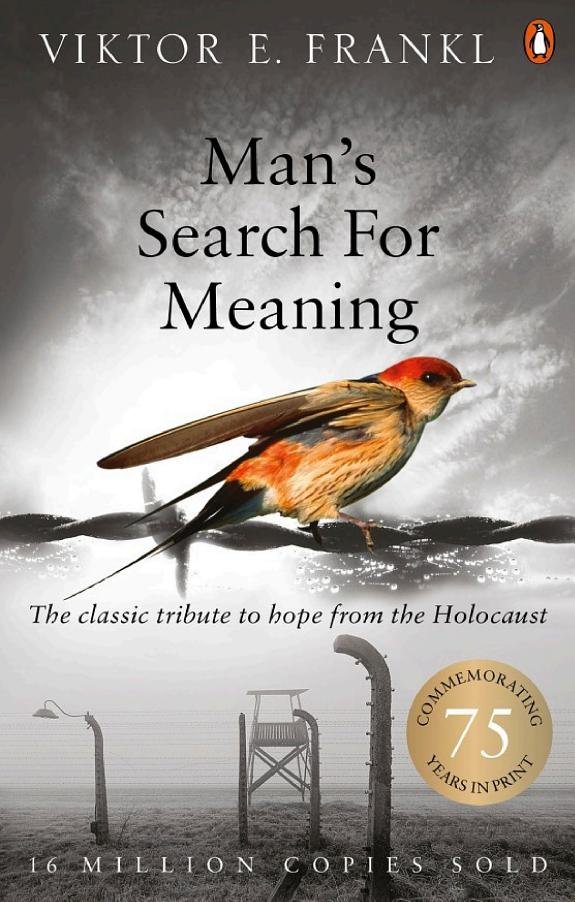
Man’s Search for Meaning
5. Man’s Search for Meaning by Viktor E. Frankl
Viktor Frankl was a psychiatrist in Vienna when he was arrested by the Nazis in 1942. He survived four concentration camps, including Auschwitz. His wife, parents, and brother did not. This book, written in nine days after his liberation, is his account of that experience and the psychological framework he developed from it, a school of thought he called logotherapy, which holds that the primary human drive is not pleasure or power but meaning.
It would be easy to misuse this book, to hold it up as a kind of extreme proof that anyone can endure anything if they just think correctly. Frankl himself was careful to avoid that trap. He’s clear that suffering is not noble in itself, and that the conditions he survived were an atrocity, full stop. What he observed, and what he writes about with remarkable precision, is that the prisoners who retained some sense of purpose, some reason to survive, tended to hold on longer than those who had lost all orientation toward the future.
The second half of the book outlines logotherapy in more clinical terms, and it’s somewhat drier than the memoir section. But the memoir itself is one of the most quietly extraordinary pieces of writing you’ll encounter. Frankl describes moments of beauty noticed through a cattle car window, small acts of kindness between prisoners, and the strange inner freedom that survives even when everything external is stripped away. It’s not a comfortable read. It’s not meant to be. But it reframes what a major life change actually threatens to take from you, and what it cannot.
“When we are no longer able to change a situation, we are challenged to change ourselves.” Frankl earned the right to say that in a way very few people ever have.
This is perfect for readers grappling with loss, illness, or circumstances genuinely outside their control who are searching for a philosophical foundation rather than tactical advice. It’s not a good fit for readers in acute crisis who need immediate, practical support, or for those who find existentialist philosophy alienating.
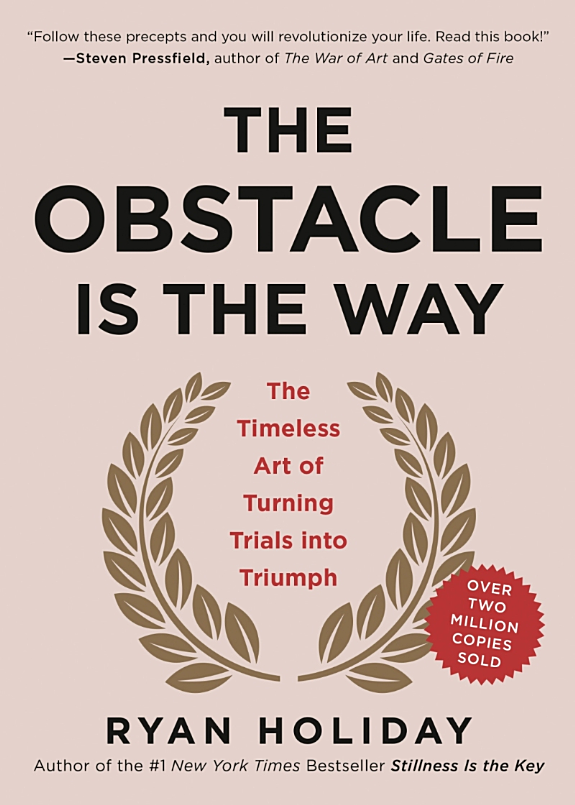
The Obstacle Is the Way
6. The Obstacle Is the Way by Ryan Holiday
Ryan Holiday draws on Stoic philosophy, particularly the writings of Marcus Aurelius, Epictetus, and Seneca, to argue that the obstacles in your path are not interruptions to your progress. They are the path. That’s either a clarifying idea or an infuriating one, and Holiday is self-aware enough to know the difference depends entirely on how it’s presented.
He presents it well. The book is structured around three disciplines: perception, action, and will. Each section builds on the last. You learn to see your obstacle clearly and without the distortions of panic or self-pity. You learn to act on what’s actually in front of you rather than what you wish were there. And you learn to cultivate a kind of inner will that endures when neither perception nor action is enough. Holiday illustrates each principle with historical examples, from Amelia Earhart to Ulysses S. Grant to a very entertaining account of how Demosthenes overcame a speech impediment to become one of history’s great orators. (He allegedly practiced with pebbles in his mouth. Whether or not you try this at home is your business.)
The writing is crisp and direct, occasionally to the point of feeling a little blunt. Holiday isn’t interested in nuance for its own sake. He wants to give you tools, and he does. The Stoic framework he’s drawing from has survived roughly two thousand years of human difficulty, which is a reasonable endorsement. Whether you’re navigating a career setback, a health crisis, or a transition you didn’t choose, the core argument holds: the thing in your way is also the thing that, handled correctly, moves you forward.
“The impediment to action advances action. What stands in the way becomes the way.” Marcus Aurelius said it first, but Holiday makes sure you actually understand what it means.
This is perfect for readers who respond well to historical examples and practical philosophy, and who are looking for a framework they can apply actively rather than simply reflect on. It’s less suited to readers who are in the middle of grief or emotional processing and need softness before strategy.
Major life changes have a way of making you feel like you’re the first person to ever experience them. You’re not, and these books are proof of that. From Bridges mapping the invisible interior of transition to Frankl writing about meaning from the depths of unimaginable loss, each of these authors has sat with hard things and come back with something worth sharing.
You don’t need to read all six at once. Pick the one that matches where you are right now. If you’re in the middle of an ending and can’t see what comes next, start with Bridges. If you’re in grief, Chödrön or Sandberg might feel closer to what you need. If you’re ready to stop waiting and start moving, Holiday is there. The right book at the right moment doesn’t solve anything, but it can make you feel considerably less alone in the solving.