6 Books to Help You Heal Your Inner Child
There is a particular kind of ache that shows up in adulthood without much warning. You overreact to something small, or you freeze when someone raises their voice, or you find yourself people-pleasing your way through a situation that deserves a firm no. And somewhere in the back of your mind, you know the feeling is older than the moment. It did not start today. It started a long time ago, probably before you had the words to name it.
Inner child work is one of those phrases that can sound a little soft until you actually sit with it. The books on this list take the concept seriously, drawing on psychology, somatic therapy, and years of clinical experience. Some are workbook-style and ask a lot of you. Others are more narrative and theoretical. None of them promise a quick fix, and honestly, that is part of what makes them worth reading. Healing is slow, nonlinear, and sometimes inconvenient. These books get that.
Homecoming: Reclaiming and Championing Your Inner Child
1. Homecoming: Reclaiming and Championing Your Inner Child by John Bradshaw
John Bradshaw was one of the first writers to bring inner child work into mainstream conversation, and this book, published in 1990, still holds up in ways that feel almost startling. Bradshaw writes with the warmth of someone who has done the work himself, which he had. His own story of addiction and recovery runs quietly beneath the surface of the text, giving it a weight that purely academic writing rarely achieves.
The central idea is that many adults carry a wounded inner child who was never allowed to grieve, play, or simply exist without performing. Bradshaw walks through each developmental stage of childhood and helps readers identify where they got stuck or hurt. He draws on Erik Erikson’s developmental theory and blends it with family systems thinking, creating a framework that feels both clinical and deeply human. There are guided meditations and exercises throughout, though the book reads more like a conversation than a workbook.
Where Bradshaw shines is in his ability to explain shame. Not guilt, which is about what you did, but shame, which is about who you are. His exploration of toxic shame as the root of so many adult struggles is some of the clearest writing on the subject you will find anywhere. It can be a bit repetitive in places, and some of the spiritual language may not land for every reader, but the core insights are solid.
Bradshaw argues that the wounded inner child is not a metaphor but a real psychic presence, one that quietly drives behavior until it is acknowledged and cared for.
This is perfect for readers who want a warm, narrative introduction to inner child work and are open to some spiritual framing alongside the psychology.
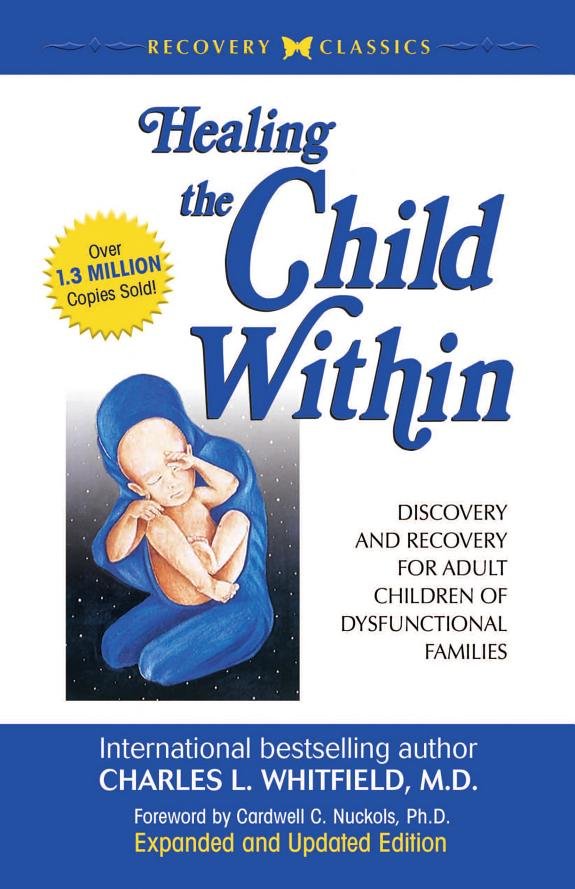
Healing the Child Within: Discovery and Recovery for Adult Children of Dysfunctional Families
2. Healing the Child Within: Discovery and Recovery for Adult Children of Dysfunctional Families by Charles L. Whitfield
Charles Whitfield is a physician and therapist, and that background shows in the way he writes. This book is precise, methodical, and grounded in clinical observation. It was one of the early texts in the adult children of dysfunctional families movement, and it remains one of the more quietly thorough books in this space. Whitfield does not sensationalize. He explains.
At the heart of the book is a distinction between the True Self and the false self. The True Self is the child within, the authentic core of who you are. The false self is the adaptive persona built in response to an environment that was not safe. Whitfield argues that most people raised in dysfunctional households spend their adult lives operating almost entirely from the false self, without realizing it. The work of recovery is learning to distinguish between the two and gradually giving the True Self more room to breathe.
The book includes a lot of charts and lists, which some readers will find grounding and others will find a little dry. It is not the most literary book on this list. But if you appreciate clarity and structure, Whitfield delivers both. He also covers co-dependency, boundaries, and the grief process in ways that connect the inner child concept to everyday relational patterns, which makes the material feel practical rather than abstract.
Whitfield’s distinction between the True Self and the false self offers a simple but useful lens for understanding why so many adults feel like strangers in their own lives.
This is perfect for readers who prefer a clinical, structured approach and want a clear framework for understanding how childhood dysfunction shows up in adult relationships.
Recovery of Your Inner Child: The Highly Acclaimed Method for Liberating Your Inner Self
3. Recovery of Your Inner Child: The Highly Acclaimed Method for Liberating Your Inner Self by Lucia Capacchione
Lucia Capacchione is an art therapist, and this book is unlike anything else on this list. Where other authors approach inner child work through talk therapy frameworks and developmental psychology, Capacchione goes straight for the non-dominant hand. Yes, you read that correctly. Her method involves writing and drawing with the hand you do not normally use, which bypasses the analytical brain and, she argues, gives the inner child a more direct channel of expression.
It sounds unusual. It also works in ways that are difficult to explain until you try it. The non-dominant hand writing tends to come out childlike in appearance, slower, less controlled, and for many people it surfaces emotions that years of journaling with the dominant hand never touched. Capacchione guides readers through a series of exercises that involve dialogue between the inner child and the nurturing inner parent, using both hands to carry on the conversation. It is experiential in the fullest sense of the word.
This book is not for everyone, and there is no point pretending otherwise. If the idea of drawing pictures and writing in a wobbly hand makes you want to close the cover immediately, this is probably not your entry point into inner child work. But for readers who are drawn to creative and somatic approaches, or who have tried talk-based methods and hit a wall, Capacchione offers something genuinely different. The exercises are accessible and the book is well organized, even if the overall tone leans toward the New Age end of the spectrum.
Capacchione’s method trusts the body and the non-verbal self in a way that most psychology books simply do not, and that trust turns out to be the whole point.
This is perfect for creative, artistically inclined readers or anyone who has found traditional journaling and talk therapy approaches insufficient for reaching deeper emotional material.
The Inner Child Workbook: What to Do with Your Past When It Just Won’t Go Away
4. The Inner Child Workbook: What to Do with Your Past When It Just Won’t Go Away by Cathryn L. Taylor
The title of this book is refreshingly honest. Your past just will not go away. That is the whole problem, and Taylor does not dress it up. This is a proper workbook, meaning it asks you to write, reflect, and engage rather than simply read. If you are the kind of person who buys workbooks and then reads them like novels without touching the exercises (no judgment, we have all been there), this one will not do its job unless you actually pick up the pen.
Taylor organizes the book around seven developmental stages, from infancy through young adulthood, and dedicates a section to each. For every stage, she explains what healthy development looks like, what can go wrong, and how unresolved wounds from that period tend to manifest in adult life. The exercises are varied, combining writing prompts, visualization, and inner dialogue. The cumulative effect is a fairly comprehensive emotional audit of your own history, which sounds daunting and sometimes is.
The book’s strength is its structure. It gives readers a clear path through material that can otherwise feel overwhelming and formless. The weakness is that some sections move quickly through genuinely complex territory, and readers dealing with significant trauma may find they need additional support alongside the workbook rather than instead of it. Taylor acknowledges this herself, which is a mark in her favor. This is a book that knows what it is and what it is not.
Taylor’s stage-by-stage approach gives readers a map, and sometimes having a map is the only thing that makes it possible to start the journey at all.
This is perfect for self-directed readers who want a structured, step-by-step process and are ready to engage actively with written exercises rather than passively absorbing theory.
Adult Children of Emotionally Immature Parents: How to Heal from Distant, Rejecting, or Self-Involved Parents
5. Adult Children of Emotionally Immature Parents: How to Heal from Distant, Rejecting, or Self-Involved Parents by Lindsay C. Gibson
Lindsay Gibson’s book does something quietly important. It names a specific kind of parental dynamic that many people experienced but could never quite articulate. The emotionally immature parent is not necessarily abusive in any dramatic or obvious way. They are often loving in their own limited fashion. But they are fundamentally unable to attune to their child’s emotional world, and that absence, repeated over years, leaves a particular kind of wound. Gibson describes it with precision and without melodrama.
The book covers four types of emotionally immature parents, the emotional, the driven, the passive, and the rejecting, and explains how each type shapes the child who grows up in their orbit. Gibson is especially good on the role of the internalizer, the child who turns their distress inward and becomes exquisitely attuned to others’ needs while losing touch with their own. If that sentence landed somewhere specific in your chest, this book is probably for you.
The second half of the book focuses on healing and on building what Gibson calls a mature, individuated self. The advice is practical and grounded, covering how to manage ongoing relationships with emotionally immature parents without losing yourself in the process. The writing is clear and compassionate throughout. It does not wallow. If you grew up in a household that looked fine from the outside but felt lonely in ways you could never explain, this book will likely feel like someone finally switched on a light.
Gibson makes the case that emotional neglect, even when unintentional, shapes children just as surely as more visible forms of harm, and that naming it is the first step toward something better.
This is perfect for adults who had parents who were physically present but emotionally unavailable, and who are trying to understand why their childhood left them feeling unseen despite appearing outwardly normal.
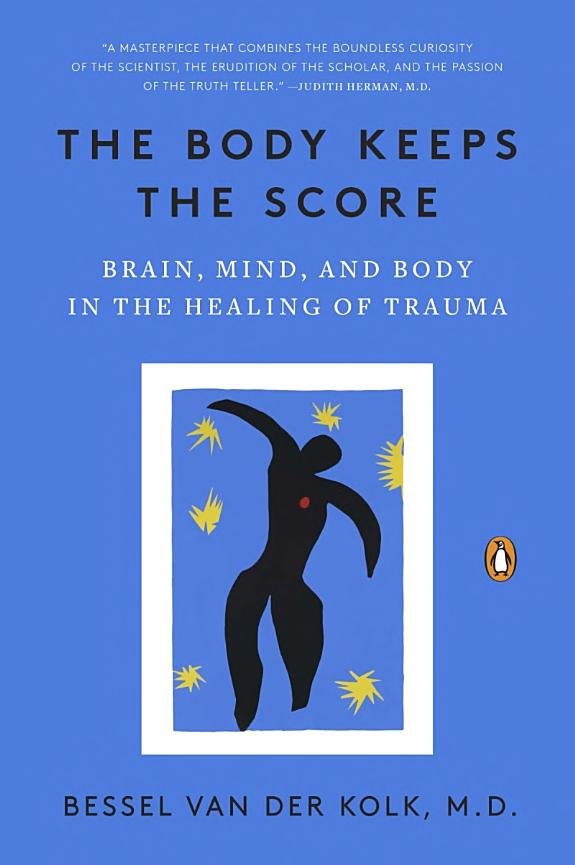
The Body Keeps the Score: Brain, Mind, and Body in the Healing of Trauma
6. The Body Keeps the Score: Brain, Mind, and Body in the Healing of Trauma by Bessel van der Kolk
Bessel van der Kolk spent decades working with trauma survivors, and this book is the distillation of that work. It is the most scientifically dense book on this list, drawing on neuroscience, attachment theory, and clinical research to explain what trauma actually does to the brain and body. It is also, somehow, deeply readable. Van der Kolk writes with genuine care for the people whose stories appear throughout the text, and that care keeps the science from feeling cold.
The central argument is in the title. Trauma is not just a story the mind tells. It is something the body holds, in muscle tension, in the nervous system’s hair-trigger responses, in the way certain smells or sounds can collapse the distance between then and now in an instant. For anyone doing inner child work, this is important context. The reason old wounds resurface so viscerally in adult life is not weakness or irrationality. It is neurobiology. Van der Kolk explains the mechanisms clearly, and that explanation alone can be a source of relief.
The book covers a wide range of therapeutic approaches, including EMDR, yoga, theater, and neurofeedback, making the case that healing trauma often requires working with the body, not just the talking brain. It is a long book and a demanding one, and readers who are currently in an acute phase of trauma recovery may find some sections activating. It is worth having a therapist or support system in place if you are going through a difficult period. This is not a criticism of the book so much as an acknowledgment of how seriously it takes its subject.
Van der Kolk’s core insight is that the body is not just a bystander to psychological suffering but an active participant in it, and that real healing has to include the body in the conversation.
This is perfect for readers who want to understand the science behind why trauma and childhood wounds feel so physical, and for anyone who has found purely talk-based approaches incomplete.
None of these books will do the work for you. That is not a flaw in them. It is just the nature of this particular territory. What they can do is give you language for experiences that may have felt wordless for a long time, offer frameworks that make confusing patterns suddenly legible, and remind you that what happened to you was real and that you are not alone in trying to move through it.
Some people will find one book on this list and feel like it was written specifically for them. Others will work through several over the course of years, returning to different ones at different stages of the process. There is no wrong way to use them. Start with whichever one feels most approachable, or most pressing, and go from there. The inner child is patient. It has been waiting a while already.