

8 Essential Investment Books That Actually Make Sense
Let’s be honest: most investment books are either dry enough to cure insomnia or filled with get-rich-quick schemes that smell fishier than a week-old sushi. But buried among the thousands of finance books out there are some genuine gems that can help anyone build wealth sensibly.
I’ve read dozens of investment books over the years, and these eight stand out for their clarity, wisdom, and practical advice. Whether you’re just starting to invest or looking to deepen your knowledge, there’s something here for every type of investor.

The Simple Path to Wealth
1. The Simple Path to Wealth by J.L. Collins
Originally written as a series of letters to his daughter, Collins has created what might be the least intimidating investment book ever written. His straightforward approach to index fund investing feels like getting advice from a knowledgeable uncle who genuinely wants you to succeed.
Collins breaks down complex concepts into digestible pieces, focusing on low-cost index funds and long-term thinking. He explains why trying to beat the market is a fool’s errand and how simplicity often beats complexity in investing.
The book isn’t for active traders or those seeking sophisticated trading strategies. Collins takes a firm stance against individual stock picking, which might frustrate those who enjoy researching companies and making tactical investment decisions.
“The more complex an investment is, the more likely it is to suck.” Collins’s refreshing candor cuts through the usual financial jargon.
This is perfect for beginners who want a no-nonsense introduction to investing and anyone intimidated by financial markets.
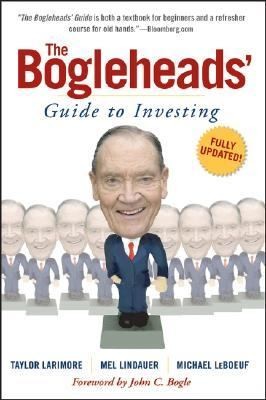
The Bogleheads’ Guide to Investing
2. The Bogleheads’ Guide to Investing by Taylor Larimore, Mel Lindauer, Michael LeBoeuf
The Bogleheads’ Guide is like having a team of wise mentors walk you through every aspect of investing. Based on the philosophy of Vanguard founder Jack Bogle, this book covers everything from basic investment concepts to tax strategies and retirement planning.
What sets this book apart is its community-driven wisdom. The authors are longtime members of the Bogleheads forum, and their collective experience shows in their practical, tested advice. They explain complex topics without talking down to readers.
Some readers might find the conservative, index-focused approach too boring or restrictive. If you’re looking for exciting stock picks or aggressive growth strategies, this isn’t your book.
The authors’ dedication to evidence-based investing might seem unexciting, but boring can be beautiful when it comes to building wealth.
This is perfect for methodical learners who want a comprehensive guide to long-term investing success.

A Random Walk Down Wall Street
3. A Random Walk Down Wall Street by Burton G. Malkiel
Malkiel’s classic has been challenging conventional wisdom since 1973, and its core message remains as relevant as ever. He systematically dismantles various investing fads and techniques, from technical analysis to fundamental analysis, showing why they often fail to beat the market.
The book’s strength lies in its blend of academic research and practical advice. Malkiel explains complex economic concepts through engaging stories and examples, making the material accessible to general readers.
The academic tone might put off some readers, and active traders will likely disagree with many of Malkiel’s conclusions about market efficiency. The book can be dense in places, requiring careful attention.
Malkiel’s assertion that a blindfolded monkey throwing darts at stock listings could select a portfolio as good as one chosen by experts remains delightfully provocative.
This is perfect for analytical thinkers who want to understand the theoretical foundations of modern investing.
The Little Book of Common Sense Investing
4. The Little Book of Common Sense Investing by John C. Bogle
Bogle, the founder of Vanguard and creator of the first index fund, presents his investment philosophy with the clarity of someone who has spent decades refining his message. This compact book focuses on one core idea: buying and holding low-cost index funds is the surest path to investment success.
The beauty of this book lies in its simplicity and conviction. Bogle uses clear data and compelling arguments to show why costs matter and why trying to beat the market is counterproductive for most investors.
Those seeking detailed investment strategies or specific stock recommendations will be disappointed. Bogle’s message is deliberately simple, which some might find too basic.
“Don’t look for the needle in the haystack. Just buy the haystack.” This quintessential Bogle quote captures his entire investment philosophy.
This is perfect for cost-conscious investors who appreciate straightforward, actionable advice.
The Psychology of Money
5. The Psychology of Money by Morgan Housel
Housel takes a different approach to investing by focusing on how we think about money rather than technical analysis or stock picking strategies. Through 19 short stories, he illustrates how our behavior and mindset often matter more than our technical knowledge.
The book’s strength lies in its storytelling and insights into human nature. Housel shows how personal history, worldview, and emotions shape our financial decisions, often in ways we don’t realize.
Readers looking for specific investment advice or technical analysis will need to look elsewhere. This is more about the philosophy and psychology of money than practical investment strategies.
“Doing well with money has little to do with how smart you are and a lot to do with how you behave.” This central insight runs through every chapter.
This is perfect for readers interested in the behavioral and emotional aspects of financial decision-making.

The Intelligent Investor
6. The Intelligent Investor by Benjamin Graham
Graham’s masterpiece, first published in 1949, remains relevant despite its age. Warren Buffett calls it “by far the best book on investing ever written,” and its principles of value investing have influenced generations of investors.
The book introduces crucial concepts like margin of safety and Mr. Market, teaching readers how to think about stocks as ownership in real businesses rather than just numbers on a screen. Graham’s focus on fundamental analysis and emotional discipline provides a solid foundation for any serious investor.
The dated examples and formal writing style can be challenging for modern readers. Some of the specific techniques Graham describes are less practical for individual investors today.
Graham’s distinction between investing and speculation remains one of the most important lessons any investor can learn.
This is perfect for serious investors who want to understand the philosophical foundations of value investing.
Your Money or Your Life
7. Your Money or Your Life by Vicki Robin and Joe Dominguez
While not strictly an investment book, this work revolutionizes how readers think about money’s role in their lives. Robin and Dominguez present a nine-step program that connects personal finance with personal values and life energy.
The book’s unique perspective helps readers understand the true cost of their spending and investment choices. It’s particularly valuable for those struggling to balance financial goals with life satisfaction.
Traditional investors might find the focus on lifestyle and philosophy frustrating if they’re looking for pure investment advice. The authors’ emphasis on frugality and simple living isn’t for everyone.
The book’s central question, “Is this worth trading my life energy for?” changes how many readers view both spending and investing.
This is perfect for readers seeking to align their investment strategy with their life values and goals.
The Four Pillars of Investing
8. The Four Pillars of Investing by William J. Bernstein
Bernstein, a neurologist turned investment advisor, brings scientific rigor to the art of investing. He breaks down successful investing into four fundamental principles: theory, history, psychology, and business.
The book’s systematic approach helps readers understand not just what to do, but why. Bernstein excels at explaining market history and the academic research behind modern portfolio theory in accessible terms.
Some readers might find Bernstein’s writing style too academic or technical. The book requires more concentration than most investment guides, and casual readers might struggle with some sections.
Bernstein’s careful analysis of market history helps readers avoid the trap of thinking “this time is different.”
This is perfect for detail-oriented readers who want to understand the science behind successful investing.
These eight books offer different perspectives on investing, from basic principles to advanced concepts. You don’t need to read them all, start with the one that best matches your current knowledge and interests. Remember, the goal isn’t to become a financial expert, but to learn enough to make confident, informed decisions about your money.
The best investment book is the one you’ll actually read and apply. Pick one that speaks to your situation and start there. Your future self will thank you.